Gujarat Police Introduces NARIT AI: A Revolutionary Tool for Narcotics Investigation
Synopsis
The Gujarat Police has launched 'NARIT AI,' an innovative AI-based tool aimed at revolutionizing narcotics investigations and significantly increasing conviction rates, marking a first for state police forces in India.
Key Takeaways
NARIT AI is the first AI-based tool for narcotics investigations by a state police in India.
It provides real-time legal analysis under the NDPS Act, 1985 .
Utilizes RAG technology for assessing FIRs and case strengths.
Designed to improve procedural compliance and reduce errors in investigations.
Not publicly accessible, classified as a private AI system.
Gandhinagar, April 10 (NationPress) The Gujarat Police has unveiled an innovative Artificial Intelligence (AI)-driven investigation tool aimed at enhancing the management of narcotics cases and boosting conviction rates. Officials have stated that this is the first such system implemented by any state police force in India.
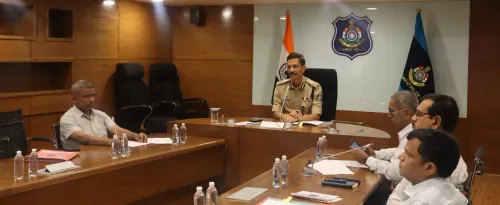
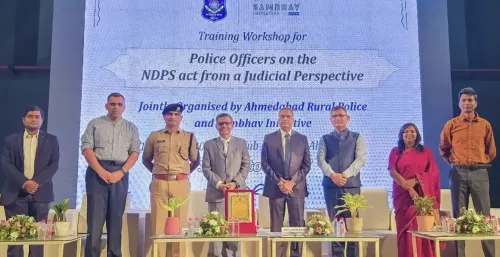
The application, referred to as ‘NARIT AI’ (Narcotics Analysis and RAG-based Investigation Tool), was officially launched in Gandhinagar as part of the state's stringent approach towards drug-related crimes.
This tool is designed to support investigating officers in handling cases under the Narcotic Drugs and Psychotropic Substances (NDPS) Act, 1985, by offering real-time legal analysis and procedural direction.
Utilizing Retrieval Augmented Generation (RAG) technology, the system evaluates First Information Reports (FIRs) submitted by officers and produces comprehensive reports that assess the strengths and weaknesses of each case.
It gathers pertinent legal provisions, case laws, and investigation protocols while providing recommendations on legal remedies, compliance obligations, and evidence gathering.
“This is the first instance of an AI-based tool being employed by any state police or law enforcement agency in India,” officials remarked, highlighting that the initiative aims to enhance the effectiveness of investigations and fortify cases during court proceedings to ensure that justice is served for the accused.
Deputy Chief Minister Harsh Sanghavi emphasized the state's commitment to dismantling drug networks.
“Gujarat is resolute in eradicating drug-related offenses. We are determined to take all necessary measures to dismantle this entire network. Comprehensive arrangements have been made to ensure efficient investigations into drug-related crimes and to construct a robust legal case against the accused, and technology will significantly bolster this effort,” he stated.
The application was developed by the Western Railway Police in the Vadodara division in partnership with an AI startup based in Mumbai.
It has been implemented under the supervision of Gujarat Director General of Police (DGP), Dr. K. L. N. Rao, and Surat City Police Commissioner Anupam Singh Gehlot, with Western Railway Vadodara SP Abhay Soni spearheading the initiative.
Soni indicated that the tool addresses a persistent challenge in narcotics investigations, where procedural errors have resulted in acquittals despite compelling evidence.
“Previously, investigations were conducted solely by specially trained police personnel, leading to increased workload and administrative delays. This tool will serve as a ‘force multiplier’ by leveraging advanced RAG-based AI technology, empowering every investigating officer to carry out thorough investigations in accordance with regulations, thus enhancing the conviction rate in NDPS cases. Given that this application is trained on landmark High Court and Supreme Court cases, as well as government guidelines, the risk of inaccuracies is minimized, aiding officers in conducting scientific investigations,” he explained.
Police officials acknowledged that maintaining procedural compliance is one of the most significant hurdles in drug-related cases.
The application is crafted to assist officers in avoiding such lapses by pinpointing weaknesses in FIRs, advising on necessary actions, delineating dos and don’ts during investigations, and providing an evidence checklist.
The reports generated can also be utilized in making final decisions, thereby enhancing the quality and consistency of investigations.
This system has been trained on pivotal judgments from High Courts and the Supreme Court, along with legal frameworks like the NDPS Act, 1985, and the bare acts of BNS, BNSS, and BSA, in addition to government guidelines and circulars.
It operates on a closed database and does not rely on open internet searches, a feature designed to mitigate the likelihood of erroneous outputs.
In accordance with recent guidelines from the Gujarat High Court regarding the utilization of artificial intelligence, the application is classified as a private AI system specifically developed for the Gujarat Police and is not accessible to the general public.
Beyond aiding investigations, the tool can assist during court trials by predicting potential defense arguments and proposing responses grounded in established case law from High Courts and the Supreme Court, thereby facilitating a more effective presentation of cases during trials.
Point of View
It's essential to highlight the significance of Gujarat Police's initiative in adopting AI for narcotics investigations. This move not only showcases technological advancement but also reflects a commitment to combating drug-related crimes more effectively. Ensuring justice through enhanced investigations is a national priority, and such innovations are crucial in achieving this goal.
NationPress
26 Sept 2026
Frequently Asked Questions
How does NARIT AI assist investigators?
The tool provides real-time legal analysis, procedural guidance, and generates detailed reports assessing the strengths and weaknesses of cases under the NDPS Act.
Is NARIT AI accessible to the public?
No, NARIT AI is classified as a private AI system developed specifically for Gujarat Police and is not available to the general public.
What technology does NARIT AI use?
NARIT AI is built on Retrieval Augmented Generation (RAG) technology, which enhances its ability to analyze FIRs and generate informative reports.
Who developed NARIT AI?
The application was developed by the Western Railway Police in collaboration with an AI startup based in Mumbai.