How is the Gujarat government Utilizing CCTV and AI to Tackle Stray Cattle?
Synopsis
In an innovative move towards enhancing urban management, the Gujarat government is leveraging advanced technologies like CCTV and AI to address the persistent problem of stray cattle in Ahmedabad. This initiative promises to streamline identification processes and improve public safety significantly.
Key Takeaways
Integration of AI and CCTV for real-time identification of stray cattle Reduction in manpower and time spent on cattle identification Enhancement of public safety and traffic management Unique biometric identification through nose patterns Establishment of a data-driven monitoring system
Gandhinagar, Jan 19 (NationPress) In a bid to foster smarter and more efficient urban environments, the Gujarat government is placing a strong emphasis on the implementation of modern technologies and Artificial Intelligence (AI) in its governance framework.
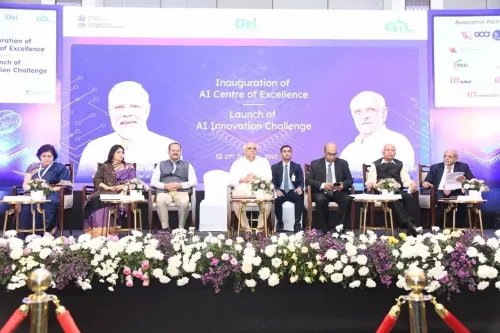
Under the guidance of Chief Minister Bhupendra Patel, an AI Centre of Excellence has been set up in Gandhinagar, focusing on integrating cutting-edge technologies into public administration to improve services for citizens.
In line with this vision, a pioneering pilot project is being developed for the Ahmedabad Municipal Corporation (AMC) aimed at tackling the persistent issue of stray cattle in urban locales.
This initiative seeks to expedite the identification process of stray cows and their owners, making it quicker, more precise, and less resource-intensive.
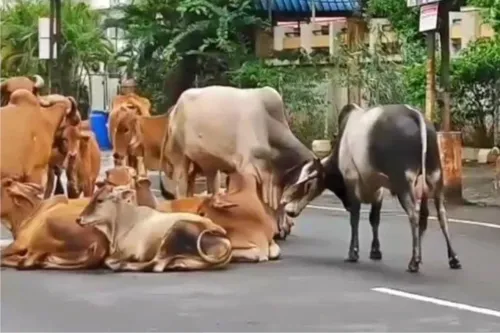
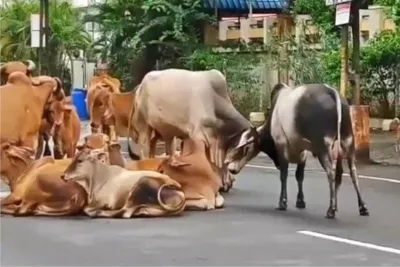
Stray cattle on the streets of Ahmedabad often cause traffic disruptions and accidents.
Currently, AMC teams utilize CCTV footage to capture images of these animals, which are then manually identified using microchips and RFID tags.
However, this method is laborious and demands significant manpower.
To optimize this approach and reduce both time and effort, the integration of AI technology is now being actively pursued.
The AI Centre of Excellence located at GIFT City in Gandhinagar has commissioned an agency to create a specialized AI model.
This agency is working on solutions rooted in deep learning and is in the final stages of developing a model that will be presented to the operational committee soon.
The envisioned system will merge CCTV camera feeds with the AI model to provide real-time identification of stray cows and disclose their owners' information.
This AI model will employ computer vision and deep learning techniques.
It will analyze the cow's face, paying particular attention to the nose pattern, which serves as a unique biometric identifier—akin to a human fingerprint.
Each cow's nose design is unique.
Furthermore, the system will evaluate other features such as the eyes, facial structure, and any visible marks or scars.
Through these parameters, the AI will be capable of identifying a specific cow amidst a crowd and matching it with the existing database to retrieve owner details.
Currently, approximately 1.1 lakh cows in Ahmedabad have been equipped with RFID tags and microchips, with their information managed by the municipal corporation.
CCTV cameras at around 130 junctions throughout the city capture images of stray cattle.
If this AI-driven solution proves successful, it is anticipated to substantially improve traffic management and alleviate other issues stemming from stray cows within AMC limits.
This initiative aims to avert accidents involving stray cattle, enhance public safety, and establish a data-driven monitoring system—representing a significant stride towards AI-enabled smart governance in Gujarat.
Point of View
I observe that the Gujarat government's initiative to incorporate technology for managing urban challenges like stray cattle is a commendable step towards enhancing public safety and efficiency in governance. This integration of AI and CCTV can serve as a model for other regions facing similar issues, reflecting a commitment to leveraging technology for the greater good.
NationPress
7 Oct 2026
Frequently Asked Questions
What is the main goal of the Gujarat government's initiative?
The primary goal is to utilize CCTV and AI technology to swiftly and accurately identify stray cattle and their owners, thereby improving public safety and traffic management.
How will the AI model identify stray cows?
The AI model will analyze unique features such as the cow's nose pattern, eyes, and facial structure, allowing for precise identification even in crowds.
How many cows in Ahmedabad have RFID tags?
Approximately 1.1 lakh cows in Ahmedabad are fitted with RFID tags and microchips, with their data managed by the municipal corporation.
What are the expected benefits of this initiative?
This initiative is expected to significantly ease traffic management, reduce accidents caused by stray cattle, and create a data-driven monitoring system.
Where is the AI Centre of Excellence located?
The AI Centre of Excellence is located at GIFT City in Gandhinagar.