Giriraj Singh flags Hajipur Electronics Park for 1 lakh jobs
Synopsis
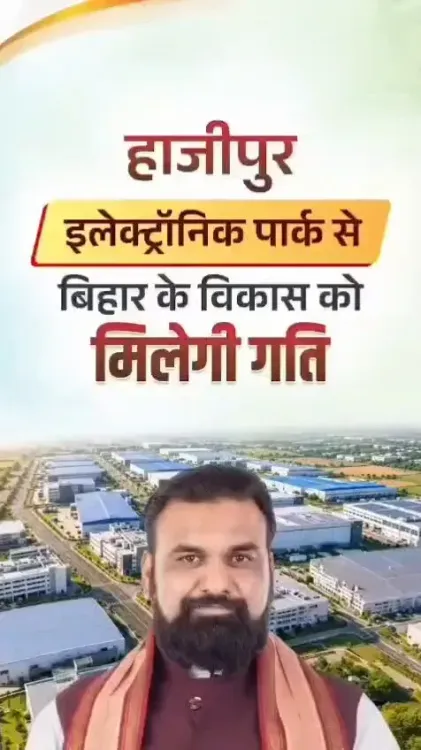
Union Textiles Minister Giriraj Singh has highlighted the Hajipur Electronics Park in Bihar as a transformative project set to attract major investment and generate close to one lakh jobs, framing it as a direct outcome of PM Modi's national manufacturing push.
Key Takeaways
Union Textiles Minister Giriraj Singh posted on 5 November 2026 about an Electronics Park being developed in Hajipur, Bihar .
The project is projected to create approximately one lakh new employment opportunities in Bihar.
Hajipur in Vaishali district was chosen for its road-rail connectivity and proximity to the national capital region.
The initiative aligns with the Make in India (2014) and PLI scheme for IT hardware and electronics (2020) frameworks.
Bihar's electronics park follows a national strategy of building sector-specific industrial clusters in tier-2 and tier-3 cities to attract anchor investors.
Key milestones still pending include land acquisition, infrastructure tenders, and anchor investor commitments.
A single industrial park in Hajipur, Bihar could reshape the employment map of one of India's most populous states — that is the promise Union Textiles Minister Giriraj Singh put on record on Thursday, 5 November 2026, spotlighting a fast-developing electronics manufacturing hub that he says will unlock close to one lakh new jobs.
Posting on X in Hindi, Singh credited Prime Minister Narendra Modi's manufacturing push for creating the conditions that make such a project possible, writing: 'Under the leadership of Hon'ble Prime Minister Shri Narendra Modi ji, the country is touching new heights in the field of manufacturing. In this series, the Electronic Park being developed in Hajipur under the leadership of Bihar's Hon'ble Chief Minister will create major investment and around one lakh new employment opportunities in Bihar.'
Hajipur's electronics bet — why this location
Hajipur, headquartered in Vaishali district, sits across the Gandak river from Patna and already hosts one of North India's older industrial estates. Its road and rail connectivity to the national capital region makes it a logical anchor for Bihar's industrialisation ambitions. The choice of electronics — rather than textiles or food processing, Bihar's traditional industrial bets — signals a deliberate pivot toward higher-value manufacturing.
That pivot fits neatly into the architecture of two central government programmes. The Make in India initiative, launched in 2014, set the strategic goal of positioning India as a global manufacturing destination. The Production Linked Incentive (PLI) scheme for IT hardware and electronics, introduced in 2020, followed with hard cash incentives designed to pull large-scale investment away from China-centric supply chains and into domestic plants.
Bihar's push to turn policy into payrolls
Bihar has historically struggled to convert central policy tailwinds into industrial ground-level investment. The Hajipur Electronics Park represents an attempt to change that calculus — by offering a dedicated, infrastructure-ready zone that lowers the entry cost for manufacturers who might otherwise default to established hubs in Tamil Nadu, Karnataka, or Uttar Pradesh.
The broader national pattern is well-established: sector-specific industrial parks in tier-2 and tier-3 cities have consistently outperformed generic special economic zones in attracting anchor investors, because they signal a credible, long-term state commitment to a single value chain. If Hajipur can land even one or two marquee electronics assemblers, component suppliers typically follow in clusters — that is the multiplier logic behind the one lakh jobs figure Singh cited.
What the project still needs to demonstrate: firm land acquisition, infrastructure tenders in the market, and at least one anchor investor commitment on paper. Those milestones will determine whether the one-lakh headline becomes a factory floor or a footnote.
Bihar is watching Hajipur. So is every state still chasing India's manufacturing moment.
Point of View
Unverified and projection-stage, is the kind of aspirational anchor that shapes public expectations long before a sod is turned. Watched against the broader PLI-and-Make-in-India playbook, Hajipur's electronics bet is structurally sound — but the gap between announced parks and operational ones in Bihar's industrial history means execution credibility will ultimately define the story.
NationPress
5 Nov 2026
Frequently Asked Questions
What is the Hajipur Electronics Park in Bihar?
The Hajipur Electronics Park is a proposed industrial infrastructure project in Hajipur, Vaishali district, Bihar, designed to host electronics and related manufacturing units and attract large-scale domestic and foreign investment.
How many jobs will the Hajipur Electronics Park create?
Union Textiles Minister Giriraj Singh has stated the park is expected to generate close to one lakh (100,000) new employment opportunities in Bihar, though this figure is a projection at this stage.
What is the Make in India scheme and how does it relate to this project?
Make in India was launched in 2014 to position India as a global manufacturing hub. The Hajipur Electronics Park is framed as part of that initiative, drawing on central policy support including the PLI scheme for IT hardware introduced in 2020.
Why was Hajipur chosen for the electronics park?
Hajipur's strong road and rail connectivity, its location near Patna, and its existing industrial estate infrastructure make it a practical choice for a new electronics manufacturing cluster in Bihar.
What still needs to happen before the Hajipur Electronics Park becomes operational?
Key milestones include the completion of land acquisition, the floating of infrastructure tenders, and securing commitments from anchor investors — none of which have been publicly confirmed as finalised.