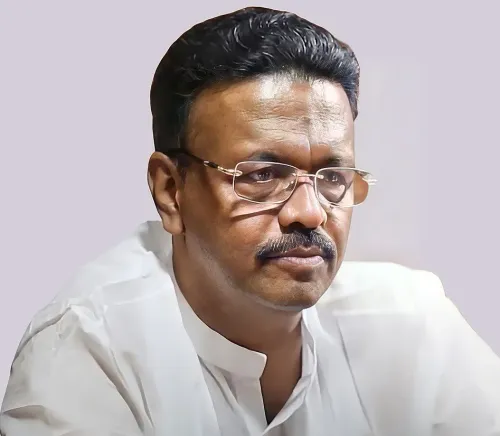
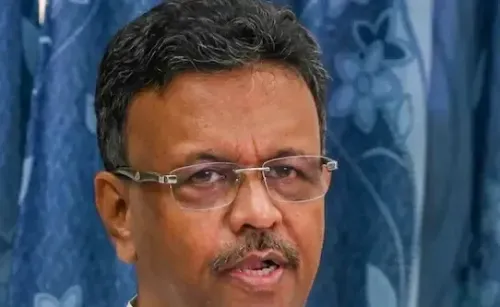
Firhad Hakim Critiques BJP's 'False Politics' and Champions Trinamool's Development Approach
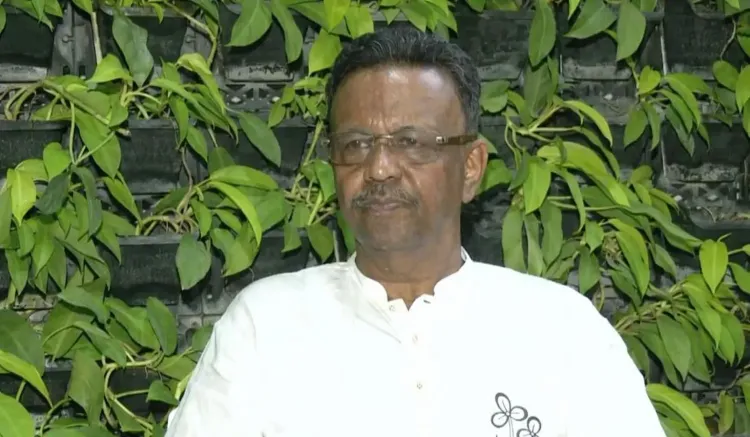
Synopsis
In a bold address, West Bengal's Firhad Hakim criticizes BJP's deceptive tactics in electoral politics, defending Trinamool Congress's development agenda and governance. He emphasizes the importance of secularism, personal rights, and the need for political integrity.
Key Takeaways
Firhad Hakim strongly criticizes the BJP for misleading political tactics.
He emphasizes the importance of development and governance.
Hakim advocates for the separation of religion and politics.
He defends the Trinamool Congress against allegations of electoral malpractice.
Hakim highlights the need to preserve secular values in politics.
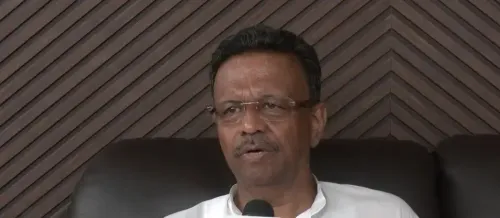
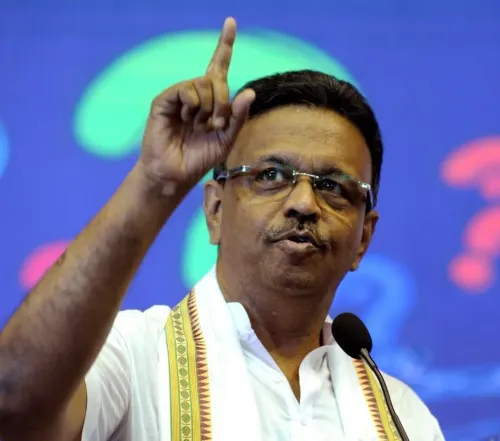
Kolkata, April 17 (NationPress) West Bengal Minister and Kolkata Mayor Firhad Hakim launched a strong critique against the BJP on Friday, contending that the landscape of electoral politics has transitioned from a battle of ideologies to one dominated by deceptive narratives, misinformation on social media, and pressure from various agencies. He staunchly defended the development achievements and governance model of his party, the Trinamool Congress.
Hakim noted that in the past, elections were characterized by distinct political confrontations, especially during the Left Front era, but asserted that the dynamics of political rivalry have dramatically transformed in recent years.
"Previously, we engaged in political struggles with the Left on the streets. Today, confronting the BJP involves more than just political discourse; it encompasses agency involvement and misleading social media content, alongside personal attacks," he remarked.
In a pointed remark aimed at the BJP, Hakim claimed the party would not gain power in West Bengal. "I can guarantee that the BJP government will not be established here—100 percent, it will not happen," he expressed, while alleging violent incidents connected to dietary choices in BJP-led states and asserting that their ideology does not tolerate non-vegetarian practices.
He further critiqued food-related politics, inviting BJP leaders to dine with him. "I challenge them to join me for a meal. I will prepare non-vegetarian dishes. Will they share the table with me? Restrictions based on dietary preferences are being championed in states governed by double-engine administrations," he accused.
Hakim also charged the BJP with attempting to divide voters through religious narratives. Referring to recent events involving AJUP founder Humayun Kabir, a former legislator from their party, he noted that the Trinamool took necessary disciplinary actions in response to raised concerns. "We have suspended and removed him. This is not a matter of religion or historical context; it revolves around financial interests and political manipulation. Religious sentiments are being exploited to fragment votes," he stated.
He dismissed the BJP's claims of labeling Trinamool’s politics as "appeasement," firmly rejecting the accusation. "They refer to it as appeasement, but that's part of their agenda. We have focused on uplifting marginalized communities and fostering overall social advancement," he added, noting progress in areas such as Amlasole as evidence of the state's evolution.
Speaking on secularism and rights, Hakim emphasized that the discussion transcends simple minority-majority divisions. "Both minority and majority communities exist. All individuals who advocate for secularism are under threat. Our rights are inherent as per the Indian Constitution, not granted by any government or the Election Commission. These rights are inviolable," he stated.
He also advocated for the notion that religion is a personal affair and should remain separate from politics. "I am religious. I practice Durga Puja, and I am affiliated with a mosque too. However, religion is a private matter. Bringing it into the political arena is inappropriate," he remarked.
On the Uniform Civil Code (UCC), Hakim criticized the Narendra Modi government's unilateral stance on significant legal reforms. "You are an elected Prime Minister, not a monarch. You cannot alter rights instantaneously. There exist Parliament, political parties, and established constitutional procedures. Personal laws for different communities require dialogue with all stakeholders," he emphasized.
Discussing language and identity politics, Hakim asserted that Urdu is an Indian language and should not be associated with religion. Citing historical figures like Atal Bihari Vajpayee and Manmohan Singh, he stated that intertwining language with religion is erroneous.
Regarding governance in West Bengal, Hakim highlighted the Trinamool government's commitment to development, including welfare initiatives, infrastructure enhancement, job creation, and upgrades to civic amenities. He noted that previous challenges, such as the underdevelopment in certain areas, have been effectively addressed through ongoing development efforts.
Rebutting claims of electoral malpractice, he maintained that the Trinamool relies on public support rather than coercion or manipulation. He challenged critics to substantiate their allegations, asserting that if even a single valid complaint of electoral fraud emerged, he would willingly assume accountability.
On the subject of supposed "infiltrators" and the Special Intensive Revision (SIR) of voter lists, Hakim questioned the government's role. "If individuals are entering the country, who is responsible for preventing this at the borders? Why is there a lack of vigilance from the BSF?" he queried, directing his criticism at Union Home Minister Amit Shah. He suggested that such narratives are being politically weaponized in anticipation of elections.
Expressing optimism regarding the party's future, Hakim stated he believes that the people of West Bengal will continue to endorse their development model. "We are assured of public backing. Voters will evaluate us based on our achievements, not on propaganda," he asserted.
Reaffirming that elections should concentrate on governance and development instead of identity politics, Hakim insisted that secular values and constitutional rights must be preserved throughout the democratic process.
Point of View
Firhad Hakim's statements reflect a significant shift in political discourse in West Bengal. His emphasis on development and governance highlights the ongoing ideological battle between the Trinamool Congress and BJP, revealing the complexities of contemporary electoral politics.
NationPress
7 Oct 2026
Frequently Asked Questions
What did Firhad Hakim say about BJP's political tactics?
Firhad Hakim accused the BJP of using fake narratives and social media misinformation to influence electoral politics.
How does Hakim defend Trinamool Congress's governance model?
He emphasized the party's commitment to development, social upliftment, and the implementation of welfare schemes.
What is Hakim's stance on secularism?
Hakim believes that secularism is essential for all communities and that rights are guaranteed by the Constitution, not by any government.
What challenge did Hakim pose to BJP leaders?
He challenged them to share a meal with him, highlighting the dietary restrictions imposed by BJP-led states.
What did Hakim say about the Uniform Civil Code?
He criticized the Modi government's approach, asserting that changes to personal laws should involve discussions with all communities.