Haryana Cabinet meets, takes key decisions: CMO
Synopsis
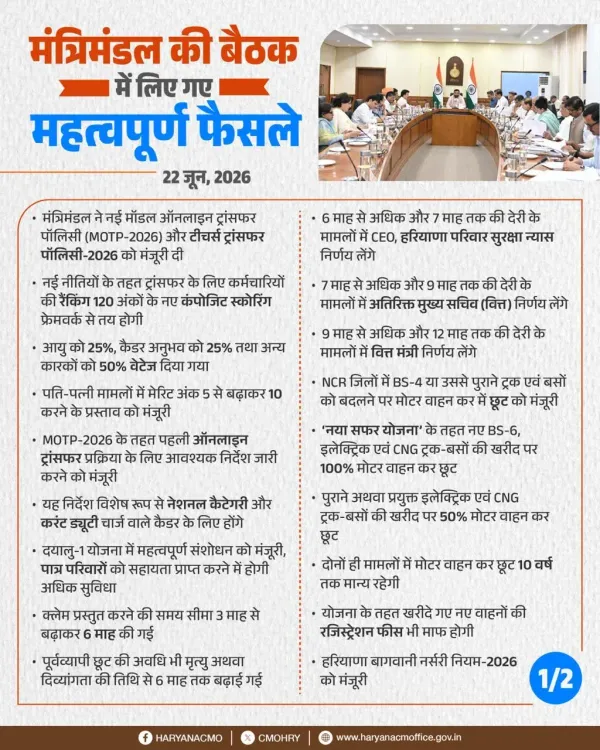
The Chief Minister's Office of Haryana announced on 22 June 2026 that the state cabinet convened and took several important decisions. Detailed orders and gazette notifications are expected to follow as the formal public record of the session's outcomes.
Key Takeaways
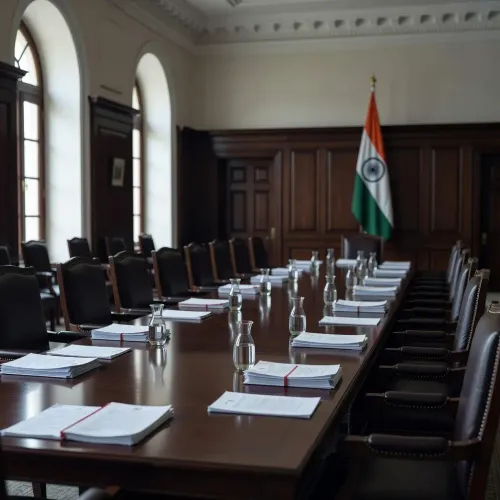
The Haryana Cabinet held a meeting on 22 June 2026 , according to the Chief Minister's Office.
The CMO described the outcomes as 'important decisions' ( महत्वपूर्ण फैसले ) without itemising them in the social media post.
The announcement was made via the official CMO account on X , serving as the initial public notice.
Formal press releases and gazette notifications detailing the specific decisions are expected to follow.
All residents of Haryana are potential stakeholders depending on the nature of the approvals made at the session.
The Chief Minister's Office of Haryana announced on Monday, 22 June 2026 that the Haryana Cabinet held a meeting in which several important decisions were taken. The official post, shared from the CMO's verified account on X, described the outcomes as 'महत्वपूर्ण फैसले' ('important decisions'), signalling consequential executive action at the state level.
Context
The Haryana Cabinet is the apex collective executive body of the state government, headed by the Chief Minister and comprising senior ministers. Under the constitutional framework, all major policy approvals, scheme launches, and administrative changes require cabinet sanction before implementation. The CMO's post on 22 June 2026 served as the initial public notice of the session's outcomes, consistent with the practice of state governments using official social media channels for real-time announcements ahead of formal press releases.
Cabinet meetings in Haryana are convened periodically and often address a wide range of subjects — from welfare scheme expansions and regulatory amendments to infrastructure project approvals and personnel matters. The brevity of the social media announcement, without itemising individual decisions, is standard practice; detailed government orders and gazette notifications are typically issued subsequently.
Policy Backdrop
Indian states are constitutionally mandated to govern through collective cabinet responsibility, meaning decisions carry the weight of the entire council of ministers. Haryana, a state with significant agricultural, industrial, and urban constituencies, regularly sees cabinet agendas that span farmer welfare, employment policy, urban infrastructure, and law enforcement reforms.
Official social media posts from CM offices across India have increasingly become the first point of public communication for cabinet outcomes, often preceding formal briefings by hours. This practice reflects a broader shift toward digital-first governance communication at the state level.
Stakeholders and Impact
The primary stakeholders of any Haryana Cabinet decision are the state's residents, who number in the crores across urban centres like Gurugram, Faridabad, and Ambala, as well as rural districts. Depending on the specific decisions taken — details of which are expected through official follow-up communications — the impact could range from direct beneficiary schemes to regulatory changes affecting business and industry.
Civil society groups, government employees, farmers' bodies, and local administrative machinery in Haryana typically await formal government orders before assessing the ground-level implications of any cabinet session.
What's Next
The Chief Minister's Office is expected to release a detailed press communiqué or official list of decisions taken at the meeting, which will clarify the scope and nature of the approvals. Follow-up gazette notifications or departmental circulars will give legal force to the decisions and set timelines for implementation.
For Haryana residents and policy watchers, the specifics emerging from this cabinet session will be the key indicator of the state government's immediate legislative and administrative priorities heading into the second half of 2026.
Point of View
Where social media posts flag an event while the bureaucratic machinery catches up with formal orders. For Haryana, a state that has oscillated between agricultural distress and rapid industrial growth, cabinet decisions carry outsized political weight. The absence of specifics in the initial post keeps political opponents and civil society in a holding position, unable to respond until the full list emerges. Watchers of Haryana politics will parse the eventual decision list closely for signals about the ruling dispensation's priorities ahead of future electoral cycles.
NationPress
21 Sept 2026
Frequently Asked Questions
What decisions were taken in the Haryana Cabinet meeting on 22 June 2026?
The Chief Minister's Office announced that important decisions were taken at the Haryana Cabinet meeting on 22 June 2026, but the specific details had not been itemised in the initial social media post. A formal press communiqué with the full list of decisions is expected to be released separately.
Who heads the Haryana Cabinet?
The Haryana Cabinet is headed by the Chief Minister of Haryana. The council of ministers collectively approves executive decisions and policies for the state government.
How are Haryana Cabinet decisions made public?
Cabinet decisions in Haryana are typically announced first via the official CMO social media channels, followed by detailed press releases and gazette notifications that give legal force to the approvals.
What is the role of the Haryana Cabinet?
The Haryana Cabinet is the apex collective executive body of the state, responsible for approving major policies, welfare schemes, regulatory changes, and administrative matters before they are implemented across the state.
Where can I find the full list of decisions from the Haryana Cabinet meeting?
The full list of decisions is expected to be published through official Haryana government press releases, the CMO's communication channels, and gazette notifications issued by the relevant state departments.