Haryana CMO Clears 32 Projects Worth ₹1,468 Cr at HPPC Meet
Synopsis
Haryana's Chief Minister's Office announced on 17 June 2026 that joint HPPC and HPWPC meetings cleared 32 projects worth ₹1,468.25 crore, advancing the state's infrastructure pipeline through a key procedural approval stage.
Key Takeaways
32 projects worth ₹1,468.25 crore were approved at a joint HPPC-HPWPC meeting on 17 June 2026 .
The High-Powered Purchase Committee (HPPC) oversees procurement approvals; the High-Powered Works Purchase Committee (HPWPC) clears construction and works contracts.
Holding a joint session of both committees in a single sitting is part of Haryana 's established practice of accelerating budget implementation.
The average project outlay works out to approximately ₹45.9 crore per project across the 32 sanctioned works.
Next steps include tender finalisation and formal work-order issuance, which will determine how quickly ground-level construction begins.
The approvals are a critical milestone for Haryana 's capital expenditure targets for the current fiscal year.
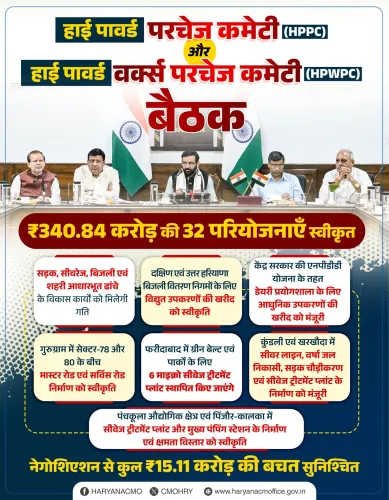
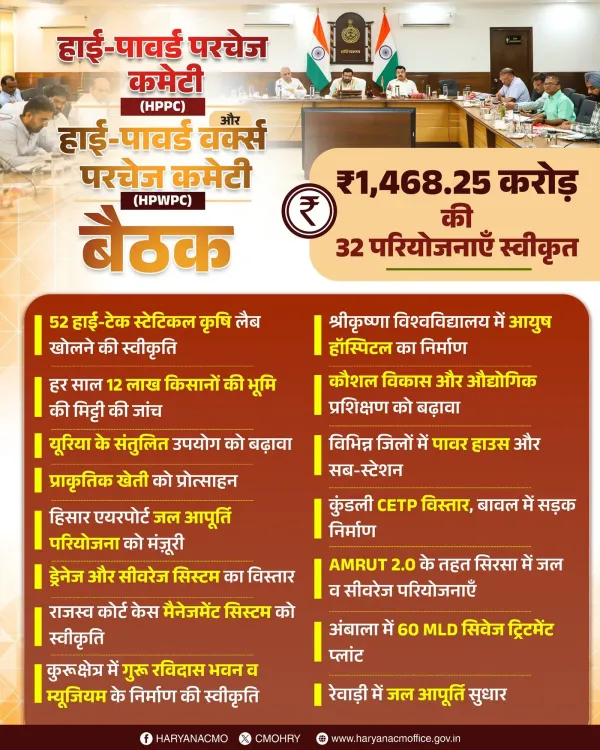
The Chief Minister's Office of Haryana announced on Wednesday, 17 June 2026 that joint meetings of the High-Powered Purchase Committee (HPPC) and the High-Powered Works Purchase Committee (HPWPC) have approved 32 projects valued at a combined ₹1,468.25 crore.
Context
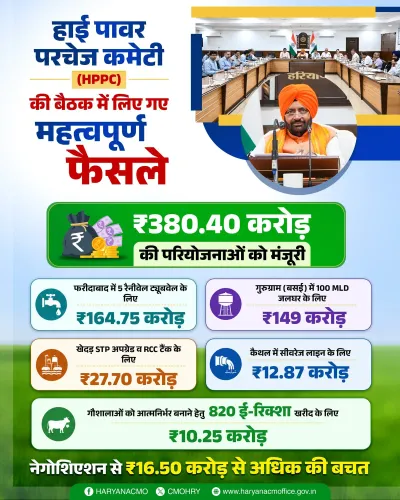
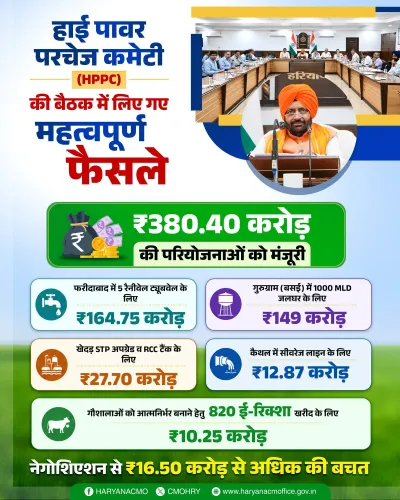
The official post from the Chief Minister's Office stated: 'हाई-पावर्ड परचेज कमेटी (HPPC) और हाई-पावर्ड वर्क्स परचेज कमेटी (HPWPC) बैठक में ₹1,468.25 करोड़ की 32 परियोजनाएँ स्वीकृत' — ('32 projects worth ₹1,468.25 crore approved at the High-Powered Purchase Committee and High-Powered Works Purchase Committee meeting'). The twin-committee format signals that the approvals span both procurement-heavy and construction-intensive works, requiring clearance from two separate oversight bodies in a single sitting.
Policy Backdrop
The HPPC is a Haryana government body that scrutinises and approves high-value procurement proposals across departments, while the HPWPC is specifically authorised to clear major works and construction contracts. Holding a joint session of both committees is consistent with Haryana's established practice of fast-tracking large-ticket approvals during annual budget implementation cycles, ensuring inter-departmental coordination and financial oversight in a single procedural step.
State governments across India routinely route project approvals of this scale through empowered committees to maintain procedural checks while avoiding bureaucratic delays. The combined value of ₹1,468.25 crore across 32 projects translates to an average outlay of roughly ₹45.9 crore per project, suggesting a mix of mid-size and large infrastructure and works contracts.
Stakeholders and Impact
The primary beneficiaries of these approvals are Haryana residents who will be served by the resulting infrastructure — whether roads, public buildings, irrigation works, or urban facilities. Construction firms and contractors registered with the state government stand to receive work orders once tenders are finalised following committee clearance.
For the state administration, the HPPC-HPWPC approval marks the completion of a critical procedural milestone. Projects cleared at this stage move into tendering and contract-award phases, which directly determine how quickly ground-level work can begin and whether capital expenditure targets for the fiscal year are met on schedule.
What's Next
The immediate next steps involve the issuance of formal work orders and the launch of tender processes for each of the 32 sanctioned projects. Progress will be tracked through subsequent quarterly reviews by the respective departments, with physical and financial progress reports expected to surface in the months ahead.
The pace at which these approvals translate into on-ground activity will be a key indicator of Haryana's capital expenditure absorption capacity for the current fiscal year. Observers will watch whether the state can convert the ₹1,468.25 crore pipeline into awarded contracts before the year's procurement deadlines close.
Point of View
468.25 crore across 32 projects in a single sitting reflects Haryana's deliberate effort to compress approval timelines and push capital spending forward within the fiscal calendar. Routing large-value works and procurement through empowered committees is a well-established state-government mechanism to maintain financial discipline while bypassing slower departmental processes. The scale of the approval — averaging roughly ₹45.9 crore per project — suggests the state is prioritising mid-to-large infrastructure works that carry visible public impact. How quickly these approvals convert into awarded contracts and physical progress will be the real test of Haryana's execution capacity this fiscal year.
NationPress
16 Sept 2026
Frequently Asked Questions
What was approved at the Haryana HPPC and HPWPC meeting in June 2026?
A total of 32 projects worth ₹1,468.25 crore were approved at the joint High-Powered Purchase Committee (HPPC) and High-Powered Works Purchase Committee (HPWPC) meeting on 17 June 2026.
What is the HPPC in Haryana?
The High-Powered Purchase Committee (HPPC) is a Haryana government body that scrutinises and approves high-value procurement proposals across state departments to ensure financial oversight.
What is the difference between HPPC and HPWPC in Haryana?
The HPPC handles procurement approvals broadly, while the HPWPC — High-Powered Works Purchase Committee — is specifically authorised to clear major construction and works contracts in the state.
How much is Haryana spending on infrastructure projects approved in June 2026?
Haryana approved infrastructure and works projects totalling ₹1,468.25 crore across 32 individual projects at the June 2026 HPPC-HPWPC meeting.
What happens after HPPC approval in Haryana?
After HPPC or HPWPC approval, the state issues formal work orders and initiates tender processes; physical and financial progress is then tracked through quarterly departmental reviews.