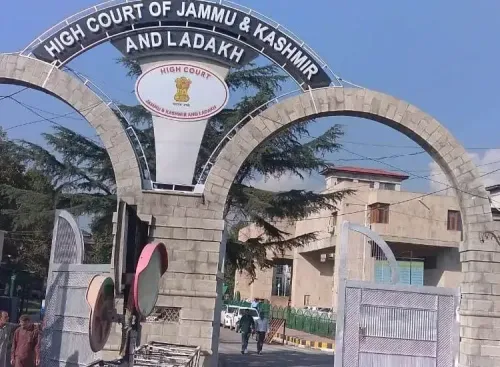
J&K High Court denies SRO 520 regularisation to 179 PDD daily wagers

Synopsis
The J&K and Ladakh High Court has shut the door on 179 Power Development Department daily wagers seeking regularisation under SRO 520, ruling that a provisional name in a departmental list is no substitute for proof of pre-ban engagement. The verdict underscores how the 17 March 2015 cut-off date remains the decisive — and largely unforgiving — threshold in J&K's daily-wage regularisation framework.
Key Takeaways
The J&K and Ladakh High Court dismissed appeals filed by 179 PDD daily wagers seeking regularisation under SRO 520 of 2017 .
Petitioners claimed engagement between 2012 and 2015 , before the ban imposed on 17 March 2015 via Government Order No.
The Division Bench — Acting Chief Justice Sanjeev Kumar and Justice Mohammad Yousuf Wani — ruled that provisional inclusion in a departmental list does not confer regularisation rights.
An Inquiry Committee had already recorded a finding against the petitioners after examining departmental records.
The court held that the burden of proving pre-cut-off engagement rested on the claimants, and no reliable material was placed on record.
The J&K and Ladakh High Court has refused to extend regularisation benefits under SRO 520 of 2017 to 179 daily wagers employed in the Power Development Department (PDD), ruling that the petitioners failed to establish a foundational requirement — that they were engaged before the government-imposed ban on fresh daily-wage appointments. The judgment was uploaded on Sunday, 31 August, a day after it was delivered.
Background to the Dispute
The 179 daily wagers had approached the court contending that their names were wrongly excluded from a list of 472 PDLs/TDLs prepared by the PDD for consideration of regularisation under SRO 520 of 2017. They claimed to have been engaged as daily-rated workers between 2012 and 2015 — before the government imposed a ban on fresh engagement of daily wagers effective 17 March 2015, through Government Order No. 43-F of 2015.
The petitioners further argued that their names had appeared in earlier departmental lists, and that their subsequent exclusion from the final list of 472 was arbitrary and unjustified.
What the Court Found
A Division Bench comprising Acting Chief Justice Sanjeev Kumar and Justice Mohammad Yousuf Wani dismissed the appeals, holding that a preliminary or provisional inclusion in a departmental list cannot, by itself, confer any right to regularisation when the core eligibility criterion — engagement prior to the cut-off date — remains unproven.
'The entitlement of the appellants depended clearly upon their establishing that they have been engaged prior to 17.03.2015,' the court noted in its judgment.
The bench also observed that once the government specifically disputed the claim of pre-ban engagement, the burden shifted squarely to the petitioners to produce reliable supporting material — which they failed to do.
Government's Stand and Inquiry Findings
Additional Advocate General Shahbaz Sikander submitted that an Inquiry Committee, after examining relevant departmental records, had recorded a finding against the daily wagers. The court noted that this finding had neither been shown to be perverse or arbitrary, nor demonstrated to be contrary to the record.
The respondents also explained that persons included in the final list of 472 had been verified as having been engaged prior to the imposition of the ban — a process the appellants could not clear.
Court's Reasoning on Custody of Records
The bench acknowledged that muster rolls and departmental records ordinarily remain in the custody of the department and may not be easily accessible to employees. However, it clarified that this practical difficulty does not relieve the claimants of their legal obligation to establish the fact of pre-cut-off engagement.
'No such material has been placed on record,' the judgment stated, underlining that the absence of documentary proof was fatal to the appellants' case.
Verdict and Implications
The court upheld the earlier single-bench order, finding no error of law or fact that would warrant interference. 'We find no merit in these appeals. The appeals are, accordingly, dismissed,' the Division Bench held.
The ruling sets a clear precedent: provisional listing in a departmental register does not substitute for verified proof of engagement before the statutory cut-off date. For the 179 daily wagers, all avenues for regularisation under SRO 520 now appear closed unless fresh material evidence emerges and a higher forum intervenes.
Point of View
Which remain in government custody, are the primary means of proof. The court acknowledged this asymmetry but declined to relax the burden of proof, which critics argue structurally favours the administration. Notably, the petitioners' earlier provisional inclusion in departmental lists suggests the verification process itself may have been inconsistent — a question the judgment does not fully resolve. For the broader class of daily wagers in J&K, the verdict signals that SRO 520 benefits will be defended vigorously at the verification stage, making documentary rigour at the point of engagement — not litigation — the only reliable safeguard.
NationPress
30 Aug 2026
Frequently Asked Questions
What is SRO 520 of 2017 and who does it cover?
SRO 520 of 2017 is a J&K government order that provides a framework for regularising daily-wage workers — specifically PDLs (Part-time Daily Labourers) and TDLs (Temporary Daily Labourers) — who were engaged before the ban on fresh daily-wage appointments imposed on 17 March 2015. Only workers who can prove pre-ban engagement are eligible for consideration under the policy.
Why did the J&K High Court dismiss the 179 daily wagers' plea?
The court dismissed the appeals because the petitioners failed to produce reliable documentary evidence proving they were engaged before the statutory cut-off date of 17 March 2015. The Division Bench ruled that provisional inclusion in an earlier departmental list does not, by itself, establish eligibility for regularisation.
What was the role of the Inquiry Committee in this case?
A government-constituted Inquiry Committee examined the relevant departmental records and recorded a finding against the 179 daily wagers, concluding they had not established pre-ban engagement. The High Court found no basis to hold this finding perverse, arbitrary, or contrary to the record.
Who imposed the ban on daily-wage appointments and when?
The J&K government imposed the ban through Government Order No. 43-F of 2015, dated 17 March 2015, prohibiting fresh engagement of daily-wage workers from that date. Any worker claiming regularisation under SRO 520 must prove their appointment predates this order.
What happens next for the 179 daily wagers after this ruling?
With the Division Bench upholding the single-bench dismissal, all regularisation avenues under SRO 520 are effectively closed for these 179 workers unless they can surface fresh material evidence and approach a higher judicial forum. No further relief was indicated in the judgment.