Gujarat Celebrates Launch of Heaviest Beam for Mumbai-Ahmedabad Bullet Train Project
Synopsis
In a groundbreaking achievement for the Mumbai-Ahmedabad Bullet Train project, officials successfully launched one of the heaviest precast portal beams on the Ahmedabad-Vadodara railway line, showcasing remarkable engineering prowess and efficiency.
Key Takeaways
The successful launch of a 1,360 metric tonne portal beam marks a significant engineering milestone for the Mumbai-Ahmedabad Bullet Train project.
The beam measures 34 metres long and is part of a total of five beams planned for installation.
Efficient planning reduced the launch time to just 3.5 hours, showcasing effective project management.
The project aims for phased operations to start in 2027 and full completion by 2028.
Collaboration with Indian Railways ensured safety and efficiency during the operation.
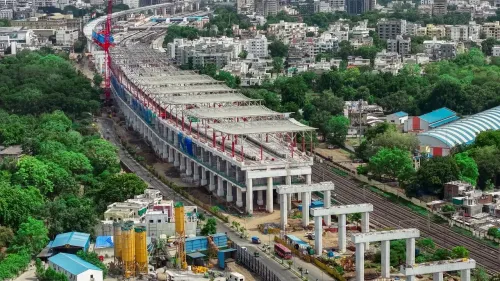
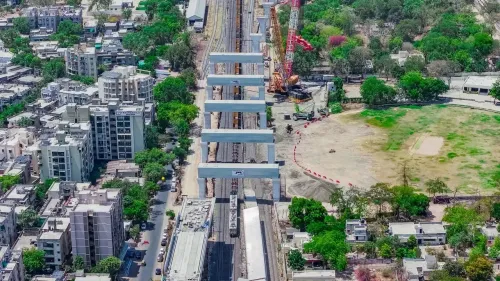
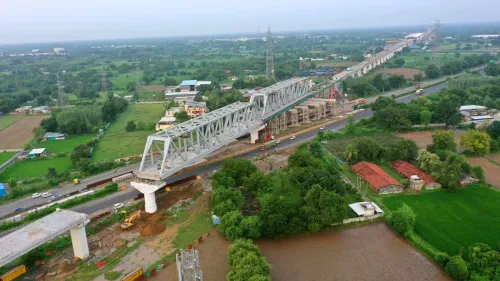
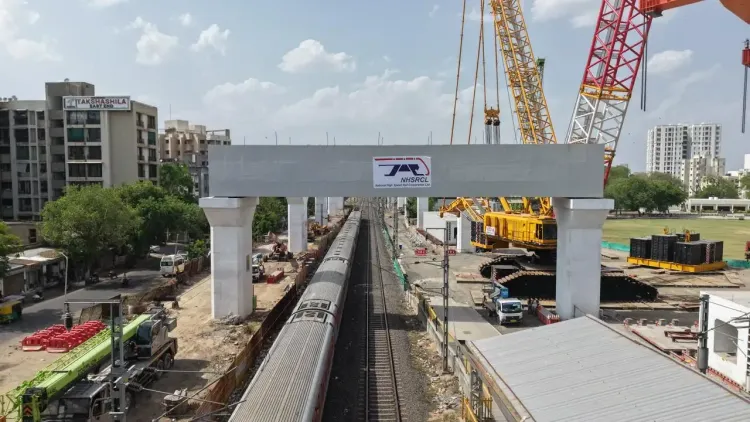
Ahmedabad, April 8 (NationPress) The Mumbai-Ahmedabad Bullet Train initiative achieved a significant engineering feat on Wednesday, marking the successful deployment of one of its heaviest precast-prestressed portal beams along the Ahmedabad-Vadodara railway line in the Maninagar locality, according to officials.
The portal beam, a robust precast concrete structure, weighs approximately 1,360 metric tonnes and spans 34 metres in length, featuring a cross-section of 5.5 metres by 4.5 metres.
Officials have indicated that a total of five such beams are slated for installation close to the Maninagar railway station.
Each beam is produced on-site in precast form and installed as a unified heavy unit.
"The entire launching process was accomplished in an impressively brief timeframe of about 3.5 hours while adhering to stringent safety protocols," an official statement disclosed.
This operation was executed during a complete traffic and power shutdown, meticulously coordinated with the Indian Railways.
Previously, a lengthy caution order of around six months and a block of nearly nine hours had been arranged for the same task.
"Through diligent planning and optimization, this duration was condensed to merely 3.5 hours for both lines of the Ahmedabad-Vadodara section," the statement further explained.
The lifting operation utilized a 2,200-metric tonne capacity crawler crane, with the support of a 260-tonne standby crane, an 80-tonne crane, man-lifters, and a lifter beam system equipped with anchoring frames.
The setup comprised 75 mm diameter prestressed macalloy bars, lifting beams, and heavy-duty slings to effectively handle the substantial load.
Officials acknowledged the engineering hurdles faced, stating: "This operation poses several engineering complexities, including managing an ultra-heavy lift of nearly 1,360 metric tonnes—one of the heaviest lifts ever conducted on Indian railway infrastructure—and the necessity to complete the entire erection within a tight timeframe."
Further complications arose from the constrained working area, overhead machinery, and multiple active railway lines, requiring precise installation at a height of approximately 15 metres.
Officials emphasized the significance of real-time collaboration with railway personnel, the provision of backup lifting systems, rigorous rigging oversight, constant monitoring of wind speeds due to the large surface area of the beam, and precise survey and alignment control to guarantee safe and accurate installation.
The Mumbai-Ahmedabad Bullet Train project, officially referred to as the Mumbai-Ahmedabad High Speed Rail (MAHSR) Corridor, is a 508-kilometre high-speed route linking Mumbai in Maharashtra to Ahmedabad in Gujarat.
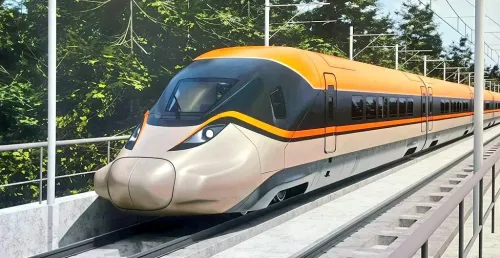
Implemented by the National High Speed Rail Corporation Limited (NHSRCL) with technical and financial backing from Japan, the project is designed for trains to operate at speeds reaching up to 320 km/h.
A total of twelve stations are proposed along the corridor.
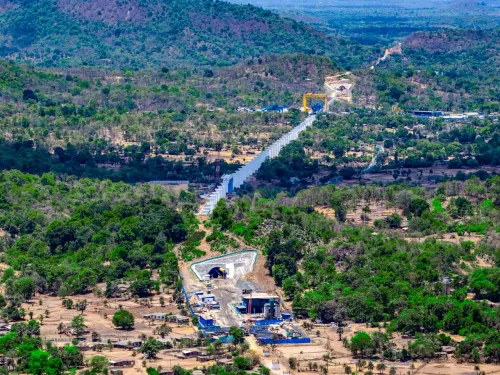
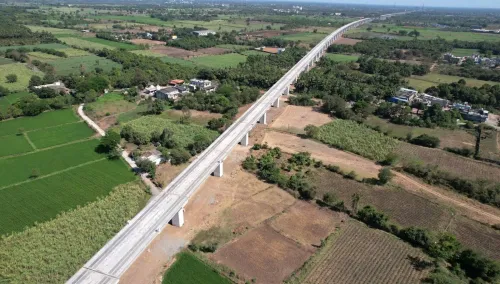
Authorities have reported notable progress along the alignment, including pier construction, girder casting, and completion of viaducts.
The project aims to initiate phased operations in 2027, with full completion expected around 2028.
Point of View
The successful launch of the heaviest portal beam for the Mumbai-Ahmedabad Bullet Train project represents a significant step toward modernizing India's rail infrastructure, enhancing connectivity, and promoting economic growth. The meticulous planning and execution reflect a commitment to engineering excellence and safety standards.
NationPress
15 Oct 2026
Frequently Asked Questions
What is the weight of the portal beam launched?
The portal beam launched weighs approximately 1,360 metric tonnes.
How long is the portal beam?
The portal beam measures 34 metres in length.
How many beams are planned for installation?
A total of five such beams are planned for installation near the Maninagar railway station.
What speed is the bullet train designed to operate at?
The bullet train is designed to operate at speeds of up to 320 km/h.
When is the project expected to be completed?
The project aims to commence phased operations in 2027, with full completion anticipated around 2028.