CM Himanta: 35% of Assam's Population Has Exited BPL Category

Synopsis
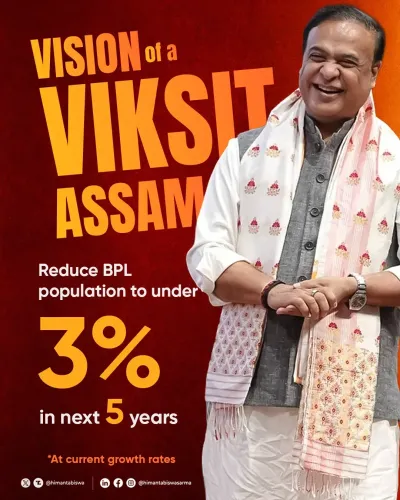
Chief Minister Himanta Biswa Sarma cited NITI Aayog data in the Assam Assembly on 26 May 2026, claiming 35 per cent of Assam's population has exited the Below Poverty Line category — a figure that, if verified, marks a significant welfare milestone for the northeastern state.
Key Takeaways
CM Himanta Biswa Sarma stated in the Assam Assembly that 35% of Assam's population has exited the BPL category.
The claim is attributed to NITI Aayog , the Government of India's policy think tank that publishes the national Multidimensional Poverty Index .
Assam has a population of over 3.5 crore , making the absolute numbers behind the percentage figure substantial.
NITI Aayog's 2023 MPI report documented a national reduction of 13.5 crore people from multidimensional poverty, with northeastern states showing measurable progress.
The statement was made during Assam Legislative Assembly proceedings and officially amplified by the Chief Minister's Office on X .
Independent verification will depend on the next NITI Aayog MPI update and forthcoming state budget welfare data.
The Chief Minister's Office of Assam on Tuesday, 26 May 2026 shared a statement by Chief Minister Dr Himanta Biswa Sarma citing NITI Aayog data to assert that 35 per cent of Assam's population has successfully moved out of the Below Poverty Line (BPL) category — a claim made during proceedings of the Assam Legislative Assembly.
Context
Speaking in the Assam Assembly, CM Himanta Biswa Sarma stated, 'According to NITI Aayog, 35% of Assam's population has successfully come out of the Below Poverty Line (BPL) category.' The remark was made in response to a query directed at the Chief Minister's Office and was amplified through the official government handle on X. Assam has a population of over 3.5 crore, making the claimed figure significant in absolute terms.
Policy Backdrop
NITI Aayog, the Government of India's apex policy think tank established in 2015, publishes the national Multidimensional Poverty Index (MPI) — a composite measure tracking deprivation across health, education, and living standards. Its 2021 baseline report established state-level poverty estimates, including for Assam. A subsequent 2023 MPI report documented a national reduction of 13.5 crore people from multidimensional poverty, with measurable progress noted across several northeastern states.
The BPL classification is used by both central and state governments to target households for subsidies, food security entitlements, and social welfare programmes. Progress on BPL exit rates is increasingly measured through the MPI framework rather than income thresholds alone, reflecting a broader shift in how poverty is defined and tracked in India.
Stakeholders and Impact
The primary beneficiaries of any genuine reduction in BPL households are Assam's rural poor — families that, upon exiting the BPL category, may see changes in their eligibility for targeted welfare transfers, subsidised rations, and government housing schemes. Civil society groups and opposition legislators are among those who scrutinise such claims during assembly sessions, often demanding district-level disaggregated data to validate state-level averages.
CM Himanta Biswa Sarma, who has led the state since May 2021, has consistently cited NITI Aayog metrics in public communications to frame the government's welfare record. The assembly floor provides a formal setting where such data points are placed on official record, adding institutional weight to the claim.
What's Next
Attention will now turn to the release of any updated NITI Aayog MPI report that could independently corroborate or contextualise the 35 per cent figure cited by the Chief Minister. Observers will also watch for the tabling of Assam's next state budget welfare allocations, which typically reflect the government's own assessment of remaining poverty gaps. If the MPI data holds, it could shape the state's approach to rationalising or expanding its portfolio of anti-poverty schemes in the coming fiscal cycle.
Point of View
Government-endorsed framework — insulating the assertion from easy political rebuttal. The 35 per cent figure, if substantiated by the next MPI update, would represent one of the more significant poverty-exit narratives from a northeastern state since the index's 2021 baseline. However, citing an aggregate without district-level granularity leaves the claim open to scrutiny from opposition benches and independent researchers. The broader pattern — ruling dispensations across states racing to claim MPI-backed poverty reduction ahead of electoral cycles — means this statement will be watched closely for evidentiary follow-through.
NationPress
23 Sept 2026
Frequently Asked Questions
What did Assam CM Himanta Biswa Sarma say about poverty in Assam?
CM Himanta Biswa Sarma stated in the Assam Assembly that, according to NITI Aayog, 35 per cent of Assam's population has successfully exited the Below Poverty Line (BPL) category.
What is NITI Aayog's Multidimensional Poverty Index?
The Multidimensional Poverty Index (MPI) is published by NITI Aayog and measures poverty across health, education, and living standards — going beyond income alone. Its 2023 report noted a national reduction of 13.5 crore people from multidimensional poverty.
How many people does 35% of Assam's population represent?
Assam has a population of over 3.5 crore, so 35 per cent translates to over 1.2 crore people who, according to the Chief Minister's claim, have moved out of the BPL category.
Is the 35% BPL exit figure for Assam officially verified?
The figure was cited by CM Himanta Biswa Sarma in the Assam Assembly and attributed to NITI Aayog. Independent confirmation will depend on the next official NITI Aayog MPI report.
What happens when a household exits the BPL category in India?
When a household exits the BPL category, it may lose eligibility for certain targeted welfare benefits such as subsidised rations and housing schemes, though the exact implications vary by programme and state policy.