CM Himanta Sets 5-Year Target to Cut Assam BPL Below 3%
Synopsis
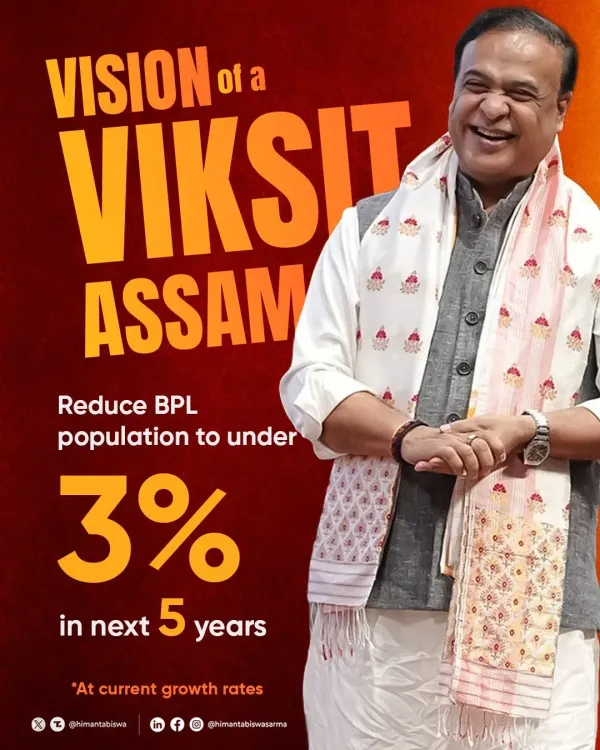
Assam Chief Minister Himanta Biswa Sarma has set a five-year target to bring the state's BPL population below 3 per cent, linking the goal to the national Viksit Bharat framework and pledging that growth must reach every household across the state.
Key Takeaways
CM Himanta Biswa Sarma announced a target to reduce Assam 's BPL population to below 3 per cent within the next five years.
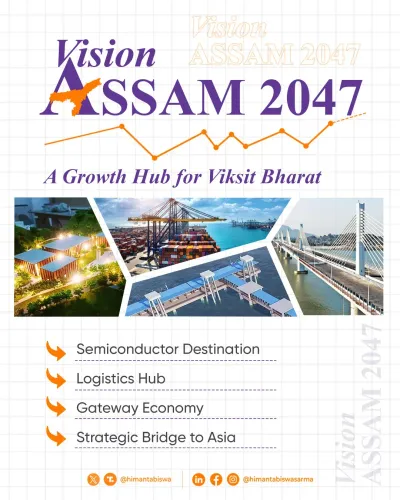
The goal is framed under the #ViksitAssam vision, directly aligned with the national Viksit Bharat roadmap for 2047 .
NITI Aayog 's 2023 Multidimensional Poverty Index reports had already documented measurable poverty declines in northeastern states including Assam .
The five-year horizon broadly coincides with the current BJP government's tenure, making it both a governance benchmark and a political accountability marker.
Assam is part of the North-East Democratic Alliance (NEDA) , convenored by Sarma, which has adopted quantified welfare targets tied to central scheme delivery.
Budget presentations and the next NITI Aayog MPI update will be key indicators of whether concrete programmes are deployed to meet the target.
Assam Chief Minister Himanta Biswa Sarma on Friday, 29 May 2026 outlined an ambitious poverty-reduction goal, pledging to bring the state's Below Poverty Line (BPL) population to under 3 per cent within the next five years through sustained economic growth and expanded opportunities for every household.
Context
Posting on X, CM Sarma framed the commitment in the language of measurable governance: 'A #ViksitAssam is not built through promises, but through sustained growth that reaches every household.' The statement signals a shift from broad welfare rhetoric toward a specific, time-bound metric that the government can be held accountable to by 2031.
The five-year horizon aligns with the likely tenure of the current BJP government in Assam, making the target simultaneously a governance benchmark and a political commitment ahead of the next state assembly cycle.
Policy Backdrop
CM Sarma took charge in May 2021 with an explicit mandate to accelerate economic expansion and welfare delivery in one of India's historically underdeveloped northeastern states. Since then, the administration has pursued a combination of infrastructure investment, direct benefit transfers, and saturation-model welfare schemes.
The target draws directly from the national Viksit Bharat framework — Prime Minister Narendra Modi's vision for India to achieve developed-economy status by 2047 — which state governments across BJP-ruled territories have translated into localised, quantified goals. NITI Aayog's Multidimensional Poverty Index reports released in 2023 documented measurable declines in poverty headcount across several northeastern states, providing a statistical baseline that state governments have used to project forward trajectories.
Assam and other states under the North-East Democratic Alliance (NEDA) — the regional coalition convenored by Sarma himself — have increasingly adopted this model of tying welfare ambition to central scheme delivery and MPI metrics, creating a feedback loop between Delhi's development roadmap and state-level execution.
Stakeholders and Impact
The most direct beneficiaries of the stated goal are BPL households and rural families spread across Assam's 35 districts, many of whom depend on central and state welfare programmes for food security, healthcare, and livelihood support. Achieving sub-3 per cent BPL penetration would represent a significant structural shift for a state that has historically ranked among the lower tiers of India's human development indices.
For the BJP at both the state and national level, a verifiable poverty-reduction achievement in Assam would serve as a model for replication across other northeastern states and as evidence of the Viksit Bharat agenda's ground-level impact. Civil society organisations and opposition parties are likely to scrutinise the methodology used to define and measure BPL status as the target approaches.
What's Next
The operationalisation of this pledge will be closely watched in Assam's upcoming annual budget presentations and in the next NITI Aayog MPI update, which will indicate whether new schemes or revised expenditure allocations are being deployed to support the five-year goal. Analysts will look for a concrete policy roadmap — including specific programme outlays and district-level targets — to assess whether the commitment moves beyond a political statement into a structured implementation plan.
If the trajectory holds, Assam could position itself as a benchmark case for poverty reduction in northeastern India, with implications for how the Centre allocates development funds to the region in the run-up to 2047.
Point of View
Auditable metric — one that mirrors the BJP's broader national strategy of converting the Viksit Bharat narrative into state-level scorecards. By setting a quantified target rather than a directional aspiration, Sarma raises the political stakes for his own administration while simultaneously signalling to the Centre that Assam is a model implementer of the development agenda. The alignment with NITI Aayog's MPI methodology also suggests the government intends to use the same measurement framework to claim credit, making the choice of baseline and methodology a likely flashpoint with opposition groups. Whether the pledge translates into a funded, district-level action plan or remains a headline commitment will define its policy significance over the next budget cycle.
NationPress
12 Oct 2026
Frequently Asked Questions
What is Assam CM Himanta Biswa Sarma's BPL reduction target?
CM Himanta Biswa Sarma has pledged to reduce Assam's Below Poverty Line (BPL) population to below 3 per cent within the next five years, approximately by 2031.
What is Viksit Assam?
'Viksit Assam' is the Assam government's state-level development vision, modelled on Prime Minister Modi's national Viksit Bharat framework that aims for India to become a developed economy by 2047.
What is Assam's current poverty situation?
NITI Aayog's 2023 Multidimensional Poverty Index reports documented measurable declines in poverty headcount across northeastern states including Assam, though precise current BPL figures are subject to ongoing measurement updates.
How does Assam plan to achieve the BPL reduction goal?
CM Sarma has stated the approach will involve expanding opportunities and ensuring growth reaches every family, consistent with the BJP's model of combining infrastructure investment with direct benefit transfers and central scheme delivery.
What is NEDA and what role does Himanta Biswa Sarma play in it?
The North-East Democratic Alliance (NEDA) is a BJP-led political coalition of parties governing northeastern states. CM Himanta Biswa Sarma serves as its convenor and has pushed member states to adopt quantified welfare targets aligned with the national development agenda.