CM Himanta Hails DRDO's Ballistic Missile Defence Shield Trials
Synopsis
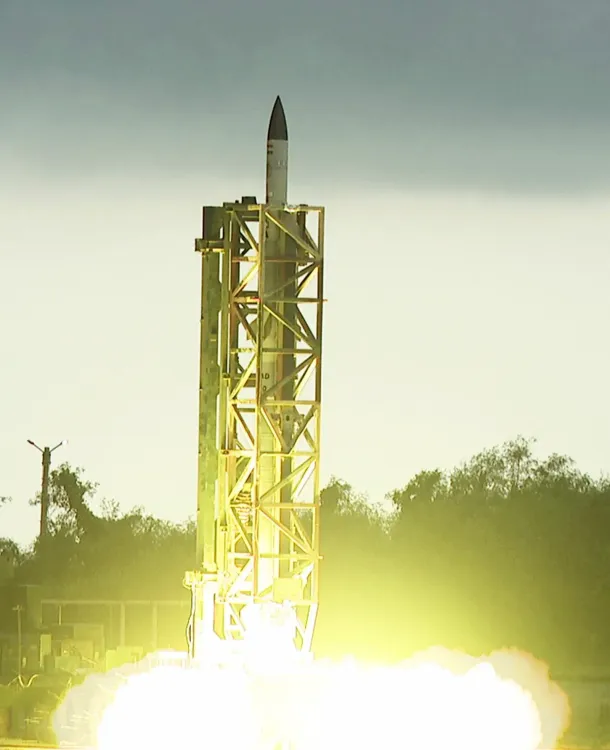
Assam Chief Minister Himanta Biswa Sarma on 13 June 2026 hailed DRDO's successful trials of a Ballistic Missile Defence shield capable of intercepting 5,000-km-class missiles at the exo-atmospheric level, calling it a landmark indigenous achievement that surpasses conventional Iron Dome-class systems.
Key Takeaways
Assam CM Himanta Biswa Sarma publicly congratulated DRDO on 13 June 2026 for the successful BMD shield trials.
The system is claimed to intercept and neutralise missiles of the 5,000-km class at the exo-atmospheric level — outside the Earth's atmosphere.
Sarma explicitly stated the capability is 'far beyond' what conventional Iron Dome -type systems can achieve, highlighting the difference in threat tiers.
India joins a small group of nations — including the United States , Russia , and Israel — to have indigenously developed exo-atmospheric BMD capability.
The programme aligns with the Atmanirbhar Bharat framework, reinforcing India's push for strategic self-reliance in advanced defence technologies.
Next steps include formal user trials, integration with early-warning radars and S-400 units, and a possible Cabinet Committee on Security decision on operational deployment.
Assam Chief Minister Himanta Biswa Sarma on Saturday, 13 June 2026, congratulated the Defence Research and Development Organisation (DRDO) on what he described as a landmark achievement — the successful trials of a Ballistic Missile Defence (BMD) shield capable of intercepting and neutralising missiles of the 5,000-km class at the exo-atmospheric level, placing India among an elite group of nations to have indigenously developed such a system.
Context
Sarma's post described the trials as 'a huge achievement,' noting that India 'now has a phenomenal Ballistic Missile Defence Shield that can intercept and neutralise 5,000-km-class enemy missiles at the exo-atmospheric level.' He drew a pointed comparison with Israel's widely cited Iron Dome, stating that India's new interception capability is 'far beyond what conventional Iron Dome systems can achieve.' The Iron Dome is designed for short-range rockets and artillery, whereas exo-atmospheric interceptors target long-range ballistic missiles during their mid-course phase, outside the Earth's atmosphere — a significantly more complex technological challenge.
Sarma also underlined the indigenous character of the system, calling it 'even more special' because India developed it in-house, placing the country in a small club of nations — which includes the United States, Russia, and Israel — with demonstrated exo-atmospheric BMD capability.
Policy Backdrop
India's BMD programme has its roots in the strategic reassessment that followed the 1998 nuclear tests. DRDO conducted the country's first successful exo-atmospheric intercept in 2007 using the Prithvi Air Defence (PAD) interceptor, and completed integrated Phase-I trials of both the PAD (exo-atmospheric) and Advanced Air Defence (AAD) (endo-atmospheric) interceptors by 2011–2012, establishing a two-tier national shield architecture.
The programme fits squarely within the Atmanirbhar Bharat framework, India's policy of strategic self-reliance in defence manufacturing. By indigenously developing a system capable of engaging long-range ballistic threats, India reduces its dependence on imported platforms and strengthens its deterrence posture, particularly in a neighbourhood that includes two nuclear-armed states.
Stakeholders and Impact
The primary beneficiaries of an operational BMD shield are the Indian Army and Indian Air Force, which would be responsible for deploying and operating the interceptor batteries. DRDO scientists and engineers — the 'Team DRDO' Sarma specifically addressed — are the architects of the programme, having worked on it across multiple decades and successive trial phases.
A functional exo-atmospheric layer also has strategic implications for India's nuclear doctrine, potentially reinforcing a credible second-strike capability by improving the survivability of command-and-control assets. Allied nations and strategic partners in the Indo-Pacific region are likely to take note of the development as India's defence profile continues to evolve.
What's Next
Analysts and defence observers will watch for formal user trials by the armed forces, which typically follow successful developmental trials before a system is cleared for induction. Integration of the BMD shield with India's existing early-warning radar network and the S-400 Triumf air defence units — acquired from Russia — will be a key technical and operational milestone to track.
Any announcement by the Cabinet Committee on Security (CCS) on full operational deployment or production orders for the interceptors would mark the next definitive step in translating this trial success into a deployed national shield.
Point of View
Particularly under the Atmanirbhar Bharat narrative. The comparison to Iron Dome is deliberate — it anchors an abstract technological feat to a system the public already recognises, making the achievement legible to a non-specialist audience. If the trials hold up to independent scrutiny, this would represent a genuine leap in India's strategic deterrence architecture, potentially reshaping threat calculus with both Pakistan and China. The political class's swift endorsement also telegraphs that full operational deployment — and the attendant announcement — may be closer than official timelines have previously suggested.
NationPress
13 Sept 2026
Frequently Asked Questions
What is India's Ballistic Missile Defence shield?
India's Ballistic Missile Defence (BMD) shield is an indigenously developed two-tier system built by DRDO to intercept incoming ballistic missiles at both exo-atmospheric (outside the atmosphere) and endo-atmospheric (inside the atmosphere) levels, protecting against short- to long-range missile threats.
How is India's BMD system different from Israel's Iron Dome?
Israel's Iron Dome is designed to intercept short-range rockets and artillery shells within the atmosphere. India's exo-atmospheric BMD interceptors target long-range ballistic missiles — up to the 5,000-km class — during their mid-course phase outside the Earth's atmosphere, representing a far more complex and strategically significant capability.
Which countries have exo-atmospheric missile defence capability?
A small group of nations including the United States, Russia, and Israel have demonstrated exo-atmospheric ballistic missile defence capability. India, with its DRDO-developed system, is now claimed to have joined this elite group after the June 2026 trials.
What is DRDO's role in India's missile defence programme?
DRDO is India's premier defence research agency and the architect of the BMD programme, which formally began after India's 1998 nuclear tests. DRDO conducted the first successful exo-atmospheric intercept in 2007 and has since developed both the Prithvi Air Defence (PAD) and Advanced Air Defence (AAD) interceptors.
Why did Assam CM Himanta Biswa Sarma comment on a defence trial?
As a senior BJP leader and Chief Minister, Sarma frequently comments on national policy milestones, particularly those aligned with the Atmanirbhar Bharat framework. His post on 13 June 2026 reflected the broader ruling establishment's effort to highlight India's indigenous defence achievements.