HP CM Ends State Salary Cuts, Keeps Own Pay Reduction

Synopsis
The Himachal Pradesh Chief Minister's Office announced the withdrawal of state-wide salary reduction measures introduced during fiscal stress, citing progress toward self-reliance. The Chief Minister separately pledged to personally continue his own salary cut as a symbolic commitment to austerity.
Key Takeaways
The Chief Minister's Office of Himachal Pradesh announced on June 10, 2026 the rollback of salary reduction measures imposed during a period of fiscal difficulty.
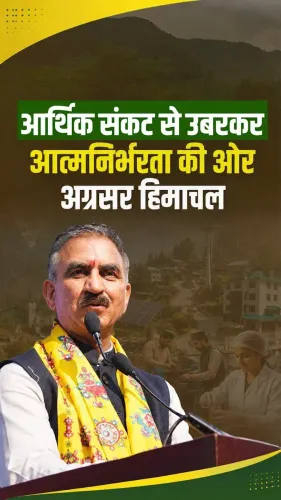
The decision is framed as recognition that Himachal Pradesh has moved toward aatmanirbharta (self-reliance) and emerged from earlier financial hardship.
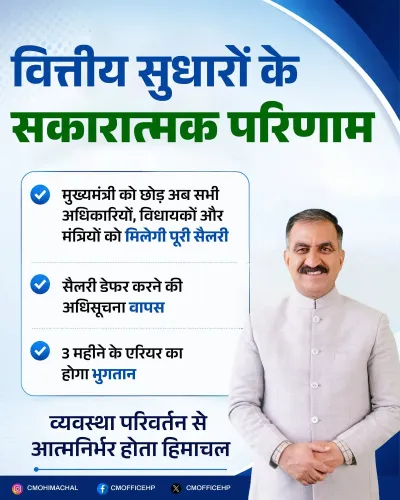
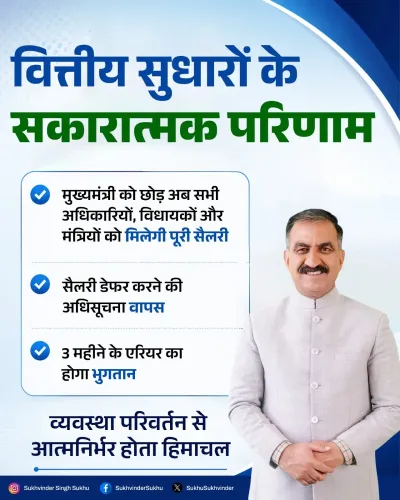
The Chief Minister stated his own salary cut will continue as a personal commitment, separate from the state-level reversal.
State government employees stand to benefit from the restoration of full pay scales.
The move follows a broader Indian pattern of states using temporary salary cuts during fiscal crises — including the COVID-19 pandemic in 2020 — and reversing them as revenues recover.
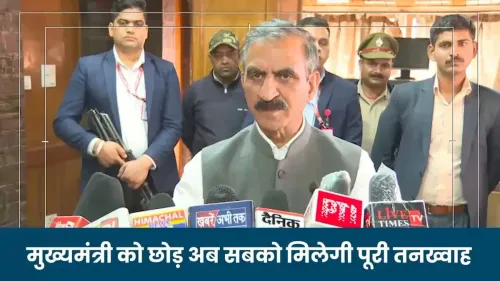
The Chief Minister's Office of Himachal Pradesh announced on Wednesday, June 10, 2026 that the state government has decided to withdraw the salary reduction measures that were introduced during a period of acute fiscal stress, citing the state's progress toward financial self-reliance. In a notable personal commitment, the Chief Minister stated that his own salary cut would continue in force even after the broader rollback.
Context
The post, shared from the official Chief Minister's Office of Himachal Pradesh account, states in Hindi: 'आज, जब प्रदेश उन कठिन परिस्थितियों से बाहर निकलकर आत्मनिर्भरता की दिशा में मजबूती से कदम बढ़ा रहा है, तब हमने इसे वापस लेने का निर्णय लिया है' — translated as: 'Today, as the state emerges from those difficult circumstances and moves firmly in the direction of self-reliance, we have decided to withdraw it.' The post further clarifies that as a personal resolve, the Chief Minister's own salary deduction will continue as before, even as the state-level austerity measure is lifted.
The salary cuts were originally introduced when Himachal Pradesh faced severe fiscal pressure — a pattern common across Indian states during periods of revenue shortfall caused by natural disasters or reduced central transfers. The reversal signals that the state administration believes conditions have improved sufficiently to restore normal pay for government employees and officials.
Policy Backdrop
Voluntary and directed salary reductions for ministers, legislators, and senior officials have been a recurring fiscal tool in India. During the COVID-19 pandemic in 2020, Himachal Pradesh joined several other states in cutting ministerial pay to conserve revenue at a time when tax collections collapsed and welfare spending surged. Hill states such as Himachal Pradesh are structurally dependent on central transfers and tourism revenue, making them particularly vulnerable to economic shocks.
The concept of aatmanirbharta (self-reliance) invoked in the post echoes a broader national policy vocabulary, applying it here at the state level to describe improved fiscal health. The decision to roll back the cuts is framed not as a reversal of austerity values, but as a recognition that the emergency conditions that necessitated them have passed.
Stakeholders and Impact
State government employees are the primary beneficiaries of the rollback, as the austerity measures had affected salary disbursements across government departments. The restoration of full pay scales is likely to be welcomed by employees' unions and public servants who had borne reduced compensation during the period of fiscal stress.
The Chief Minister's personal decision to maintain his own salary cut distinguishes his position from the broader policy reversal, presenting it as a gesture of continued accountability and personal austerity even as the state normalises its expenditure framework. This dual messaging — relief for employees, continued sacrifice at the top — is a well-established political signalling device in Indian governance.
What's Next
The formal restoration of pay scales is expected to be reflected in upcoming state budget allocations and departmental expenditure orders. Observers will watch the next Himachal Pradesh state budget speech for detailed announcements on employee welfare, revised pay structures, and the fiscal roadmap the government envisions as it pursues greater self-reliance. The Chief Minister's personal salary arrangement is also likely to remain a point of political discussion in the state legislature.
Point of View
The invocation of 'self-reliance' also carries forward-looking ambition about revenue generation. The real test will come in the next budget, where the fiscal numbers will either validate or complicate that narrative.
NationPress
26 Oct 2026
Frequently Asked Questions
Why is Himachal Pradesh reversing its government salary cuts?
The state government says Himachal Pradesh has emerged from the difficult fiscal circumstances that made the cuts necessary and is now moving toward self-reliance, making the austerity measure no longer required.
Will the Himachal Pradesh Chief Minister also get his full salary back?
No. The Chief Minister stated that as a personal commitment, his own salary reduction will continue even after the broader state-level rollback takes effect.
When were Himachal Pradesh government salary cuts first introduced?
Salary reduction measures for ministers and senior officials in Himachal Pradesh were part of a wider austerity drive, with similar steps taken across Indian states during the COVID-19 pandemic in 2020 when revenues fell sharply.
Who benefits from the Himachal Pradesh salary cut rollback?
State government employees and officials whose pay was reduced under the austerity measure are the primary beneficiaries of the rollback announced by the Chief Minister's Office.
What does 'aatmanirbharta' mean in the context of Himachal Pradesh's fiscal policy?
Aatmanirbharta means self-reliance. The Himachal Pradesh government used the term to describe the state's improving fiscal health and its reduced dependence on emergency measures to manage public finances.