HP CM Office Reverses Salary Deferral for Ministers, MLAs, Top Officials

Synopsis
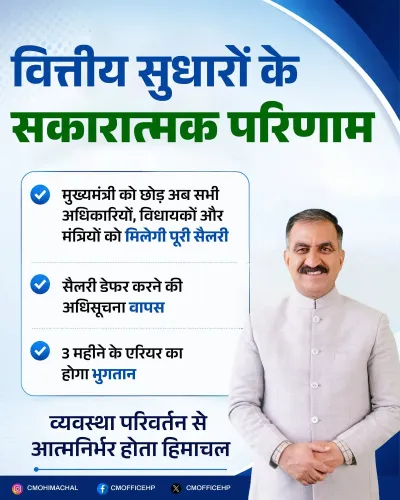
The Himachal Pradesh CMO announced on June 7, 2026 that the salary deferral imposed on the Chief Secretary, Additional Chief Secretary, Deputy Commissioners, MLAs and ministers has been withdrawn, with the government citing improved financial consolidation as the reason for the reversal.
Key Takeaways
The Chief Minister's Office of Himachal Pradesh announced on June 7, 2026 that the salary deferral order has been withdrawn.
The deferral had applied to the Chief Secretary, Additional Chief Secretary, Deputy Commissioners, MLAs and cabinet ministers .
The government attributed the reversal to 'vittiya sudriddhata' — financial consolidation — without citing specific fiscal figures.
The salary deferral was originally introduced after the Congress government took office in December 2022 as a temporary austerity step.
Salary deferrals on elected representatives and top civil servants are a recognised short-term fiscal tool used by Indian states during revenue stress.
Analysts will track the next state budget and quarterly finance accounts to verify whether the claimed fiscal improvement is sustained.
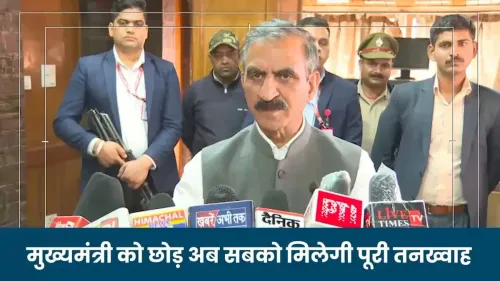
The Chief Minister's Office of Himachal Pradesh announced on Sunday, June 7, 2026 that the state government has withdrawn the salary deferral order that had been imposed on senior officials and elected representatives, citing improved financial stability as the basis for the decision.
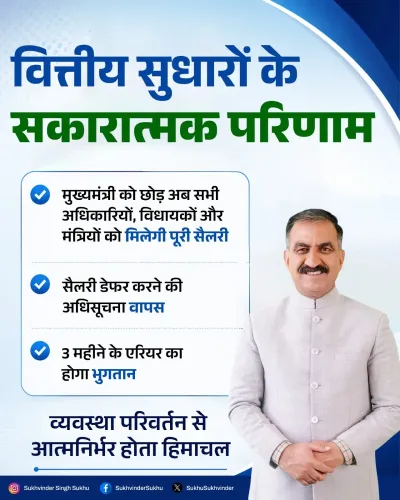
The post, shared from the official CMO handle, states: 'isi vittiya sudriddhata ka parinam hai ki...' ('It is the result of this very financial consolidation that the decision to impose salary deferral on the Chief Secretary, Additional Chief Secretary, Deputy Commissioners, MLAs and Ministers has been withdrawn.')
Context
The salary deferral had been put in place as a temporary austerity measure after the Congress government under Chief Minister Sukhvinder Singh Sukhu took office in December 2022 following the party's victory in the Himachal Pradesh assembly elections. A review of state finances at the time prompted the administration to defer salaries and allowances for ministers, MLAs, and top-tier civil servants including the Chief Secretary and Additional Chief Secretary.
The move was intended as a short-term signal of fiscal discipline amid elevated expenditure commitments and relatively high public debt levels that have historically characterised Himachal Pradesh's finances, which are shaped by hydropower revenues, tourism, and horticulture receipts.
Policy Backdrop
Salary and dearness-allowance deferrals imposed on elected representatives and senior civil servants are a recognised fiscal tool used by Indian states during periods of revenue stress. Such measures are typically reversed once own-tax revenues stabilise, central transfers improve, or committed expenditure spikes ease.
The CMO's framing — attributing the reversal explicitly to 'vittiya sudriddhata' (financial consolidation) — positions the rollback as a positive milestone rather than a routine administrative step. The government has not, in this post, cited specific fiscal indicators to substantiate the claim of improved finances.
Stakeholders and Impact
The withdrawal directly benefits Chief Secretary-level officers, Additional Chief Secretaries, Deputy Commissioners, state cabinet ministers, and Members of the Legislative Assembly who had been receiving deferred compensation. For serving MLAs and ministers, the restoration means full salary disbursement resumes without further deferral.
For the broader bureaucracy, the signal is significant: the state's top administrative cadre had been operating under a formal pay-hold order, and its removal may ease recruitment and retention pressures at senior levels in a state that competes with better-resourced neighbours for experienced IAS-cadre officers.
What's Next
Observers will watch the next state budget speech and quarterly finance accounts to assess whether the reversal is accompanied by parallel restoration of deferred dearness allowance instalments or new pay commission arrears for the wider state government workforce. Any such announcements would test whether the claimed financial consolidation is broad-based or limited to the topmost pay grades. The government's ability to sustain full salary disbursements without fresh borrowing will be a key indicator of the fiscal health it has publicly claimed.
Point of View
Positioning the Sukhu government's fiscal stewardship in a positive light ahead of any upcoming budget cycle. However, the absence of hard fiscal data — deficit figures, revenue growth numbers, or debt-to-GSDP ratios — in the announcement leaves the claim unverifiable from the post alone. Indian states have a pattern of reversing such austerity signals once immediate fiscal pressure eases, without necessarily resolving the structural deficits that prompted them. The real test for Himachal Pradesh will be whether this rollback is the first in a series of broader pay restorations, or a targeted move confined to the most visible tier of government employees.
NationPress
21 Oct 2026
Frequently Asked Questions
Why did Himachal Pradesh impose a salary deferral on ministers and MLAs?
The salary deferral was introduced as a temporary austerity measure after the Congress government took office in December 2022, following a review of the state's finances that revealed elevated expenditure commitments and high public debt levels.
Who was affected by the Himachal Pradesh salary deferral order?
The deferral applied to the Chief Secretary, Additional Chief Secretary, Deputy Commissioners, state cabinet ministers and Members of the Legislative Assembly (MLAs).
Why has Himachal Pradesh withdrawn the salary deferral in 2026?
The Chief Minister's Office stated that improved financial consolidation — referred to as 'vittiya sudriddhata' — made it possible to withdraw the deferral, though specific fiscal indicators were not cited in the announcement.
What does salary deferral mean for government officials?
A salary deferral means that a portion of an official's or representative's salary is withheld temporarily and is expected to be paid at a later date, rather than being cut permanently.
What should we watch after Himachal Pradesh reverses the salary deferral?
Key indicators to watch include the next state budget speech, quarterly finance accounts, and any announcements on deferred dearness allowance or pay commission arrears for the wider state government workforce.