HP CM Office Reveals Salary Deferral to Ease Fiscal Stress
Synopsis
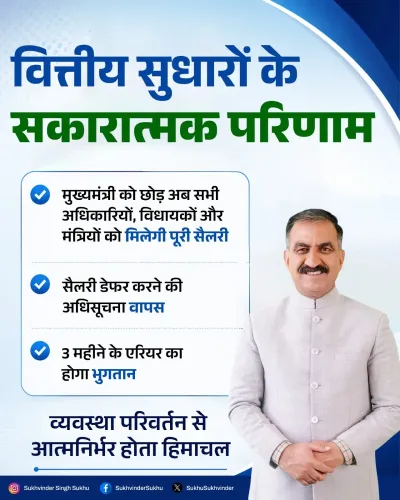
The Chief Minister's Office of Himachal Pradesh announced that the CM deferred 50% of his salary, ministers 30%, and MLAs with administrative officers 20%, as a collective step to ease the state's fiscal stress.
Key Takeaways
The Chief Minister's Office of Himachal Pradesh disclosed a collective salary deferral across the state's political and administrative leadership.
The Chief Minister deferred 50 per cent of his salary, the highest share in the tiered structure.
Cabinet ministers deferred 30 per cent and MLAs along with administrative officers deferred 20 per cent of their salaries.
The measure was described as a collective decision aimed at helping the state overcome economic challenges.
The duration of the deferral and the status of arrear restoration were not specified in the announcement.
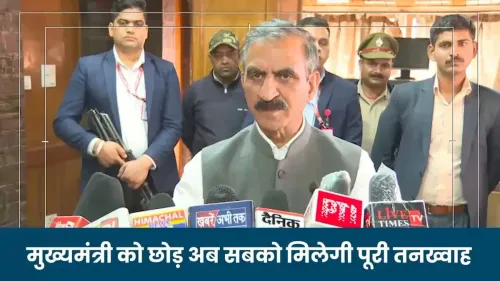
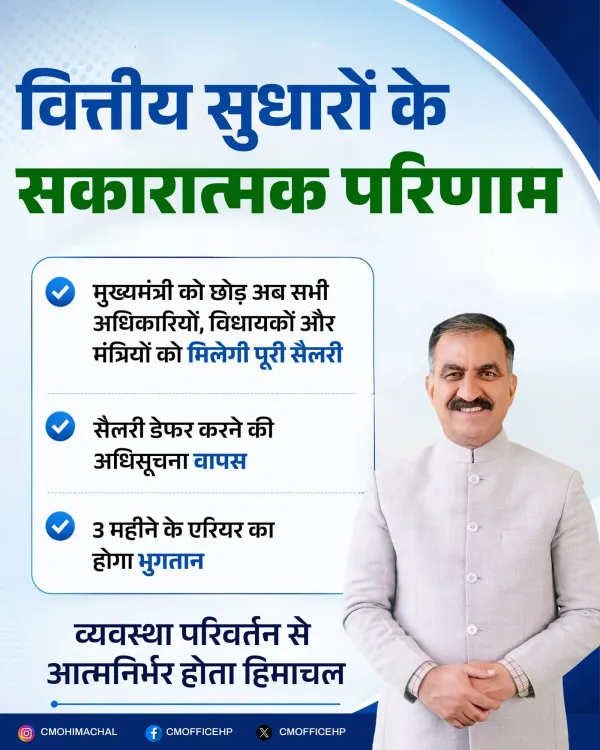
The Chief Minister's Office of Himachal Pradesh disclosed on Wednesday, June 10, 2026 that the state government had collectively deferred a portion of salaries of elected representatives and senior officials as a measure to address the state's economic challenges. The announcement, made via the official CMO account on X, outlined a tiered deferral structure across the executive and legislative branches.
Context
The post states, in translation: 'हिमाचल प्रदेश को आर्थिक चुनौतियों से उबारने के लिए हमने एक सामूहिक निर्णय लिया था' ('We had taken a collective decision to rescue Himachal Pradesh from economic challenges'). Under the arrangement, the Chief Minister deferred 50 per cent of his own salary, Cabinet ministers deferred 30 per cent, and MLAs along with administrative officers deferred 20 per cent, each for an unspecified period.
The CMO described the step as a 'सामूहिक निर्णय' (collective decision), framing it as a shared sacrifice across the political and administrative establishment rather than an individual gesture.
Policy Backdrop
Himachal Pradesh is a Himalayan state whose revenues depend heavily on tourism, horticulture, and hydropower. The state has carried a high public debt burden relative to its revenue base for several years, creating persistent pressure on its ability to fund welfare commitments and capital expenditure simultaneously.
Voluntary salary deferrals by elected representatives during periods of fiscal stress are not without precedent in India. Several state governments have at various points signalled fiscal restraint through such measures, typically accompanying broader efforts to rationalise expenditure without cutting frontline services.
Stakeholders and Impact
The deferral directly involved the Chief Minister, all Cabinet ministers, members of the state legislative assembly, and senior administrative officers — effectively the entire upper tier of Himachal Pradesh's governance machinery. By design, the burden was graduated, with the highest sacrifice at the top of the political hierarchy.
For Himachal Pradesh taxpayers, the move carries symbolic weight: it signals that those in power were willing to share the fiscal pain they were asking the broader public administration to absorb. The practical fiscal saving, while meaningful at the margin, would depend on the number of officials involved and the duration of the deferral.
What's Next
The post does not specify whether the deferred salaries have since been restored or remain outstanding, leaving open the question of how the government intends to settle these arrears. The next Himachal Pradesh state budget or economic survey is expected to shed light on fiscal outcomes and the status of emolument restoration.
Observers will watch whether this disclosure is part of a wider accounting of the state's fiscal consolidation steps, or a precursor to fresh austerity measures as the government navigates its debt obligations.
Point of View
Designed to demonstrate that the ruling establishment is not insulated from the austerity it imposes. For a state like Himachal Pradesh, where high debt servicing costs squeeze development spending, such gestures help maintain public legitimacy for harder budget choices. The tiered structure, with the Chief Minister absorbing the steepest cut, follows a logic of proportional sacrifice that is politically easier to defend than flat-rate measures. Whether this translates into durable fiscal improvement will depend on structural revenue and expenditure reforms that go well beyond symbolic salary actions.
NationPress
13 Sept 2026
Frequently Asked Questions
Why did the Himachal Pradesh government defer salaries of its officials?
The Himachal Pradesh government deferred a portion of salaries of the Chief Minister, ministers, MLAs, and administrative officers to help the state manage its economic challenges and signal fiscal restraint during a period of revenue pressure.
By how much was the Himachal Pradesh Chief Minister's salary deferred?
The Chief Minister deferred 50 per cent of his salary, the highest share under the tiered arrangement announced by the CMO.
What percentage of salary did Himachal Pradesh ministers and MLAs defer?
Cabinet ministers deferred 30 per cent of their salaries, while MLAs and administrative officers deferred 20 per cent, according to the CMO's announcement.
Is salary deferral by politicians common in India during fiscal crises?
Yes, several Indian state governments have implemented voluntary salary deferrals by elected representatives and senior officials during periods of fiscal stress as a signal of austerity and shared sacrifice.
Will the deferred salaries of Himachal Pradesh officials be paid back?
The CMO's announcement did not specify whether the deferred salaries have been restored or when they will be settled; further details are expected in the state's upcoming budget or economic survey.