HP CM Office Opens 40-Bed De-Addiction Centre at Tanda
Synopsis
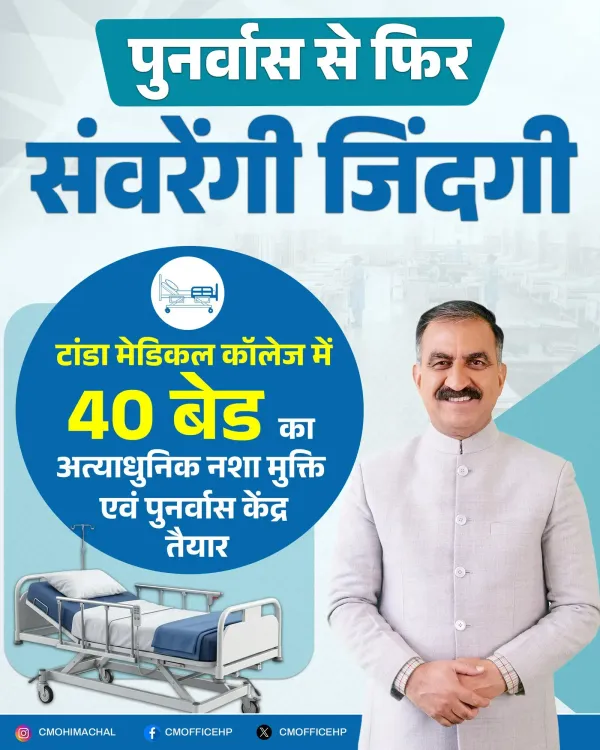
The Himachal Pradesh government has set up a 40-bed de-addiction and rehabilitation centre at Tanda Medical College in Kangra, offering specialist medical care to residents battling substance abuse and aiming to reintegrate them into mainstream society.
Key Takeaways
The Himachal Pradesh government has established a 40-bed de-addiction and rehabilitation centre at Dr.
Rajendra Prasad Government Medical College, Tanda in Kangra district.
The facility offers advanced medical infrastructure and expert specialist care for people with substance use disorders.
The centre is embedded within an existing tertiary-care teaching hospital — consistent with a broader national pattern of integrating de-addiction services into government medical colleges.
The initiative aligns with the Central government's Nasha Mukt Bharat Abhiyan , launched in 2020 , which provides states with funding and guidelines for such centres.
Key indicators to watch include patient intake data, operational handover details, and potential expansion to other districts in Himachal Pradesh.
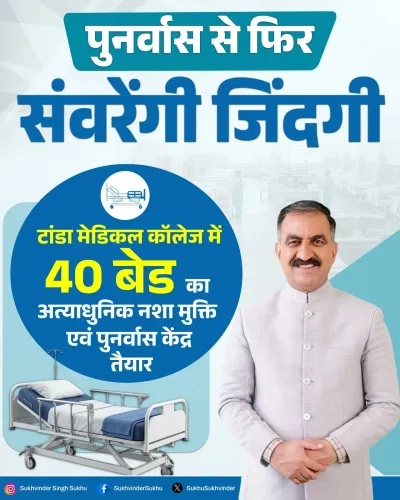
A state that has long grappled with rising substance abuse now has a dedicated frontline: the Himachal Pradesh government has commissioned a 40-bed state-of-the-art de-addiction and rehabilitation centre inside Tanda Medical College in Kangra district, promising specialist care and a structured path back to mainstream life for those battling addiction.
The Chief Minister's Office of Himachal Pradesh announced the facility on Wednesday, 11 November 2026, posting on X that the centre had been prepared to 'give a better future to those trapped in the grip of addiction' — nasha mukt (addiction-free) being an increasingly urgent goal for the hill state's public health agenda.
What the Tanda facility offers
Housed within Dr. Rajendra Prasad Government Medical College, Tanda — the region's principal tertiary-care institution — the new unit brings advanced medical infrastructure and expert supervision under a single roof. By embedding the rehabilitation centre inside an existing medical college rather than building a standalone facility, the state follows a model gaining traction across Indian states: leveraging already-staffed teaching hospitals to deliver specialised psychiatric and de-addiction care more efficiently.
The centre is designed not merely for detoxification but for full rehabilitation — meaning patients move through medically supervised withdrawal into counselling and social reintegration support, with the explicit aim of reconnecting them to mainstream society.
Himachal's substance abuse challenge and the national frame
Himachal Pradesh sits at a geographic and social crossroads that has made drug dependency a persistent public health concern, particularly among young men in the Kangra, Mandi, and Kullu belts. The state's response fits within the Nasha Mukt Bharat Abhiyan, the Central government's 2020 national programme that funds and guides states in building exactly this kind of infrastructure — dedicated de-addiction beds in government hospitals, backed by trained clinicians.
Until now, families from Kangra and surrounding districts often had to travel to Shimla or seek expensive private treatment. A 40-bed facility at Tanda — the most accessible tertiary hospital for the lower-Himalayan belt — changes that calculus considerably.
Beds as a yardstick, operations as the real test
Forty beds is a meaningful number for a government facility in a mid-sized hill district, but the true measure will be in occupancy rates, patient outcomes, and whether the state follows through with similar centres in other districts. The post signals ambition; the proof will be in the first intake figures and budget allocations that follow.
For the families who have watched loved ones cycle through crisis without institutional support, Tanda Medical College now carries a new responsibility — and a real chance to deliver on it.
Point of View
The Himachal Pradesh government is making a pragmatic institutional bet — specialist care embedded in a teaching hospital is cheaper to staff and faster to operationalise. The move fits a post-2020 national arc where the Nasha Mukt Bharat Abhiyan has pushed states to convert promise into beds. For the Congress-led state administration, announcing visible health infrastructure in Kangra — a district the BJP has historically dominated — also carries quiet political geometry. The harder test arrives when the first intake data emerge: a well-announced centre that runs at low capacity would undercut the narrative considerably.
NationPress
11 Nov 2026
Frequently Asked Questions
Where is the new de-addiction centre in Himachal Pradesh located?
The 40-bed de-addiction and rehabilitation centre is located at Dr. Rajendra Prasad Government Medical College (commonly called Tanda Medical College) in Kangra district, Himachal Pradesh.
How many beds does the Tanda de-addiction centre have?
The newly established centre has 40 beds and is designed to provide both medical detoxification and full rehabilitation services.
What is the Nasha Mukt Bharat Abhiyan?
The Nasha Mukt Bharat Abhiyan is a Central government programme launched in 2020 to fund and guide Indian states in setting up de-addiction and rehabilitation infrastructure, including dedicated beds in government hospitals.
Who announced the Tanda Medical College de-addiction centre?
The Chief Minister's Office of Himachal Pradesh announced the facility on 11 November 2026 via an official post on X, stating it was prepared to give people trapped in addiction a better future.
Will Himachal Pradesh open more de-addiction centres in other districts?
The government has not yet made a formal announcement on expansion; policy watchers are monitoring future state budget allocations for any similar centres in other Himachal Pradesh districts.