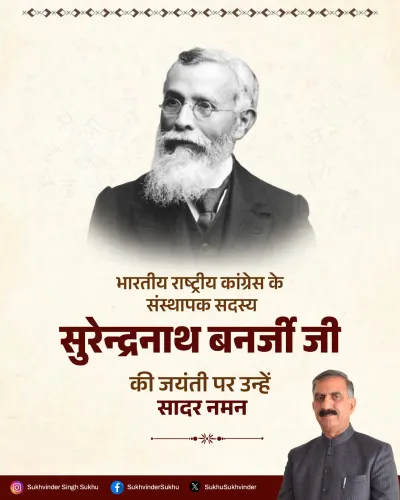
HP CM Office pays tribute to Surendranath Banerjee on birth anniversary
Synopsis
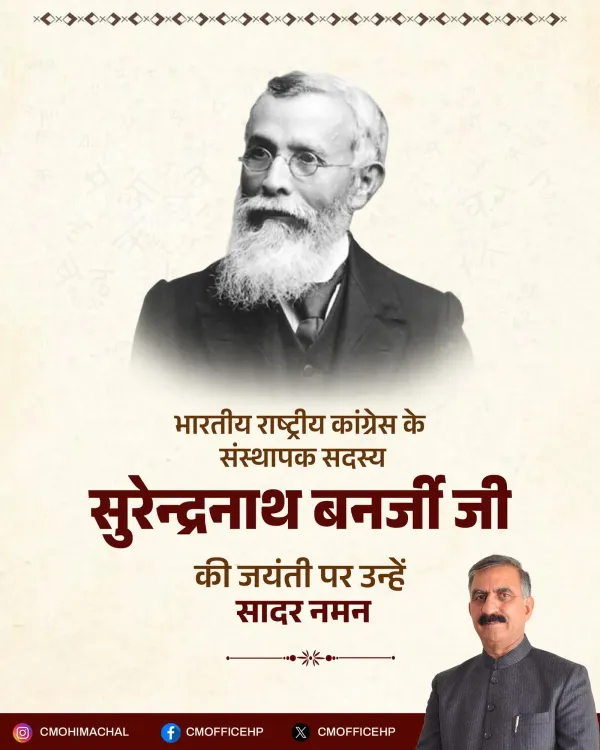
The Chief Minister's Office of Himachal Pradesh honoured Surendranath Banerjee, a founding member of the Indian National Congress born in 1848, on his birth anniversary on November 10, 2026, citing his work in spreading national consciousness and advocating constitutional reforms under British rule.
Key Takeaways
The Chief Minister's Office of Himachal Pradesh posted a tribute to Surendranath Banerjee on November 10, 2026 , his birth anniversary.
Surendranath Banerjee was born in 1848 and was a founding member of the Indian National Congress , established in 1885 .
He also founded the Indian National Association , a precursor to the Congress, and served in the Imperial Legislative Council .
The tribute highlighted three contributions: spreading national consciousness, strengthening the demand for self-governance, and advocating constitutional reforms.
Banerjee was a moderate nationalist who favoured constitutional methods over armed resistance.
Official state government tributes to pre-independence figures are a consistent practice across Indian state governments.
A founding voice of India's constitutional nationalism turns 178 today — and the Chief Minister's Office of Himachal Pradesh marked the occasion on Tuesday, November 10, 2026, with a respectful tribute to Surendranath Banerjee, one of the earliest architects of organised political resistance against British rule.
The post, shared in Hindi, reads: 'Bharatiya Rashtriya Congress ke sansthapak sadasy Shri Surendranath Banerjee ji ki jayanti par unhe sadar naman' — 'On the birth anniversary of founding member of the Indian National Congress, Shri Surendranath Banerjee, we offer our respectful salutations.' The office specifically acknowledged his three defining contributions: spreading national consciousness across the country, strengthening the demand for self-governance, and raising his voice for constitutional reforms.
Who was Surendranath Banerjee — and why he still matters
Surendranath Banerjee was born in 1848 and became one of the most consequential moderate nationalists of colonial India. Before the Indian National Congress was formally founded in 1885, he had already established the Indian National Association — an earlier platform for organised political agitation that set the template for what the Congress would become. He served in the Imperial Legislative Council and believed, with conviction, that petitions, public speeches, and constitutional pressure — not armed revolt — were the instruments of lasting change.
That faith in institutions made him a polarising figure in later years, as more radical voices grew impatient with the pace of reform. Yet his contribution to building a civic political consciousness among educated Indians in the late nineteenth century is considered foundational by historians of the independence movement.
Official remembrance as a steady state practice
The Himachal Pradesh government's tribute fits a well-established pattern in Indian public life: state governments and official handles consistently mark the birth anniversaries of pre-independence leaders, treating remembrance as an act of institutional continuity. For moderate Congress-era figures like Banerjee — who championed dialogue and due process over confrontation — these tributes also carry a quiet ideological signal about the value of constitutional methods in public life.
That signal resonates today, when the tension between institutional processes and direct political action remains a live debate in Indian democracy. Banerjee championed the idea that governance must be earned through argument, not seized through agitation alone. That is a proposition worth revisiting on his anniversary.
Point of View
Invoking a founding INC figure also serves a lineage claim, connecting the present party to its nineteenth-century roots. What is notable about Banerjee specifically is that his legacy complicates easy political ownership: a man who built the Congress but later broke with its more assertive wing, he represents the enduring tension between gradualism and urgency in Indian politics. That tension has never fully resolved — and his anniversary is a good moment to acknowledge it.
NationPress
10 Nov 2026
Frequently Asked Questions
Who was Surendranath Banerjee?
Surendranath Banerjee was a founding member of the Indian National Congress, born in 1848. He was a moderate nationalist who established the Indian National Association before the Congress was founded in 1885, and served in the Imperial Legislative Council, advocating constitutional reforms and self-governance.
When is Surendranath Banerjee's birth anniversary?
Surendranath Banerjee's birth anniversary falls on November 10. In 2026, the Chief Minister's Office of Himachal Pradesh marked the occasion with an official tribute on X.
What was Surendranath Banerjee's role in the Indian National Congress?
Surendranath Banerjee was among the founding members of the Indian National Congress when it was established in 1885. He was one of the earliest leaders who pushed for expanded Indian representation in governance through constitutional and peaceful means.
Why did Himachal Pradesh CM Office pay tribute to Surendranath Banerjee?
The Himachal Pradesh Chief Minister's Office posted the tribute on the occasion of Surendranath Banerjee's birth anniversary on November 10, 2026, acknowledging his contributions to national consciousness, the demand for self-governance, and constitutional reforms during the independence movement.
What is the Indian National Association founded by Surendranath Banerjee?
The Indian National Association was an early political organisation founded by Surendranath Banerjee before the Indian National Congress came into existence in 1885. It was one of the first platforms for organised political agitation among Indians under British rule.