Karnataka CM's Office Celebrates Folk Arts as State's Cultural Soul
Synopsis
The Chief Minister's Office of Karnataka celebrated Yakshagana, Dollu Kunitha, and Kamsale on 10 November 2026, calling these indigenous folk art forms the living breath and pride of Karnataka's rich cultural heritage.
Key Takeaways
The Chief Minister's Office of Karnataka posted on 10 November 2026 honouring the state's folk art traditions.
Yakshagana , a coastal theatrical tradition, Dollu Kunitha , a Kuruba community drum dance, and Kamsale , a devotional cymbal dance, were specifically named.
The post described folk arts as the 'breath' ( usiru ) and symbol of pride of Karnataka's culture.
The three art forms represent Karnataka's coastal, Deccan plateau, and southern forest-belt communities respectively.
The official language framing positions these traditions as living heritage rather than archived historical relics.
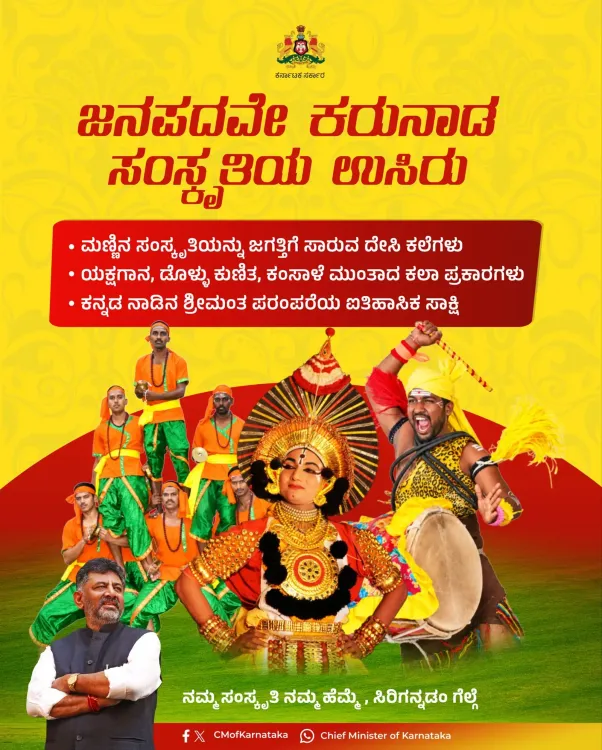
Every grain of Karnataka's red earth carries the pulse of its people — and on Tuesday, 10 November 2026, the Chief Minister's Office of Karnataka made that truth public, honouring the state's living folk traditions in a heartfelt post that placed art forms like Yakshagana, Dollu Kunitha, and Kamsale at the very centre of Karnataka's cultural identity.
The post, written in Kannada, declared: 'ಕರುನಾಡಿನ ಮಣ್ಣಿನ ಕಣಕಣದಲ್ಲೂ ನಮ್ಮ ಜನಪದರ ಜೀವಂತಿಕೆ ಅಡಗಿದೆ' — 'In every particle of Karnataka's soil lies the vitality of our folk people.' It went on to call these distinct indigenous art forms 'historical witnesses to our rich heritage' and 'the breath and symbol of pride of Karnataka's culture.'
Yakshagana, Dollu Kunitha, Kamsale: What These Art Forms Mean to Karnataka
Yakshagana is a centuries-old theatrical tradition from the coastal and Malnad regions of Karnataka, blending elaborate costumes, percussion-driven music, dance, and storytelling rooted in Hindu epics. It is widely regarded as one of South India's most sophisticated living performance arts. Dollu Kunitha is a vigorous drum dance form originating with the Kuruba community, performers playing large cylindrical drums while executing coordinated choreography — a spectacle of rhythm and collective energy. Kamsale, closely tied to devotees of Lord Mahadeshwara, features performers dancing with cymbals in a trance-like devotional style, most prominently practised in the Mysuru and Chamarajanagara districts.
Together, these three traditions represent Karnataka's geographic and community diversity — the coast, the shepherd communities of the Deccan plateau, and the forest-belt pilgrimage culture of the south. That the CMO chose to name all three in a single breath is itself a statement about inclusive cultural ownership.
Folk Arts as Living Heritage, Not Museum Pieces
The post's framing is deliberate and significant. By describing folk arts as the 'usiru' (breath) of Karnataka's culture, the CMO's language resists the tendency to treat these traditions as archival curiosities. They are positioned instead as ongoing, vital expressions of community life. This framing aligns with broader national and global conversations about intangible cultural heritage — the idea that a civilisation's most fragile assets are not monuments but living practices passed between generations.
Karnataka has historically been a pioneer in state-level support for folk and classical arts, with institutions dedicated to Yakshagana documentation and Dollu Kunitha training. Posts like this, amplified through official government channels, serve a dual function: affirming the dignity of practitioner communities and signalling that cultural patronage remains a governance priority.
When a government speaks the language of its soil, it reminds every artist still practising in a coastal village or a shepherd hamlet that their work is not forgotten — it is, in fact, the state's own heartbeat.
Point of View
Dollu Kunitha, and Kamsale by name, the Karnataka CMO's post does more than offer ceremonial praise — it signals a continued state commitment to intangible cultural heritage at a time when folk practitioners increasingly compete with digital entertainment for audiences and patronage. The choice of Kannada as the language of the post reinforces a Kannada-pride political register that successive Karnataka governments have leaned on. Globally, governments that publicly champion living folk traditions tend to do so as a soft-power exercise as much as a cultural one, and Karnataka's internationally recognised art forms — particularly Yakshagana — carry real tourism and diaspora-identity value. The real test, as always, will be whether symbolic affirmation translates into funded institutions, artist welfare schemes, and documentation programmes.
NationPress
10 Nov 2026
Frequently Asked Questions
What is Yakshagana and where is it performed in Karnataka?
Yakshagana is a centuries-old theatrical performance tradition from Karnataka's coastal and Malnad regions, combining elaborate costumes, percussion music, dance, and storytelling drawn from Hindu epics. It is most prominent in districts like Udupi, Dakshina Kannada, and Uttara Kannada.
What is Dollu Kunitha?
Dollu Kunitha is a vigorous folk drum-dance form originating with the Kuruba shepherd community of Karnataka. Performers play large cylindrical drums while executing coordinated group choreography, making it one of the most energetic folk art forms of the Deccan plateau region.
What is Kamsale dance in Karnataka?
Kamsale is a devotional dance form practised by followers of Lord Mahadeshwara, primarily in Karnataka's Mysuru and Chamarajanagara districts. Performers dance with cymbals in a trance-like state as an act of devotion, and the tradition is closely tied to the Mahadeshwara Hills pilgrimage culture.
Why did the Karnataka CMO post about folk arts?
The Chief Minister's Office of Karnataka posted on 10 November 2026 to honour the state's indigenous folk art traditions, describing them as the living breath and historical witnesses of Karnataka's rich cultural heritage.
What does 'Karunadu' mean in Kannada?
'Karunadu' — written as ಕರುನಾಡು in Kannada — is an affectionate traditional name for Karnataka, meaning roughly 'the beloved land' or 'the land of grace', widely used in Kannada literature, folk songs, and political discourse to evoke pride in the state's identity.