HP CM Office: Rajiv Gandhi Startup Scheme Backs Solar, EV Youth
Synopsis
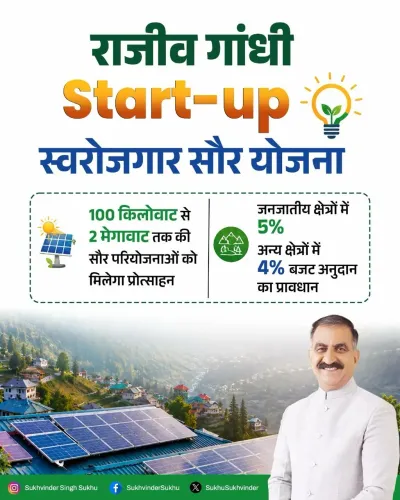
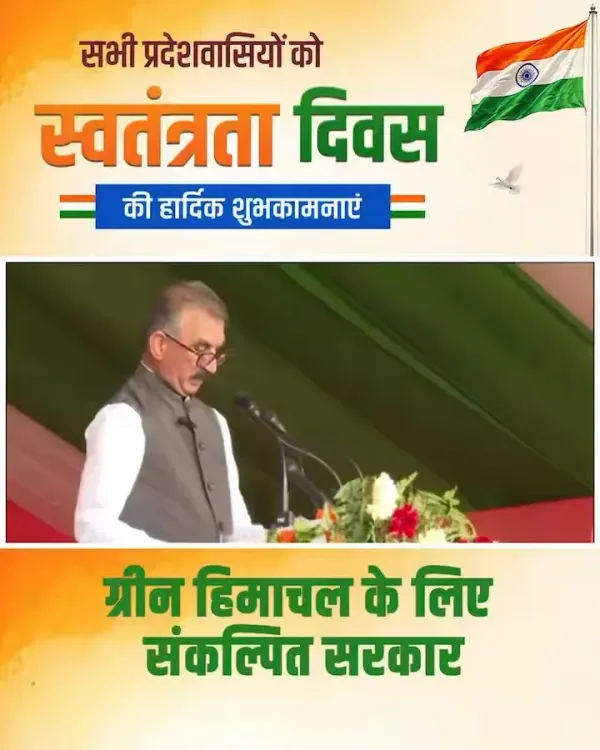
The Chief Minister's Office of Himachal Pradesh announced on Independence Day 2026 that the Rajiv Gandhi Startup Scheme provides interest subsidies on loans to help young entrepreneurs enter solar energy and electric transport, linking green transition with youth self-employment in the hill state.
Key Takeaways
The Rajiv Gandhi Startup Scheme targets youth self-employment in solar energy and electric transport in Himachal Pradesh .
The scheme provides interest subsidy on loans taken by young entrepreneurs in these sectors.
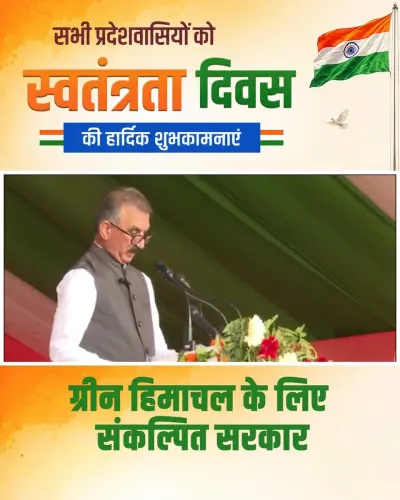
The announcement was made on Independence Day, 15 August 2026 , by the Chief Minister's Office of Himachal Pradesh .
The initiative aligns with India's national target of 500 GW non-fossil fuel capacity by 2030 and the country's electric vehicle push.
Specific subsidy rates, beneficiary numbers, and operational guidelines have not yet been officially published.
On Independence Day, 15 August 2026, the Chief Minister's Office of Himachal Pradesh spotlighted a state initiative that bets on two of India's fastest-growing sectors to solve one of its oldest problems — youth unemployment. Through the Rajiv Gandhi Startup Scheme, the Himachal Pradesh government is offering interest subsidies on loans to young entrepreneurs entering solar energy and electric transport, turning green transition into a livelihood engine for the hills.
The post, in Hindi, states: 'Rajiv Gandhi Startup Yojana ke madhyam se hum Himachal ke yuvaon ko saur urja aur electric parivahan ke kshetra mein swarozgar ke avsar uplabdh karva rahe hain.' — 'Through the Rajiv Gandhi Startup Scheme, we are providing self-employment opportunities to the youth of Himachal in the fields of solar energy and electric transport, with a provision for interest subsidy on loans taken by them.'
A green ladder for hill-state entrepreneurs
The interest subsidy model is a well-worn but effective state-level instrument: by absorbing a portion of borrowing costs, governments lower the risk threshold for first-generation entrepreneurs who lack collateral or credit history. In Himachal Pradesh, where terrain limits traditional industrial expansion, solar installations and electric vehicle services represent sectors where small-scale, distributed ownership is genuinely viable.
Indian states have increasingly tied startup support to green transition goals — aligning with the national target of 500 GW of non-fossil fuel capacity by 2030 and the central government's electric vehicle adoption push. Himachal Pradesh's own renewable energy policy, updated through the 2010s, has emphasised solar capacity alongside its dominant hydropower base. The Rajiv Gandhi Startup Scheme appears to channel that state-level commitment down to the individual entrepreneur.
Why solar and electric transport, specifically
Both sectors share a structural advantage for a hill state: solar micro-installations can power remote households and small businesses off the grid, while electric vehicles — particularly two- and three-wheelers — are increasingly cost-competitive on mountain roads where fuel logistics are expensive. Seeding youth enterprises in these niches creates local service capacity that the state would otherwise have to import.
The scheme also fits within the broader arc of national entrepreneurship policy, which has evolved since the Startup India initiative of 2016 — from generic incubation support to sector-specific, subsidy-linked instruments targeted at states' own economic priorities.
The numbers that will ultimately define this scheme's impact — beneficiary count, subsidy rates, budget outlay — are yet to be officially published. What the Independence Day announcement makes clear is the political direction: Himachal Pradesh is framing green entrepreneurship not as an environmental gesture, but as a jobs policy. That framing, if backed by accessible credit and robust implementation, could set a template other hill states watch closely.
Point of View
A pairing that is becoming a common playbook across Indian states. By anchoring the scheme to interest subsidies rather than direct grants, the government places a calculated bet on credit-led entrepreneurship, which is more scalable but also more dependent on banking infrastructure reaching young, first-generation borrowers in the hills. The Independence Day timing signals that the ruling dispensation wants this framed as a legacy commitment, not a budget line item. Whether the scheme delivers will hinge on the subsidy rates and outreach mechanisms that are yet to be made public.
NationPress
15 Aug 2026
Frequently Asked Questions
What is the Rajiv Gandhi Startup Scheme in Himachal Pradesh?
The Rajiv Gandhi Startup Scheme is a Himachal Pradesh government initiative that provides interest subsidies on loans to young entrepreneurs seeking self-employment in solar energy and electric transport sectors.
Who can benefit from the Rajiv Gandhi Startup Scheme?
The scheme targets youth in Himachal Pradesh who wish to start ventures in solar energy or electric transport and need loan financing to do so.
What kind of financial support does the scheme offer?
The scheme offers interest subsidy on loans taken by young entrepreneurs, reducing their borrowing costs and lowering the barrier to entry for new businesses in green sectors.
How does this scheme connect to national green energy goals?
It aligns with India's target of 500 GW of non-fossil fuel capacity by 2030 and the national push for electric vehicle adoption, channelling those goals into state-level entrepreneurship support.
When was the Rajiv Gandhi Startup Scheme announced?
The Chief Minister's Office of Himachal Pradesh highlighted the scheme on Independence Day, 15 August 2026, though the scheme itself was established as an ongoing state initiative.