CM Sukhu Launches Solar Startup Scheme for HP Youth
Synopsis
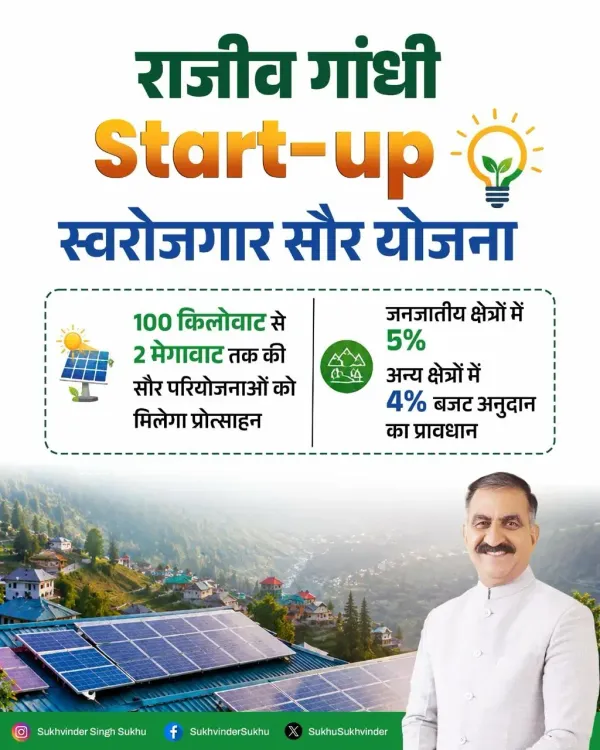
Himachal Pradesh CM Sukhvinder Singh Sukhu has announced the Rajiv Gandhi Start-up Swarozgar Solar Energy Yojana, offering 5% interest subsidy in tribal areas and 4% in non-tribal areas for solar projects of 100 kW to 2 MW, targeting youth entrepreneurs in the clean-energy sector.
Key Takeaways
CM Sukhvinder Singh Sukhu announced the Rajiv Gandhi Start-up Swarozgar Solar Energy Yojana on 30 May 2026 .
The scheme covers solar projects ranging from 100 kilowatts to 2 megawatts in capacity.
An interest subsidy of 5 per cent will be provided in tribal areas and 4 per cent in non-tribal areas.
Tribal regions such as Kinnaur and Lahaul-Spiti receive the higher subsidy tier to offset geographic disadvantages.
The scheme aims to encourage Himachal Pradesh's youth to establish enterprises in the clean-energy sector.
Operational guidelines and project sanction details are expected from HIMURJA in the coming weeks.
Himachal Pradesh Chief Minister Sukhvinder Singh Sukhu on Saturday, 30 May 2026, announced an interest-subsidy scheme under the Rajiv Gandhi Start-up Swarozgar Solar Energy Yojana to encourage young entrepreneurs to set up solar power ventures, offering differential subsidies for tribal and non-tribal regions of the state.
Context
Posting on X, CM Sukhu stated: 'हिमाचल के युवाओं में प्रतिभा और संकल्प की कोई कमी नहीं है' ('The youth of Himachal lack neither talent nor resolve'), adding that his government is continuously working to provide self-employment opportunities. Under the scheme, solar projects ranging from 100 kilowatts to 2 megawatts will be eligible for an interest subsidy of 5 per cent in tribal areas and 4 per cent in non-tribal areas.
The announcement targets aspiring entrepreneurs in the clean-energy sector, positioning solar project ownership as a viable livelihood option for the state's youth.
Policy Backdrop
Himachal Pradesh has a documented history of differentiated incentive structures between its tribal and non-tribal districts. Tribal regions — including Kinnaur, Lahaul-Spiti, and parts of Chamba and Mandi — have consistently received higher subsidy rates under state schemes to offset geographic and economic disadvantages.
The scheme's project-size window of 100 kW to 2 MW aligns with the medium-scale distributed solar segment that the central government has been promoting through programmes such as PM-KUSUM and the national rooftop solar initiative, both aimed at decentralising energy generation. Himachal Pradesh's New Renewable Energy Policy 2016 had earlier offered capital subsidies and single-window clearance for solar projects up to 5 MW, and the new scheme layers an interest-subsidy mechanism on top of that broader policy architecture.
The scheme is named after former Prime Minister Rajiv Gandhi, continuing a state tradition of attaching his name to technology, self-employment, and welfare initiatives.
Stakeholders and Impact
The primary beneficiaries are young entrepreneurs in Himachal Pradesh seeking to enter the renewable energy sector without the burden of high borrowing costs. By reducing the effective interest rate on project loans, the scheme lowers the financial barrier for first-generation solar developers who may lack collateral or credit history.
Tribal communities in Kinnaur and Lahaul-Spiti stand to gain disproportionately from the higher 5 per cent subsidy tier, which acknowledges the steeper logistical and infrastructure costs of operating in high-altitude, remote terrain. Solar project developers and the Himachal Pradesh Energy Development Agency (HIMURJA), the nodal body for renewable energy in the state, are also key stakeholders in the scheme's rollout.
What's Next
Detailed operational guidelines — including eligibility criteria, empanelled lending institutions, and application procedures — are expected to be issued by the state government in the coming weeks. Watchers of Himachal Pradesh's energy policy will track budget allocations for the scheme in the next legislative session and early project-sanction data from HIMURJA.
If uptake meets targets, the scheme could position Himachal Pradesh as a model for state-level, youth-focused renewable energy entrepreneurship — a template other hill states with similar solar potential may consider replicating.
Point of View
The Sukhu government signals fiscal sensitivity to Himachal's geographic inequities while staying within a medium-scale solar bracket that is easier to administer than large utility projects. Naming the scheme after Rajiv Gandhi reinforces the party's brand association with technology and modernisation, a deliberate symbolic choice. The scheme's real test will be implementation speed: interest subsidies are only effective if loan disbursals and project approvals move quickly enough to sustain entrepreneur confidence.
NationPress
14 Oct 2026
Frequently Asked Questions
What is the Rajiv Gandhi Start-up Swarozgar Solar Energy Yojana?
It is a Himachal Pradesh state scheme announced by CM Sukhvinder Singh Sukhu that provides interest subsidies on loans for solar power projects of 100 kW to 2 MW , aimed at encouraging youth entrepreneurs to enter the clean-energy sector.
How much interest subsidy is offered under the scheme?
The scheme offers 5 per cent interest subsidy for solar projects in tribal areas and 4 per cent for those in non-tribal areas of Himachal Pradesh .
Who is eligible for the Rajiv Gandhi Solar Startup scheme in Himachal Pradesh?
The scheme targets youth entrepreneurs in Himachal Pradesh who wish to set up solar power projects. Detailed eligibility criteria are yet to be issued by the state government through operational guidelines.
Why do tribal areas get a higher subsidy than non-tribal areas?
Himachal Pradesh's tribal districts such as Kinnaur and Lahaul-Spiti face higher logistical and infrastructure costs due to their remote, high-altitude terrain. The state has historically offered higher incentive rates in these areas to address geographic and economic disparities.
What is the project size covered under the Himachal Pradesh solar startup scheme?
The scheme covers solar energy projects with a capacity of 100 kilowatts to 2 megawatts , placing it in the medium-scale distributed solar segment aligned with central government programmes like PM-KUSUM .