Kishan Reddy Hails India-UK Trade Deal Entering Into Force
Synopsis
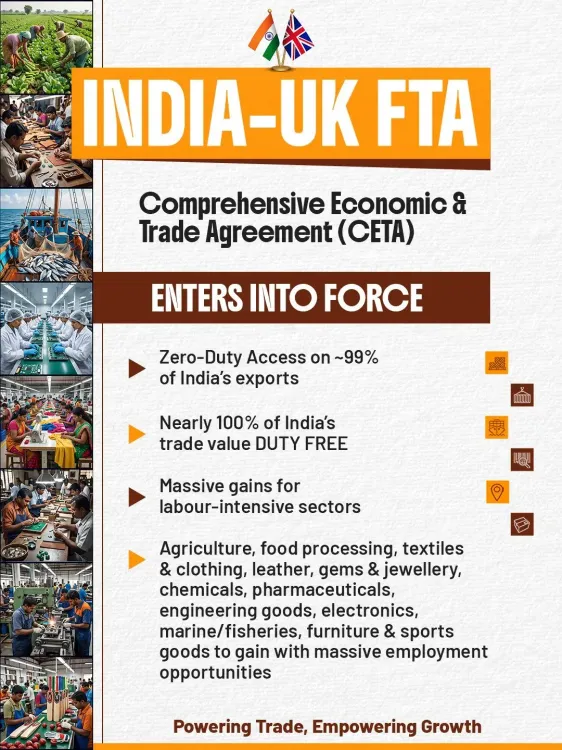
Union Coal and Mines Minister G. Kishan Reddy on 15 July 2026 announced the India-UK Comprehensive Economic and Trade Agreement has entered into force, eliminating tariffs on nearly 99 per cent of Indian tariff lines and covering almost 100 per cent of India's exports to the UK by trade value.
Key Takeaways
The India-UK Comprehensive Economic and Trade Agreement (CETA) entered into force as of 15 July 2026 , according to Union Minister G.
Tariffs are eliminated on nearly 99 per cent of Indian tariff lines , covering almost 100 per cent of India's exports to the UK by trade value.
The agreement is expected to benefit labour-intensive sectors including textiles, gems and jewellery, leather, and pharmaceuticals.
India-UK FTA negotiations were launched in January 2022 , following the UK's departure from the European Union in 2020 .
The deal is part of India's broader post-2020 FTA strategy that also includes agreements with Australia , the UAE , and the EFTA bloc .
Sectoral utilisation data and safeguard mechanisms will be closely monitored in the agreement's first operational years.
Union Coal and Mines Minister G. Kishan Reddy on Wednesday, 15 July 2026 welcomed the entry into force of the India-UK Comprehensive Economic and Trade Agreement (CETA), calling it a landmark step in India's global trade journey under Prime Minister Narendra Modi. The minister said the pact eliminates tariffs on nearly 99 per cent of Indian tariff lines, covering almost 100 per cent of India's exports to the United Kingdom by trade value.
Context
Reddy's post, shared under the hashtag #IndiaUKFTA, described the agreement as a move that will 'boost labour-intensive sectors, strengthen export competitiveness, and create new employment opportunities across the country.' The minister framed the deal as an expression of the government's 'Made in India' (Make in India) push, aimed at empowering Indian enterprise and expanding the country's footprint in global markets.
Policy Backdrop
India and the United Kingdom began exploring a bilateral free trade agreement in May 2021, shortly after the UK concluded its post-Brexit trade arrangement with the European Union. Formal negotiations were launched in January 2022, with the first negotiating round held in March 2022. The two sides worked through multiple rounds covering goods, services, investments, and intellectual property over the following years.
The India-UK deal fits within a broader pattern of trade diplomacy pursued by New Delhi since 2020. India has signed or activated agreements with partners including Australia — whose Economic Cooperation and Trade Agreement entered into force in December 2022 — as well as the UAE and the EFTA bloc. These agreements share a common design: reciprocal market access weighted toward labour-intensive Indian export sectors such as textiles, gems and jewellery, leather goods, and pharmaceuticals, while maintaining tariff protection on sensitive agricultural products.
The United Kingdom, which left the European Union in 2020, has been pursuing its own post-Brexit trade realignment, and India represents one of the world's fastest-growing large economies and a significant source of services exports and diaspora investment into Britain.
Stakeholders and Impact
The agreement's near-total tariff elimination on Indian export lines is expected to benefit sectors that employ large numbers of workers at the lower end of the skills spectrum. Textile manufacturers, leather goods producers, gem and jewellery exporters, and pharmaceutical companies are among the industries most likely to see improved market access into the UK. Indian exporters have historically faced tariff barriers that made their goods less competitive against suppliers from countries with preferential access to the British market.
UK importers and consumers stand to gain from a wider and potentially cheaper range of Indian goods. British businesses with supply-chain exposure to India may also benefit from more predictable rules governing investment and services trade. The agreement is seen as a signal of deepening strategic and economic ties between the two democracies.
What's Next
Analysts and trade bodies will closely watch sectoral utilisation data in the months following the agreement's activation to assess whether Indian exporters are in a position to take advantage of the improved access. Any review clauses or safeguard mechanisms built into the pact could be triggered if import surges affect sensitive domestic industries on either side. The government is expected to run outreach programmes for small and medium exporters to ensure awareness of the new tariff schedules and rules of origin requirements.
The India-UK CETA, if it delivers on the scale described by Minister Reddy, would represent one of the most significant trade agreements India has operationalised and could serve as a template for ongoing negotiations with other major economies.
Point of View
Which has deliberately targeted bilateral deals to compensate for stalled multilateral negotiations. Minister Kishan Reddy's statement — framing the deal as a 'Made in India' victory — reflects the BJP government's consistent effort to link trade liberalisation to domestic job creation and manufacturing competitiveness. The near-complete tariff elimination on Indian export lines is a notably ambitious outcome that, if borne out by trade flows, would validate India's strategy of pursuing deep-access agreements with high-income partners. The real test will be whether exporters, particularly in small and medium enterprises, can operationalise the new access before competitors from other preferential partners consolidate their positions in the UK market.
NationPress
15 Jul 2026
Frequently Asked Questions
What is the India-UK Comprehensive Economic and Trade Agreement?
The India-UK Comprehensive Economic and Trade Agreement (CETA) is a bilateral trade pact between India and the United Kingdom that eliminates tariffs on nearly 99 per cent of Indian tariff lines, covering almost 100 per cent of India's exports to the UK by trade value. Negotiations began formally in January 2022 following the UK's exit from the European Union.
When did the India-UK FTA enter into force?
According to Union Minister G. Kishan Reddy's post on 15 July 2026, the India-UK Comprehensive Economic and Trade Agreement entered into force on or around that date.
Which Indian sectors will benefit most from the India-UK trade deal?
Labour-intensive sectors such as textiles, gems and jewellery, leather goods, and pharmaceuticals are expected to benefit most from the agreement, as these industries will gain improved tariff-free access to the UK market.
What is G. Kishan Reddy's role in the India-UK FTA?
G. Kishan Reddy is India's Union Minister of Coal and Mines and BJP's Telangana state president. He welcomed the agreement's entry into force on social media, attributing the deal to the leadership of Prime Minister Narendra Modi.
How does the India-UK FTA compare to India's other trade agreements?
The India-UK CETA follows a similar template to India's agreement with Australia, which entered into force in December 2022, and deals with the UAE and EFTA bloc. All focus on reciprocal market access for Indian goods, particularly in labour-intensive manufacturing, while protecting sensitive agricultural sectors.