Kishan Reddy: Mining accidents down 70% under Modi govt
Synopsis
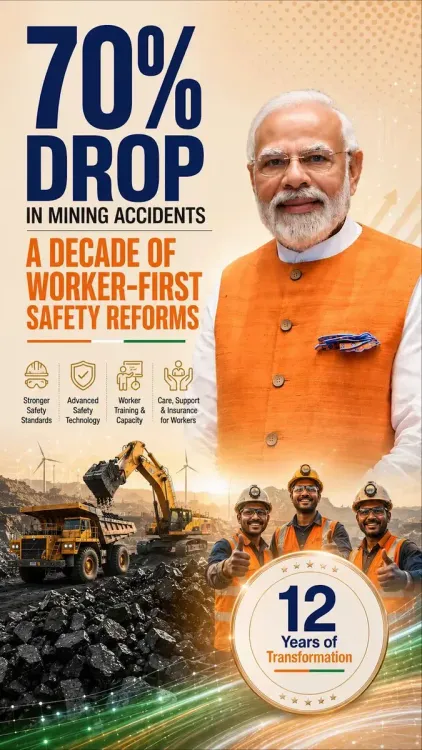
Union Coal and Mines Minister G. Kishan Reddy says the Modi government's zero-tolerance safety policy has driven a nearly 70 per cent drop in mining accidents over 12 years, backed by technology upgrades and expanded worker welfare under the PMKKKY and District Mineral Foundations.
Key Takeaways
Kishan Reddy says mining accidents have fallen by nearly 70 per cent over 12 years of the Modi government.
A 'zero-tolerance policy' backed by advanced technologies and modern safety systems is credited for the decline.
The Mines and Minerals (Development and Regulation) Amendment Act, 2015 and the Coal Mines (Special Provisions) Act, 2015 overhauled mineral governance through mandatory e-auctions.
The Pradhan Mantri Khanij Kshetra Kalyan Yojana (PMKKKY) , launched in 2015 , channels royalty funds into healthcare and welfare for mining-affected communities.
District Mineral Foundations have mobilised significant resources for local development across mining states.
The next DGMS annual report and potential MMDR Act amendments in Parliament will be key indicators of the sector's direction.
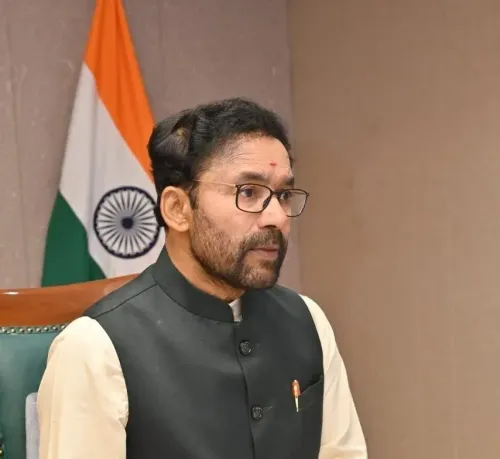
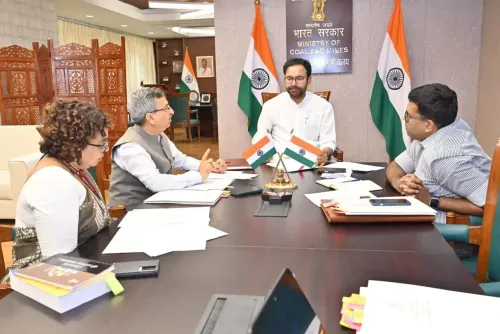
Union Coal and Mines Minister G. Kishan Reddy on Monday, 8 June 2026, highlighted a series of transformations in India's mining sector over the past 12 years under the Narendra Modi government, citing a nearly 70 per cent reduction in mining accidents and expanded welfare measures for workers.
Context
In a post on X, the minister stated that a 'zero-tolerance policy towards accidents' had driven the sharp decline in mishaps, supported by 'advanced technologies and modern safety systems.' He also pointed to 'enhanced social security, healthcare, and welfare measures' as pillars of a safer and more dignified future for mining workers. The post tagged both the Ministry of Mines and the Ministry of Coal, signalling an integrated message across both portfolios he oversees.
The claim of a near-70 per cent fall in mining accidents over 12 years is a significant benchmark, though the precise statistical basis for this figure is yet to be independently corroborated through a publicly available official report.
Policy Backdrop
The governance overhaul in mining began with landmark legislative changes in 2015. The Mines and Minerals (Development and Regulation) Amendment Act, 2015 introduced mandatory auctions for mineral concessions and established District Mineral Foundations (DMFs) — ring-fenced funds channelling a share of royalties toward local welfare and development in mining-affected regions.
Simultaneously, the Coal Mines (Special Provisions) Act, 2015 enabled transparent e-auctions of coal blocks following the Supreme Court's 2014 cancellation of earlier allocations. The Pradhan Mantri Khanij Kshetra Kalyan Yojana (PMKKKY), launched in 2015, further directed DMF proceeds toward healthcare, education, and infrastructure in mining districts, directly benefiting affected communities and workers.
Together, these reforms represented a shift from discretionary allocation to rules-based, auction-driven governance, while embedding welfare obligations into the resource-extraction framework.
Stakeholders and Impact
Coal miners and workers in the non-coal mining sector — numbering in the hundreds of thousands across states such as Jharkhand, Odisha, Chhattisgarh, Rajasthan, and Telangana — are the primary beneficiaries of the safety and welfare push the minister describes. Improved accident statistics, if sustained, translate directly into fewer fatalities and injuries in one of the country's most hazardous occupational categories.
For mining companies and state governments, the combination of transparent auctions and mandatory welfare contributions has reshaped the economics of mineral extraction, linking production rights to community obligations. District Mineral Foundations have reportedly mobilised thousands of crore rupees for local development, though utilisation levels vary across states.
What's Next
The Directorate General of Mines Safety (DGMS) releases annual statistical reports on accident trends, and the next edition will be closely watched to assess whether the trajectory cited by the minister holds. Any fresh amendments to the MMDR Act that may be tabled in Parliament could further reshape the regulatory landscape for both safety enforcement and welfare financing.
As India pursues energy security and scales up critical mineral extraction for its clean-energy transition, balancing production targets with worker safety and community welfare will remain a defining challenge for the Ministry of Coal and the Ministry of Mines.
Point of View
Technological, and welfare interventions as a coherent policy arc rather than isolated measures. Anchoring the message around a striking safety statistic serves to humanise what is otherwise a technical regulatory story, making it politically resonant in mineral-rich states where the BJP is building or defending its base. The dual tagging of the Mines and Coal ministries underscores the minister's effort to project unified stewardship across two portfolios with distinct but overlapping worker constituencies. With Parliament's monsoon session approaching, such messaging may also be pre-emptive positioning ahead of scrutiny on mining fatality data or MMDR amendment proposals.
NationPress
23 Oct 2026
Frequently Asked Questions
How much have mining accidents reduced under the Modi government?
Union Minister G. Kishan Reddy has stated that mining accidents have fallen by nearly 70 per cent over the 12 years of the Modi government, attributed to a zero-tolerance safety policy and adoption of advanced technologies.
What is the Pradhan Mantri Khanij Kshetra Kalyan Yojana?
The Pradhan Mantri Khanij Kshetra Kalyan Yojana (PMKKKY) is a central government scheme launched in 2015 that directs a portion of mining royalties and District Mineral Foundation funds toward development, healthcare, and welfare in mining-affected districts.
What is the District Mineral Foundation in India?
The District Mineral Foundation (DMF) is a statutory body created under the MMDR Amendment Act 2015 in each district affected by mining. It receives a mandatory contribution from mining leaseholders and uses the funds for local welfare, infrastructure, and healthcare.
Who is G. Kishan Reddy and what ministries does he head?
G. Kishan Reddy is the Union Minister of Coal and Mines in the Indian government and also serves as the BJP's Telangana state president. He oversees both the Ministry of Coal and the Ministry of Mines.
What reforms were made to India's mining sector after 2014?
Key reforms include the MMDR Amendment Act 2015 mandating transparent auctions for mineral concessions, the Coal Mines (Special Provisions) Act 2015 enabling e-auctions of coal blocks, and the launch of PMKKKY for welfare in mining-affected communities.