HP CM Office: Rajiv Gandhi Van Sanvardhan Yojana Backs Community Plantation
Synopsis
The Himachal Pradesh government is funding Mahila Mandals, Yuvak Mandals and Self-Help Groups to plant trees on vacant land under the Rajiv Gandhi Van Sanvardhan Yojana, with financial support guaranteed until saplings fully mature — a sustained, community-driven afforestation push in the Himalayan state.
Key Takeaways
The Chief Minister's Office of Himachal Pradesh announced financial support for community groups under the Rajiv Gandhi Van Sanvardhan Yojana on 25 June 2026 .
Mahila Mandals , Yuvak Mandals , and Self-Help Groups are the three categories of beneficiaries eligible for the plantation aid.
Assistance targets plantation on vacant land and is sustained until saplings mature into full trees — making it an outcome-linked model.
Himachal Pradesh has practised Joint Forest Management since the early 1990s , providing the institutional base for this community-driven approach.
The scheme aligns with India's national forest and tree cover expansion targets under the Forest Policy framework.
Upcoming Himachal Forest Department survival audits and the next state budget will be key indicators of the scheme's scale and effectiveness.
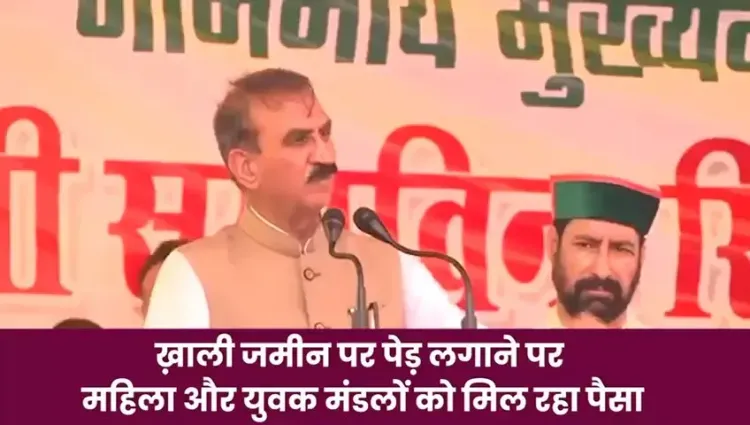
The Chief Minister's Office of Himachal Pradesh announced on Thursday, 25 June 2026 that the state government is providing sustained financial assistance to Mahila Mandals, Yuvak Mandals, and Self-Help Groups for plantation work on vacant land under the Rajiv Gandhi Van Sanvardhan Yojana, with support continuing until saplings grow into full trees.
Context
The official post stated: 'Hamari sarkar Rajiv Gandhi Van Sanvardhan Yojana ke tahat mahila mandalon, yuvak mandalon evam swayam sahayata samuohon ko khaali zameen par paudharopan karne ke liye aarthik sahayata pradan kar rahi hai.' ('Our government is providing financial assistance to women's groups, youth groups and self-help groups for plantation on vacant land under the Rajiv Gandhi Van Sanvardhan Yojana.')
The announcement underscores that the financial support is not a one-time grant — it will continue for as long as it takes for the planted saplings to mature into trees, making it a performance-linked, outcome-oriented model rather than a conventional departmental drive.
Policy Backdrop
Himachal Pradesh has a long history of community-based forest governance, having adopted Joint Forest Management since the early 1990s, which transferred plantation and protection rights to village-level institutions. The Rajiv Gandhi Van Sanvardhan Yojana builds on this lineage by channelling financial incentives directly to grassroots collectives — Mahila Mandals (women's village groups), Yuvak Mandals (rural youth associations), and Self-Help Groups — rather than relying on forest department staff alone.
This approach mirrors the broader shift visible across Indian hill states, where incentive-based community models have shown higher sapling survival rates compared to purely departmental plantation drives, a critical factor given accelerating climate stress on Himalayan forests.
Stakeholders and Impact
Mahila Mandals and Self-Help Groups stand to benefit most directly, gaining a sustained income stream tied to the health and survival of planted saplings — an arrangement that aligns economic self-interest with ecological outcomes. Yuvak Mandals bring youth energy and local knowledge to identifying and preparing vacant land parcels for afforestation.
The scheme also contributes to Himachal Pradesh's commitments under India's national forest and tree cover expansion targets. By involving community collectives, the state aims to address both forest degradation and rural livelihood gaps in a single programmatic framework.
What's Next
Observers will watch the Himachal Pradesh Forest Department's upcoming plantation survival audits to assess how effectively the scheme's financial incentive structure is translating into measurable green cover gains. The next state budget cycle will also be a key indicator of the government's commitment, revealing whether scheme allocations are scaled up in line with the ambition expressed in today's announcement.
If the sustained-support model demonstrates strong sapling-to-tree conversion rates, it could serve as a replicable template for other Himalayan states grappling with similar afforestation challenges.
Point of View
The scheme embeds ecological accountability into grassroots institutions. This aligns with a broader national pattern of using women's and youth collectives as delivery vehicles for environmental policy, lending both social legitimacy and local monitoring capacity. The political optics of invoking the Rajiv Gandhi name also reinforces the ruling Congress government's ideological lineage in Himachal Pradesh.
NationPress
25 Jun 2026
Frequently Asked Questions
What is the Rajiv Gandhi Van Sanvardhan Yojana in Himachal Pradesh?
The Rajiv Gandhi Van Sanvardhan Yojana is a Himachal Pradesh government scheme that provides financial assistance to community groups — including Mahila Mandals, Yuvak Mandals and Self-Help Groups — to carry out plantation on vacant land, with support continuing until the saplings grow into mature trees.
Who is eligible for financial help under Rajiv Gandhi Van Sanvardhan Yojana?
Mahila Mandals (women's village groups), Yuvak Mandals (rural youth associations), and Self-Help Groups operating in Himachal Pradesh are eligible to receive financial assistance under the scheme for planting trees on vacant land.
How long does the financial support last under the HP plantation scheme?
According to the Chief Minister's Office of Himachal Pradesh, the financial support under the Rajiv Gandhi Van Sanvardhan Yojana continues as long as it takes for the planted saplings to grow into full-sized trees — it is not a one-time grant.
What land can be used for plantation under this Himachal Pradesh scheme?
The scheme targets vacant or unused land parcels, where community groups are incentivised to undertake afforestation drives to increase green cover across the state.
How does Himachal Pradesh's community plantation scheme compare to national afforestation efforts?
Himachal Pradesh has practised community-based forest management since the early 1990s and the Rajiv Gandhi Van Sanvardhan Yojana extends this tradition by aligning with India's national targets for expanding forest and tree cover through people's participation rather than purely departmental drives.