HP CM Office Hails Dr. Gautam's Role in Biodiversity, Farmers' Rights Laws

Synopsis
The Himachal Pradesh Chief Minister's Office on June 24, 2026, honoured Dr. Gautam for his pivotal contributions to agriculture and biodiversity conservation, specifically crediting his role in formulating and implementing the Biological Diversity Act, 2002, and the Protection of Plant Varieties and Farmers' Rights Act, 2001.
Key Takeaways
The Chief Minister's Office of Himachal Pradesh posted a tribute to Dr.
Gautam on June 24, 2026 , citing his contributions to agriculture and biodiversity.
Gautam is credited with a key role in formulating and implementing the Protection of Plant Varieties and Farmers' Rights Act, 2001 .
He is also acknowledged for his contribution to the Biological Diversity Act, 2002 , India's primary law on conservation of biological resources.
The PPVFR Act uniquely combines TRIPS compliance with explicit recognition of farmers' rights to save, use, and exchange seeds.
The Biological Diversity Act operationalised India's commitments under the Convention on Biological Diversity, ratified in 1994 .
Himachal Pradesh , with its Himalayan agro-biodiversity, has a direct stake in the robust implementation of both landmark laws.
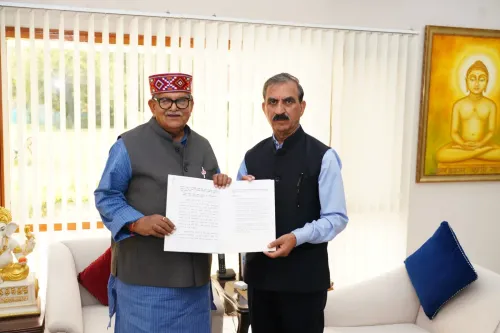
The Chief Minister's Office of Himachal Pradesh on Wednesday, June 24, 2026, paid tribute to Dr. Gautam, acknowledging his outstanding contributions to agriculture, biodiversity conservation, and the empowerment of farmers' rights in India.
Posting in Hindi, the official CMO Himachal Pradesh account stated: 'Dr. Gautam ji ne krishi, jaiv-vividhata sanrakshan tatha kisanon ke adhikaron ko sashakt banane mein ullekhaniya yogdan diya hai' — 'Dr. Gautam has made a remarkable contribution to agriculture, biodiversity conservation, and the empowerment of farmers' rights.' The post specifically credited his 'important role in the formulation and implementation of the Biological Diversity Act and the Protection of Plant Varieties and Farmers' Rights Act.'
Context
The tribute from the Himachal Pradesh Chief Minister's Office places Dr. Gautam among those who shaped two landmark pieces of Indian legislation. The Protection of Plant Varieties and Farmers' Rights (PPVFR) Act, 2001, and the Biological Diversity Act, 2002, together form the cornerstone of India's legal framework for protecting genetic resources and recognising the rights of smallholder farmers. By publicly crediting Dr. Gautam's role, the CMO signals institutional appreciation for the scientists and administrators who drove these laws from concept to implementation.Policy Backdrop
The PPVFR Act of 2001 was enacted to fulfil India's obligations under the World Trade Organization's Agreement on Trade-Related Aspects of Intellectual Property Rights (TRIPS), while simultaneously enshrining the rights of farmers to save, use, and exchange seeds — a provision unique to India's approach. A year later, the Biological Diversity Act of 2002 gave legislative force to India's commitments under the Convention on Biological Diversity, which the country had ratified in 1994. Together, the two laws sought to reconcile global trade commitments with the domestic imperatives of conserving genetic wealth and protecting millions of smallholder cultivators. India's early-2000s legislative push in this space was widely noted as an attempt to balance international intellectual property norms with the realities of a predominantly agrarian economy.Stakeholders and Impact
The beneficiaries of these two laws span a wide spectrum — from farmers across India's agricultural heartland who gained formal recognition of their seed-saving traditions, to biodiversity researchers and state-level biodiversity boards empowered to document and protect local genetic resources. Himachal Pradesh, with its rich agro-biodiversity across the Himalayan ecosystem, has a particular stake in robust implementation of both acts. The state hosts diverse crop varieties, medicinal plants, and traditional farming communities whose livelihoods are directly tied to the legal protections these laws provide. State biodiversity boards in hilly states like Himachal Pradesh have been active in preparing People's Biodiversity Registers that document local biological resources.What's Next
The CMO's public acknowledgement of Dr. Gautam's contributions may signal renewed attention to the implementation of biodiversity and farmers' rights frameworks at the state level. Observers will watch for any follow-up announcements from Shimla regarding awareness programmes for farmers, updates to state biodiversity board activities, or proposed legislative and administrative measures aligned with the PPVFR and Biological Diversity Acts. As India continues to negotiate international frameworks on genetic resources and digital sequence information, the foundational work credited to figures like Dr. Gautam remains highly relevant to both state and central policy deliberations.Point of View
With ongoing debates around amendments, benefit-sharing mechanisms, and digital sequence information — making tributes of this kind politically and administratively resonant. For a hill state like Himachal Pradesh, whose diverse genetic resources and traditional farming communities are directly protected by these laws, such acknowledgements also serve to signal policy priorities to local stakeholders. The post, while ceremonial in tone, carries a quiet institutional message about the direction the state government wishes to project on agriculture and environment governance.
NationPress
22 Sept 2026
Frequently Asked Questions
What is the Biological Diversity Act that Dr. Gautam helped create?
The Biological Diversity Act, 2002, is India's primary legislation for the conservation of biological diversity, the sustainable use of its components, and the fair and equitable sharing of benefits arising from the use of biological resources. It was enacted after India ratified the Convention on Biological Diversity in 1994.
What is the Protection of Plant Varieties and Farmers' Rights Act?
The Protection of Plant Varieties and Farmers' Rights (PPVFR) Act, 2001, provides intellectual property protection for new plant varieties while explicitly recognising farmers' rights to save, use, sow, resow, exchange, share, or sell their farm produce. It was enacted to comply with WTO TRIPS obligations while safeguarding smallholder interests.
Why did the Himachal Pradesh CM Office pay tribute to Dr. Gautam?
The Chief Minister's Office of Himachal Pradesh posted a tribute on June 24, 2026, acknowledging Dr. Gautam's remarkable contributions to agriculture, biodiversity conservation, and farmers' rights, specifically citing his role in the formulation and implementation of the Biological Diversity Act and the PPVFR Act.
How does Himachal Pradesh benefit from the Biological Diversity Act?
Himachal Pradesh, with its rich Himalayan agro-biodiversity including diverse crop varieties and medicinal plants, benefits from the Biological Diversity Act through state biodiversity boards empowered to document and protect local genetic resources via People's Biodiversity Registers.
What is the significance of the PPVFR Act for Indian farmers?
The PPVFR Act is significant because it is one of the few intellectual property laws globally that explicitly protects farmers' traditional rights to save and exchange seeds, balancing the grant of plant breeders' rights with the realities of India's smallholder farming communities.