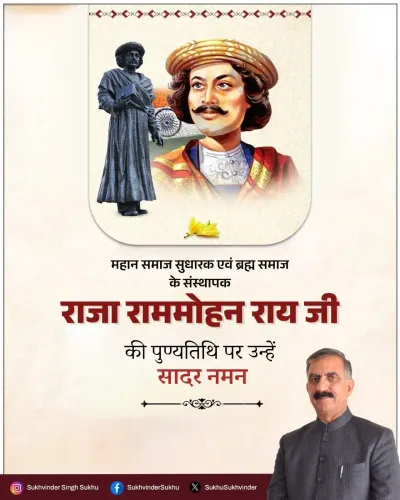
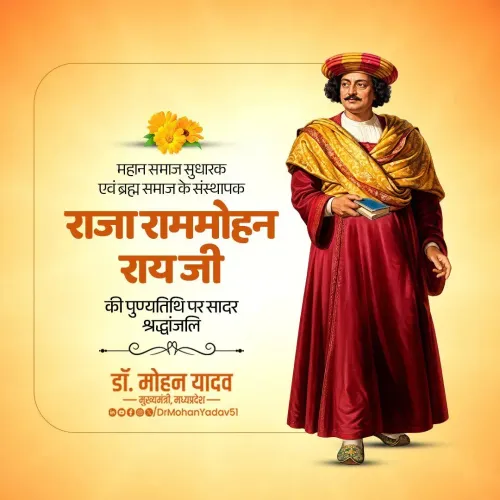
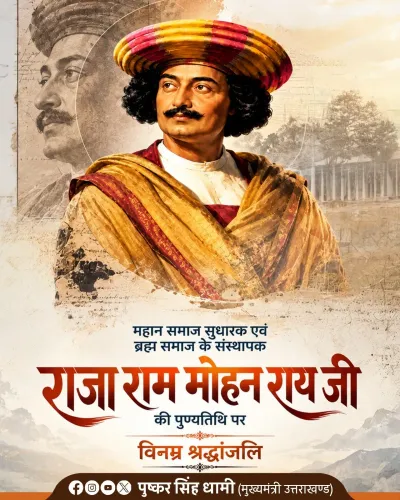
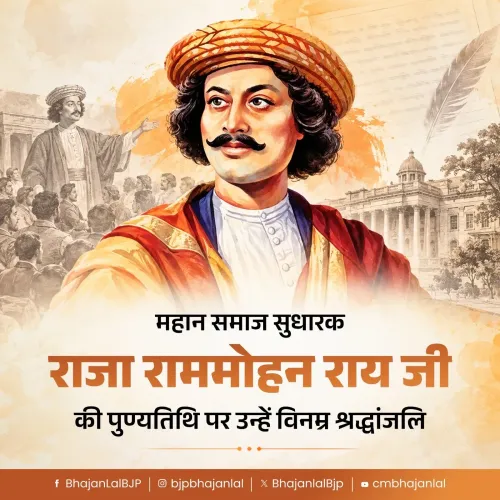
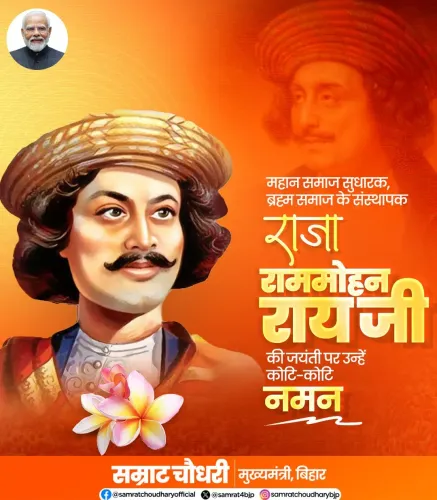
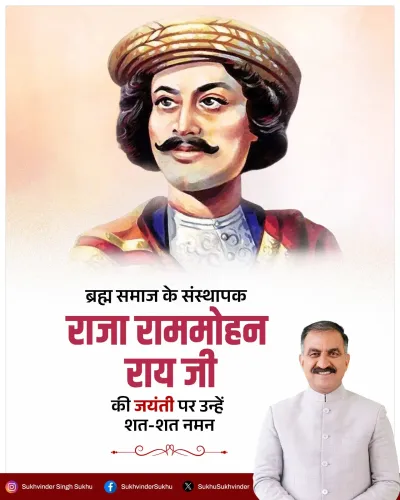
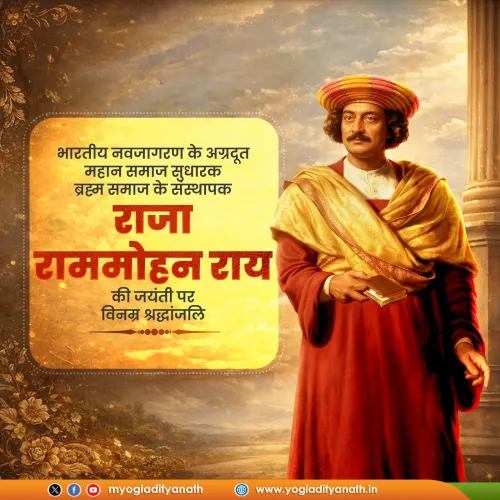
HP CM Sukhu pays tribute to Raja Ram Mohan Roy on death anniversary
Synopsis
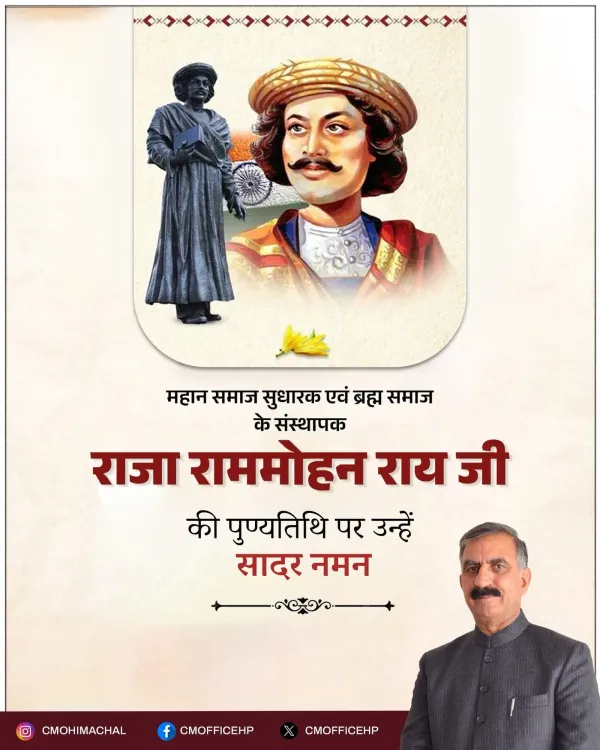
Himachal Pradesh Chief Minister Thakur Sukhvinder Singh Sukhu paid tribute to Raja Ram Mohan Roy on his death anniversary on 27 September 2026, honouring the Brahmo Samaj founder's legacy as a champion of social reform and the Indian Renaissance.
Key Takeaways
CM Thakur Sukhvinder Singh Sukhu posted the tribute via the official CMO Himachal Pradesh account on 27 September 2026 .
Raja Ram Mohan Roy founded the Brahmo Samaj in 1828 , a reform movement promoting monotheism, rationalism, and social equality.
Roy's advocacy directly led to the Bengal Sati Regulation of 1829 , one of colonial India's earliest social-reform laws.
He also campaigned against child marriage and for widow remarriage and English-language education.
The tribute is part of a standard pattern of Indian state governments commemorating 19th-century social reformers on key anniversaries.
On the death anniversary of the man who lit the fire of social reform across a sleeping subcontinent, Chief Minister Thakur Sukhvinder Singh Sukhu of Himachal Pradesh offered a formal tribute to Raja Ram Mohan Roy on Sunday, 27 September 2026, through the official Chief Minister's Office account on X.
Posting in Hindi, CM Sukhu remembered Roy as a 'mahan samaj sudharak' ('great social reformer'), founder of the Brahmo Samaj, and 'Bharatiya punarjagaran ke agradoot' — the vanguard of the Indian Renaissance. The message noted that Roy's struggle against social ills and his reformist ideas 'will always be remembered.'
The reformer who reshaped India's social conscience
Raja Ram Mohan Roy founded the Brahmo Samaj in 1828 — a reform movement that became one of the most consequential religious and social organisations of modern India. Built on monotheism, rationalism, and social equality, the Samaj gave institutional shape to Roy's belief that tradition could not excuse injustice.
Roy's most celebrated campaign was against sati — the practice of widows immolating themselves on their husband's funeral pyres. His relentless advocacy led to the Bengal Sati Regulation of 1829, one of the earliest legislative interventions in social practice in colonial India. He also fought child marriage and championed widow remarriage and English-language education, insisting that modern learning was not a threat to Indian identity but a tool for liberation.
A ritual of official memory, rooted in genuine legacy
State governments across India mark the death anniversaries of 19th-century reformers as a matter of official practice, and the tribute from Shimla follows that pattern. But Roy's relevance is not merely ceremonial. His work seeded movements that shaped the Congress, the social reform wave of the late 19th century, and constitutional commitments to equality that survive in law to this day.
The Brahmo Samaj's influence spread far beyond Bengal — its emphasis on rational inquiry and opposition to caste hierarchy found echoes in reformers from Jyotirao Phule to B.R. Ambedkar. Every September, when India pauses to remember Roy, it is also quietly acknowledging that debt.
Two centuries on, the battles Roy first named — against entrenched custom, against the exclusion of women, against the tyranny of superstition dressed as religion — are still being fought. His anniversary is less an occasion for nostalgia than a reminder of how much distance remains.
Point of View
Positioning Himachal Pradesh's government within that tradition aligns with a broader Congress party narrative that claims the reform and social-justice heritage of the independence era. The tribute also arrives at a moment when debates around caste, gender equality, and rational inquiry remain live political issues, lending Roy's memory a quiet contemporary edge. States that commemorate reformers signal, at least symbolically, where they locate their governing values.
NationPress
27 Sept 2026
Frequently Asked Questions
When is Raja Ram Mohan Roy's death anniversary?
Raja Ram Mohan Roy's death anniversary, known as his punyatithi , is observed on 27 September each year.
Who founded the Brahmo Samaj?
Raja Ram Mohan Roy founded the Brahmo Samaj in 1828 in Bengal as a movement promoting monotheism, rationalism, and social equality.
What did Raja Ram Mohan Roy campaign against?
Roy campaigned most prominently against sati , leading to its legal ban in 1829 . He also opposed child marriage and advocated for widow remarriage and English education.
Who is the Chief Minister of Himachal Pradesh in 2026?
Thakur Sukhvinder Singh Sukhu is the Chief Minister of Himachal Pradesh.
Why is Raja Ram Mohan Roy called the father of the Indian Renaissance?
Roy is called the father of the Indian Renaissance because he pioneered the integration of Western rational thought with Indian reform, challenging entrenched social practices and laying the intellectual groundwork for modern India's social and political consciousness.