HP CM Office Pays Tribute to Brig Usman, Hero of 1947-48 War
Synopsis
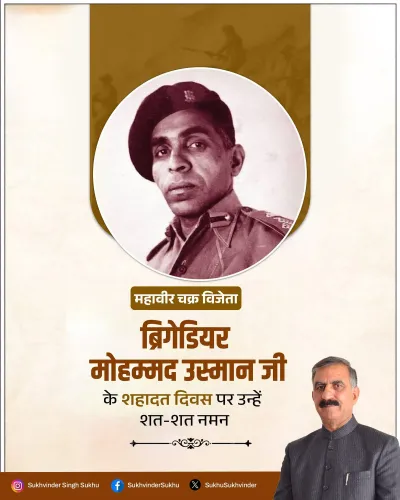
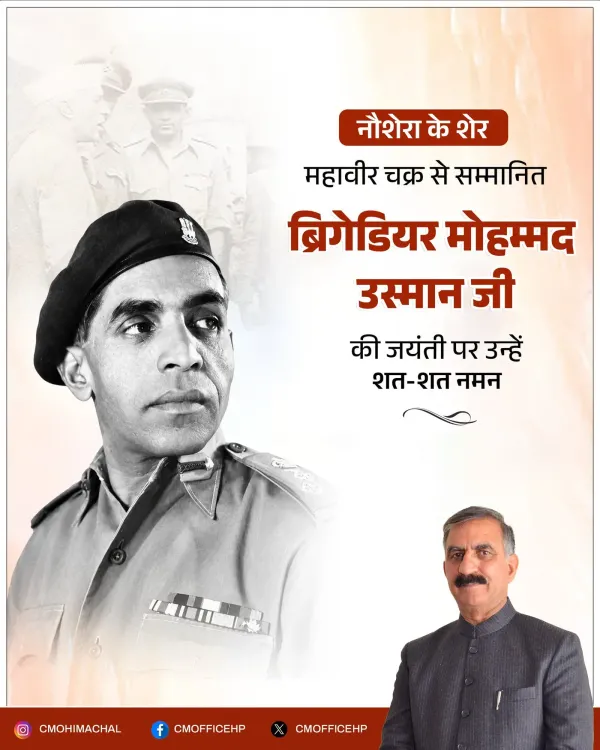
The Chief Minister's Office of Himachal Pradesh paid tribute to Brigadier Mohammad Usman, posthumous Maha Vir Chakra recipient, for his historic defence of the Naushera and Jhanger sectors in the 1947-48 Indo-Pakistani War — honouring a soldier who became a symbol of national unity and sacrifice.
Key Takeaways
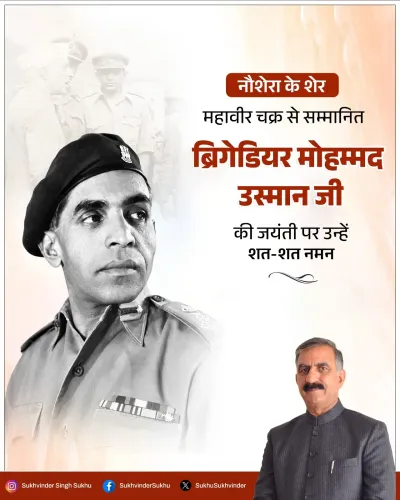
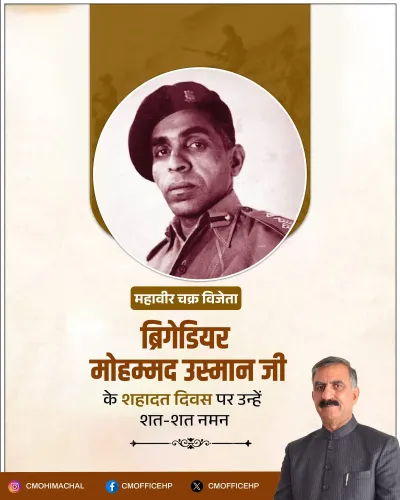
The Chief Minister's Office of Himachal Pradesh paid tribute to Brigadier Mohammad Usman on 15 July 2026 , honouring his role in the 1947-48 Indo-Pakistani War .
Brigadier Usman commanded the 50 Parachute Brigade and led the historic defence of the Naushera and Jhanger sectors in early 1948.
He was killed in action on 3 July 1948 and posthumously awarded the Maha Vir Chakra , India's second-highest wartime gallantry honour.
Usman is remembered as the 'Lion of Naushera' and is widely regarded as a symbol of secular nationalism for choosing to serve India after Partition.
State governments across India periodically issue such tributes to 1947-48 war heroes to reinforce themes of national integration and institutional military memory.
The Chief Minister's Office of Himachal Pradesh on Wednesday, 15 July 2026 paid tribute to Brigadier Mohammad Usman, honouring his historic role in defending the Naushera and Jhanger sectors during the 1947-48 Indo-Pakistani War, describing him as a soldier who never compromised on principles and exemplified duty, courage, and unwavering national loyalty.
Context
The CMO's post, written in Hindi, recalled that '1947-48 ke yuddh mein Brigadier Mohammad Usman ji ne apne adamya sahas, kushal netritva aur atoot rashtra-nishtha se Naushera tatha Jhanger sector ki raksha mein aitihasik bhumika nibhai' — meaning, 'In the 1947-48 war, Brigadier Mohammad Usman, with his indomitable courage, skilled leadership, and unbreakable national loyalty, played a historic role in defending the Naushera and Jhanger sectors.' The post further noted that Brigadier Usman, who never compromised on his principles, remains an enduring symbol of duty.
Brigadier Usman commanded the 50 Parachute Brigade and led Indian forces in repelling Pakistani-backed tribal attacks in the Jammu and Kashmir region in early 1948. He was killed in action on 3 July 1948 during operations near Naushera and was posthumously awarded the Maha Vir Chakra, India's second-highest wartime gallantry honour.
Policy Backdrop
The Maha Vir Chakra was conferred posthumously on Brigadier Usman in 1948, recognising his extraordinary leadership during the Naushera operations — a campaign widely regarded as a turning point in the first Kashmir conflict. His defence of Naushera, which repelled a major assault in February 1948, earned him the popular title 'Lion of Naushera' (Naushera ka Sher) among troops and veterans.
State governments across India have periodically issued tributes to 1947-48 war heroes, including Muslim officers who chose to serve the Indian Army after Partition. Such commemorations carry a deliberate message of national integration, underlining that patriotism and military sacrifice transcended religious identity in the newly independent nation.
Stakeholders and Impact
The tribute resonates with armed forces veterans, military families, and residents of Jammu and Kashmir, for whom the 1947-48 war remains a foundational chapter in the state's post-independence history. Brigadier Usman's legacy is particularly significant as a symbol of secular nationalism — a Muslim officer who reportedly declined an offer to lead the Pakistani Army and instead gave his life defending India's territorial integrity.
Commemorations of this kind by state administrations also serve to reinforce institutional memory of early post-independence conflicts at a time when India-Pakistan tensions over Jammu and Kashmir continue to shape public discourse. The Himachal Pradesh government's tribute adds a regional voice to a national narrative of sacrifice and unity.
What's Next
Tributes to Brigadier Usman typically intensify around key defence anniversaries, including the anniversary of the Battle of Naushera and the date of his martyrdom in July. State and central government events marking early Kashmir operations, along with possible new memorials or educational initiatives, may follow in the coming weeks.
As India continues to revisit its partition-era military history, figures like Brigadier Mohammad Usman are likely to feature more prominently in public memory campaigns — reminding successive generations that the defence of the nation's borders was a shared endeavour across communities.
Point of View
The state government aligns itself with a broader institutional effort to counter divisive narratives through the lens of shared military sacrifice. Such tributes have become a recurring instrument of soft statecraft, reinforcing the idea that post-independence India's identity was forged across religious lines on the battlefield. The timing, in July — the month of Brigadier Usman's martyrdom — adds historical weight to what might otherwise read as routine outreach.
NationPress
13 Oct 2026
Frequently Asked Questions
Who was Brigadier Mohammad Usman?
Brigadier Mohammad Usman was an Indian Army officer who commanded the 50 Parachute Brigade and led the defence of the Naushera and Jhanger sectors during the 1947-48 Indo-Pakistani War. He was killed in action on 3 July 1948 and posthumously awarded the Maha Vir Chakra, India's second-highest wartime gallantry honour.
What was the Battle of Naushera in 1948?
The Battle of Naushera, fought in February 1948, was a key engagement during the first Kashmir war in which Indian forces under Brigadier Usman repelled a major assault by Pakistani-backed tribal fighters. The victory secured a strategic sector in Jammu and Kashmir and earned Brigadier Usman the title 'Lion of Naushera'.
What award did Brigadier Mohammad Usman receive?
Brigadier Mohammad Usman was posthumously awarded the Maha Vir Chakra in 1948, recognising his extraordinary leadership and gallantry during the Naushera operations in the 1947-48 Indo-Pakistani War.
Why did the Himachal Pradesh CMO tribute Brigadier Usman?
The Chief Minister's Office of Himachal Pradesh posted a tribute on 15 July 2026 to honour Brigadier Usman's indomitable courage, skilled leadership, and national loyalty during the 1947-48 war. Such tributes also underscore themes of national integration, as Usman was a Muslim officer who chose to serve and die for India.
What is the significance of Brigadier Usman's legacy today?
Brigadier Usman's legacy is seen as a symbol of secular nationalism — a reminder that India's post-independence defence was a shared endeavour across religious communities. State governments periodically invoke his memory to reinforce national unity, especially in the context of ongoing India-Pakistan tensions over Jammu and Kashmir.