HP CMO Pitches Ready Infrastructure to Investors
Synopsis
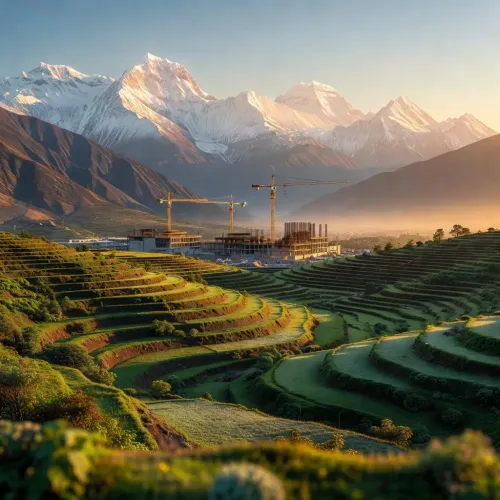
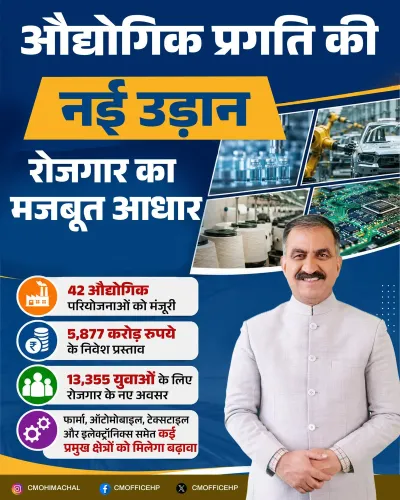
The Chief Minister's Office of Himachal Pradesh has invited investors to share their facility requirements, asserting that constructed buildings, land, and essential infrastructure are already in place and ready for immediate use across the state.
Key Takeaways
The Chief Minister's Office of Himachal Pradesh posted on 19 July 2026 inviting investors to outline their specific facility needs.
The state claims constructed buildings and sufficient land are already available, removing physical infrastructure as a barrier to entry.
The government has pledged to make every possible effort to provide investors with the facilities they require.
Himachal Pradesh 's manufacturing base is anchored in clusters such as Baddi , one of northern India's largest pharmaceutical hubs.
The outreach mirrors a wider post-pandemic national trend of hill and non-coastal states competing for investment through plug-and-play industrial offerings.
Follow-on activity to watch includes state assembly sessions and investor facilitation cell announcements on project allotments.
The Chief Minister's Office of Himachal Pradesh on Sunday, 19 July 2026 made a direct pitch to prospective investors, declaring that the state has ready-built infrastructure, constructed facilities, and sufficient land available for immediate industrial use.
Context
The post, shared from the official CMO Himachal Pradesh account, states in Hindi: 'हमारे पास निवेश के लिए आवश्यक आधारभूत ढाँचा मौजूद है' ('We have the necessary infrastructure in place for investment'). It goes on to say that constructed buildings are ready and there is no shortage of space, inviting investors to share their specific requirements so the state can tailor facilities accordingly.
The message signals a proactive outreach posture — rather than waiting for investors to approach, Himachal Pradesh is positioning itself as a customisable, investor-responsive destination with pre-existing physical assets already in place.
Policy Backdrop
Himachal Pradesh's economy has traditionally leaned on hydropower, horticulture, and tourism, with manufacturing concentrated in clusters such as Baddi in the Solan district — one of the largest pharmaceutical hubs in northern India. The state has long grappled with geographic constraints that make large-scale industrial expansion challenging compared to plains states.
To offset these limitations, successive state governments have offered pre-built plug-and-play industrial spaces and single-window clearance mechanisms. This approach aligns with a broader national trend in which states, particularly in hill and northeastern regions, compete aggressively for investment by reducing friction at the entry stage rather than relying solely on land and labour cost advantages.
Post-pandemic, India has seen a concerted push to diversify manufacturing away from coastal and plain-belt clusters, opening a window for states like Himachal Pradesh to attract light manufacturing, electronics assembly, and pharmaceutical ancillary units.
Stakeholder Impact
For potential investors — particularly in sectors such as pharmaceuticals, food processing, and light engineering — the CMO's statement offers a concrete assurance: physical infrastructure is not a bottleneck. The pledge to accommodate investor-specific facility requirements suggests flexibility in customising industrial estates or sheds to match operational needs.
Local industries and ancillary service providers stand to benefit from fresh investment inflows, which could generate downstream employment and logistics demand. For communities in and around existing industrial corridors, expanded investor interest could translate into improved connectivity and utilities as the state upgrades supporting infrastructure.
What's Next
The state's investor facilitation cell and industrial development bodies will likely be the next touchpoints for interested parties responding to this outreach. Watchers should track upcoming state assembly sessions or dedicated investor summits where concrete project proposals, allotment details, or revised industrial area policies may be announced.
If the CMO's pitch converts into formal investment commitments, the state will need to demonstrate follow-through on its promise to customise facilities — a test of its single-window and project-monitoring mechanisms. The credibility of this outreach will ultimately be measured by the speed and ease with which incoming investors can operationalise their units in Himachal Pradesh.
Point of View
Needs-based investor pitch reflects a maturing playbook among Indian hill states: rather than competing on land cost alone, they are leading with ready assets and a promise of customisation. This positions Himachal Pradesh as a responsive rather than passive investment destination — a distinction that matters to time-sensitive investors in pharmaceuticals and light manufacturing. The message also carries an implicit acknowledgment that geographic constraints are real, and the state is compensating through infrastructure readiness and administrative flexibility. Whether this translates into measurable investment inflows will depend on how swiftly the state's facilitation machinery can match its public commitments.
NationPress
18 Oct 2026
Frequently Asked Questions
What infrastructure does Himachal Pradesh offer to new investors?
The Chief Minister's Office of Himachal Pradesh has stated that the state has ready-built constructed buildings, sufficient land, and essential infrastructure available for investors who wish to set up operations.
Which industries are already present in Himachal Pradesh?
Himachal Pradesh has established industrial clusters in sectors such as pharmaceuticals, food processing, and light manufacturing, with Baddi in Solan district being one of northern India's largest pharma hubs.
How can investors approach the Himachal Pradesh government with their requirements?
The CMO's post invites investors to communicate their specific facility and infrastructure needs directly to the state government, which has pledged to make every effort to fulfil those requirements.
Why is Himachal Pradesh actively courting investors now?
Hill states like Himachal Pradesh face geographic constraints that limit large-scale industrial expansion, so the state is using pre-built infrastructure and flexible facility customisation to attract investment, particularly as India diversifies manufacturing beyond coastal regions.
What is the significance of Baddi for investment in Himachal Pradesh?
Baddi is one of the largest pharmaceutical manufacturing clusters in northern India and represents the kind of established industrial ecosystem that makes Himachal Pradesh attractive to investors in related sectors.