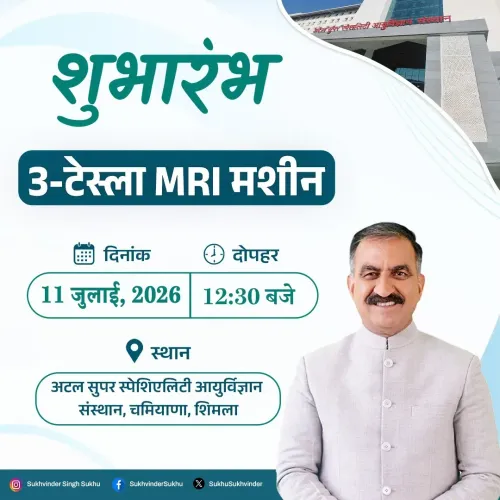
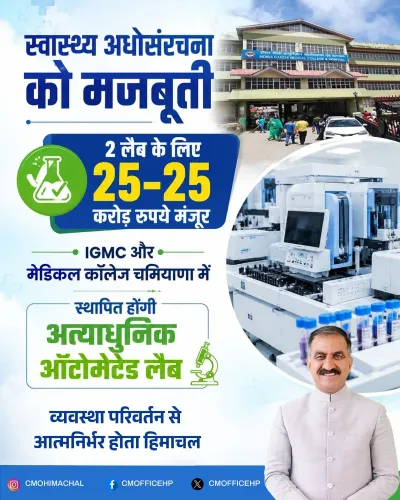
HP Govt Upgrades IGMC Shimla with 3T MRI, 256-Slice CT Scan
Synopsis
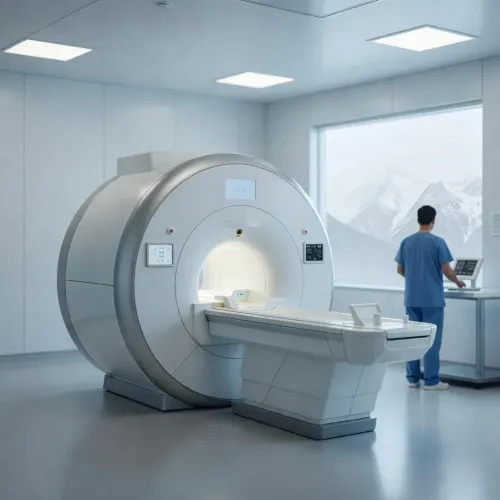
The Himachal Pradesh government has overhauled IGMC Shimla's radiology department, replacing a 19-year-old MRI and 15-year-old imaging units with a Three Tesla MRI, 256-slice CT scanner, and modern ultrasound and X-ray machines, transforming both patient care and medical training at the state's premier public hospital.
Key Takeaways
The Himachal Pradesh government has replaced ageing radiology equipment at IGMC Shimla , the state's leading government medical college and hospital.
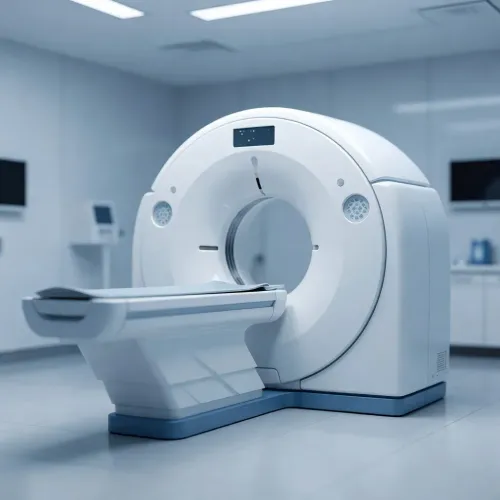
A Three Tesla (3T) MRI machine replaces a unit that was reportedly 19 years old .
A 256-slice CT scanner and updated ultrasound and X-ray machines have also been installed.
The previous ultrasound and X-ray equipment was reportedly 15 years old , hampering modern clinical training for medical students.
The upgrade benefits both patients who need advanced diagnostics at government rates and medical trainees who now learn on current-generation technology.
The announcement raises expectations for similar upgrades at other district hospitals and government medical colleges across Himachal Pradesh.
Decades-old diagnostic machines that left medical students struggling to learn modern techniques are finally out the door at Indira Gandhi Medical College (IGMC), Shimla. The Chief Minister's Office of Himachal Pradesh announced on Tuesday, 27 October 2026 that the state government has replaced ageing radiology equipment at IGMC with a full suite of cutting-edge diagnostic technology.
The post, shared in Hindi, puts the problem starkly: '19 saal purani MRI, 15 saal purane ultrasound-X-ray upakaronon ke saath aadhunik takneek seekhna aur nayi chunautiyon ke liye taiyaar hona mushkil tha' — 'With a 19-year-old MRI and 15-year-old ultrasound and X-ray machines, learning modern techniques and preparing for new challenges was difficult.' The government says it has now provided IGMC with a Three Tesla (3T) MRI machine, a 256-slice CT scanner, and state-of-the-art ultrasound and X-ray units.
Why 3T MRI and 256-Slice CT Change the Game at IGMC
The gap between a first-generation MRI and a Three Tesla system is not incremental — it is categorical. A 3T MRI delivers roughly double the magnetic field strength of a standard 1.5T unit, producing sharper images of the brain, spine, and soft tissue that radiologists and clinicians depend on for precise diagnosis. For medical trainees, it means hands-on exposure to the kind of technology they will actually encounter in modern hospitals. Similarly, a 256-slice CT scanner can capture the entire heart in a single beat, enabling advanced cardiac, trauma, and oncology imaging that older machines simply cannot perform. These are not incremental upgrades; they are generational leaps.
IGMC's Role in Himachal's Tertiary Care Network
IGMC is Himachal Pradesh's premier government medical college and hospital, serving as the anchor of the state's tertiary healthcare system. Perched in Shimla, it draws patients from across the state's mountainous terrain — a geography that has historically made access to advanced diagnostics both scarce and precious. When the flagship institution runs on obsolete equipment, the knock-on effect cascades through the entire referral network: patients travel further for scans, junior doctors graduate without mastering modern modalities, and diagnostic accuracy suffers.
State governments across India have periodically upgraded diagnostic infrastructure in public medical colleges, but the pace has been uneven. Himachal Pradesh's terrain compounds the challenge — population density is low, logistics are hard, and procuring and commissioning large-bore imaging equipment in a hill station demands additional planning. The CMO's announcement signals a deliberate policy push to close the technology gap at the state's top medical institution first.
What Students and Patients Stand to Gain
For medical students and resident doctors at IGMC, the upgrade is immediately practical. Training on a 3T MRI and a 256-slice CT scanner means that when they join hospitals — government or private — they are not encountering these machines for the first time. For patients, particularly those from rural and semi-urban districts of Himachal Pradesh who depend on public healthcare, access to advanced imaging at a government hospital could reduce out-of-pocket costs significantly. Private diagnostic centres in Shimla and Chandigarh charge a premium for 3T MRI scans; IGMC offering the same standard of imaging changes the calculus for thousands of families.
The next question the state will need to answer: whether IGMC is the beginning of a broader equipment refresh across district hospitals and other government medical colleges in Himachal Pradesh, or a one-off flagship investment. The infrastructure bar has now been raised — and the pressure to match it across the network will only grow.
Point of View
Himachal Pradesh is simultaneously addressing a training deficit and a patient-access gap, two politically resonant pressure points. The announcement fits a wider pattern of hill-state governments leveraging high-visibility medical infrastructure to counter the perception that public healthcare in remote terrain is irreversibly second-rate. The sharper political question now is whether the investment holds at the flagship alone, or whether it marks the opening of a sustained capital push into the district hospital network.
NationPress
27 Oct 2026
Frequently Asked Questions
What new medical equipment has been installed at IGMC Shimla?
The Himachal Pradesh government has installed a Three Tesla (3T) MRI machine, a 256-slice CT scanner, and advanced ultrasound and X-ray machines at IGMC Shimla, replacing equipment that was up to 19 years old.
What is a Three Tesla MRI and why is it better?
A Three Tesla (3T) MRI uses a magnetic field roughly twice as strong as a standard 1.5T machine, producing sharper images of the brain, spine, and soft tissue, enabling more accurate diagnoses and exposure to advanced technology for medical trainees.
How old was the previous MRI machine at IGMC Shimla?
According to the Himachal Pradesh Chief Minister's Office, the MRI machine being replaced at IGMC Shimla was 19 years old, while the ultrasound and X-ray units were approximately 15 years old.
How will the IGMC Shimla equipment upgrade benefit patients?
Patients from across Himachal Pradesh who rely on government healthcare will now have access to advanced diagnostic imaging — including 3T MRI and 256-slice CT scans — at government rates, potentially reducing the need to visit costly private diagnostic centres.
Will other government hospitals in Himachal Pradesh receive similar upgrades?
The CMO's announcement focused on IGMC Shimla. Whether similar equipment upgrades will be extended to district hospitals or other government medical colleges in the state has not yet been announced.