HP CM Office: Kishau Dam to Yield Rs 600 Cr Yearly
Synopsis
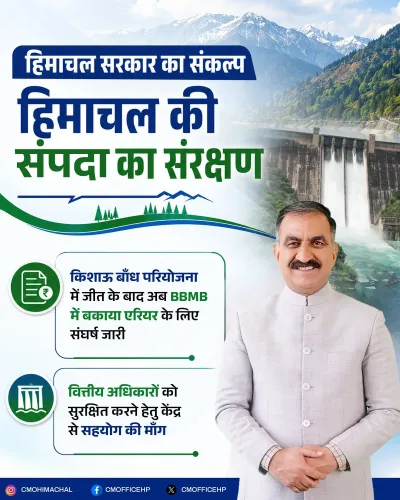
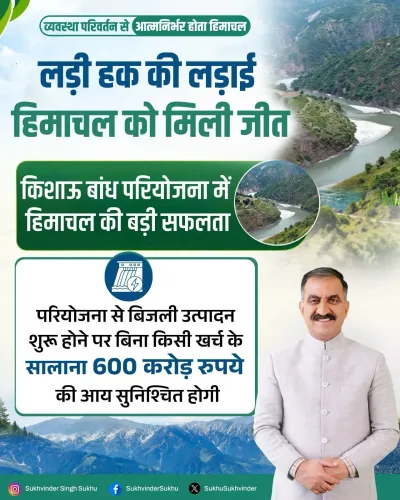
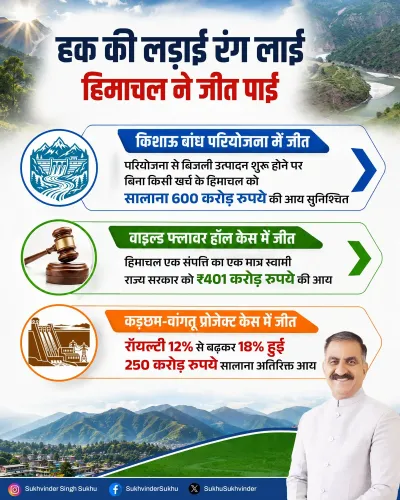
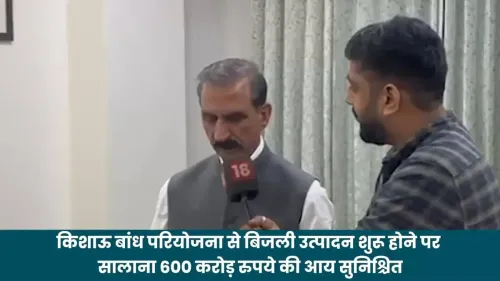
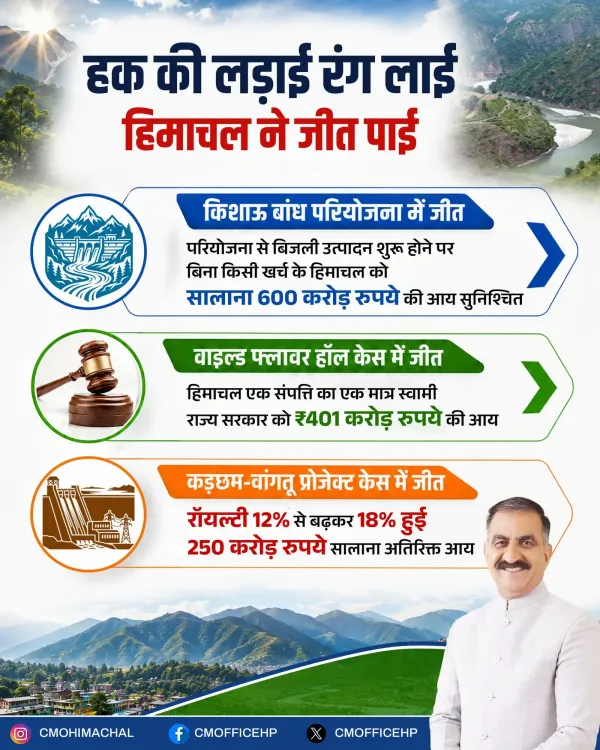
The Chief Minister's Office of Himachal Pradesh has highlighted the Kishau Dam Project on the Tons River as a landmark achievement, projecting an annual revenue of Rs 600 crore for the state without any capital expenditure once power generation commences, framing it as a vindication of the people's right over the state's natural resources.
Key Takeaways
The Chief Minister's Office of Himachal Pradesh posted on 18 June 2026 asserting the state's inalienable rights over its natural resources.
The Kishau Dam Project on the Tons River is projected to generate approximately Rs 600 crore per year for Himachal Pradesh with no state expenditure.
Revenue will flow through a free-power royalty arrangement, consistent with HP's hydropower policy frameworks mandating a 12-15 per cent royalty share.
The project is an interstate initiative involving Himachal Pradesh , Uttarakhand , and central agencies under Yamuna basin agreements.
The CMO framed resource rights as non-negotiable, reflecting a broader pattern of Himalayan states asserting upstream revenue claims.
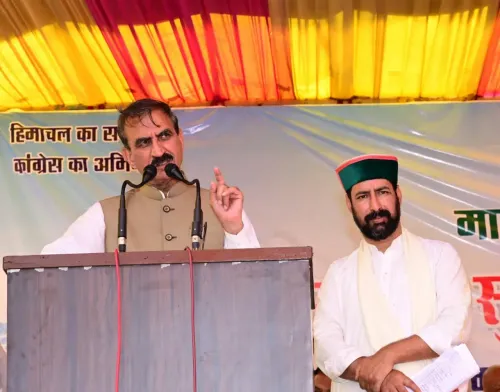
The Chief Minister's Office of Himachal Pradesh on Thursday, 18 June 2026, asserted that the state's natural resources and wealth belong to its people and cannot be taken away, highlighting a series of what it described as historic achievements in resource rights and revenue generation.
Posting in Hindi, the CMO stated: 'प्रदेश की संपदा और संसाधनों पर हिमाचल प्रदेश के लोगों का अधिकार है और इसे कोई छीन नहीं सकता' — 'The people of Himachal Pradesh have a right over the state's wealth and resources, and no one can take that away.' The post specifically cited the Kishau Dam Project as a landmark gain, claiming that once power generation begins, the state stands to earn approximately Rs 600 crore per year without incurring any expenditure.
Context
The Kishau Dam Project is a multipurpose concrete gravity dam proposed on the Tons River, a tributary in the Yamuna basin straddling Himachal Pradesh and Uttarakhand. The project has been in planning and development stages for decades, involving coordination between the two states and central government agencies. Under interstate hydropower-sharing arrangements, Himachal Pradesh is entitled to a royalty share of free power from projects on rivers originating within its territory. The CMO's assertion that the income will come 'without any expenditure' aligns with the standard free-power royalty model, under which a host state receives a percentage of electricity generated as royalty — typically between 12 and 15 per cent — without having to invest capital in the project infrastructure.Policy Backdrop
Himachal Pradesh's hydropower policy frameworks, in place since the mid-2000s, have consistently mandated royalty-based free-power shares from projects on state rivers. The state has positioned its river systems — fed by Himalayan glaciers — as sovereign natural assets, and successive governments have sought to maximise revenue flows from upstream water resources. The broader pattern across Himalayan states mirrors this approach: Uttarakhand, Himachal Pradesh, and other upstream states have long pressed for greater shares of hydropower revenue generated from rivers that originate or flow through their territories. These claims have periodically created federal tensions with central agencies and downstream states over benefit-sharing formulas.Stakeholders and Impact
The primary beneficiaries cited in the CMO's post are the residents of Himachal Pradesh, with the state government framing the projected Rs 600 crore annual income as a direct dividend on the state's natural inheritance. Hydropower developers involved in the Kishau project — operating under interstate and central government agreements — are the other key stakeholders in the revenue-sharing arrangement. For a state that depends significantly on central transfers and hydropower royalties to fund its budget, a recurring annual inflow of this scale, if realised, would represent a meaningful addition to non-tax revenue. The framing of resource rights as inalienable also carries a political dimension, reinforcing the state government's positioning on natural resource sovereignty ahead of future project negotiations.What's Next
All eyes will be on the commissioning milestones of the Kishau Dam Project and whether the projected revenue flows materialise once generation units come online. Any fresh notifications from the central government or interstate agreements between Himachal Pradesh and Uttarakhand on benefit-sharing ratios will be closely watched. The state government's continued emphasis on resource rights suggests this narrative will remain central to its political and fiscal communications in the period ahead.Point of View
The state government converts an abstract policy position into a tangible public dividend, reinforcing its political credibility. This fits a wider pattern of Himalayan states using hydropower royalty rhetoric to push back against central and downstream interests in revenue-sharing disputes. The messaging is as much about future negotiating leverage as it is about the Kishau project itself.
NationPress
19 Sept 2026
Frequently Asked Questions
What is the Kishau Dam Project in Himachal Pradesh?
The Kishau Dam Project is a multipurpose concrete gravity dam proposed on the Tons River in the Yamuna basin, shared between Himachal Pradesh and Uttarakhand, designed for hydropower generation and water storage.
How will Himachal Pradesh earn Rs 600 crore from Kishau Dam without spending money?
Under India's hydropower royalty policy, host states receive a free-power share — typically 12 to 15 per cent of electricity generated — as royalty without investing capital. The HP CMO cited this arrangement as the basis for the projected Rs 600 crore annual income.
When will Kishau Dam start generating power?
The exact commissioning timeline has not been officially confirmed in this post. The CMO referred to income that will accrue 'once power generation begins,' indicating the project has not yet reached that stage.
What is Himachal Pradesh's policy on hydropower royalties?
Himachal Pradesh has maintained hydropower policy frameworks since the mid-2000s requiring developers to provide a free-power royalty share of 12 to 15 per cent from projects on rivers within the state, with no capital investment required from the state government.
Why do Himalayan states claim rights over river resources?
Himalayan states like Himachal Pradesh and Uttarakhand are the origin points of major rivers and assert upstream resource rights under federal arrangements, seeking revenue from hydropower projects as compensation for ecological stewardship and land use.