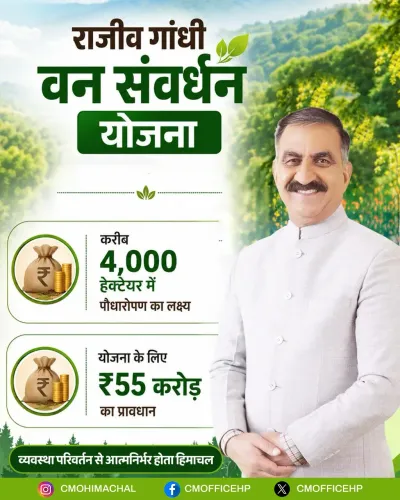
HP CM Office Launches Rajiv Gandhi Van Sanvardhan Yojana
Synopsis
The Chief Minister's Office of Himachal Pradesh announced the Rajiv Gandhi Van Sanvardhan Yojana on World Environment Day 2026, framing the state's forests as a lifeline and calling forest conservation a shared public responsibility. The scheme aims to expand and protect forest cover across the ecologically sensitive Himalayan state.
Key Takeaways
The Chief Minister's Office of Himachal Pradesh announced the Rajiv Gandhi Van Sanvardhan Yojana on June 5, 2026 — World Environment Day.
The scheme is specifically aimed at expanding and protecting forest cover across Himachal Pradesh .
The CMO described the state's forests as a 'lifeline' and framed conservation as a 'shared responsibility' of all citizens.
The initiative builds on the National Forest Policy of 1988 and the CAMPA framework, which has funded forest regeneration in Himachal Pradesh since 2009 .
Specific plantation targets, budget allocations, and operational guidelines for the scheme are yet to be publicly detailed.
Hill communities and forest-dependent households in Himachal Pradesh are the primary stakeholders of the scheme's outcomes.
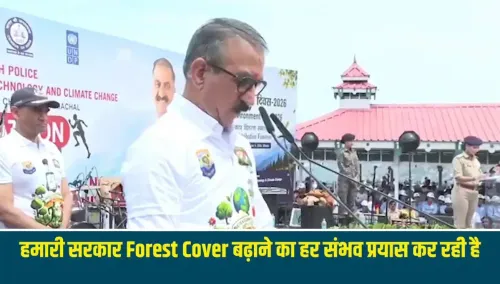
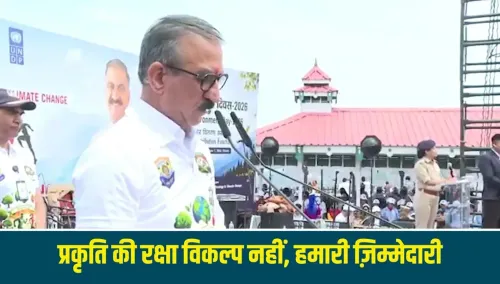
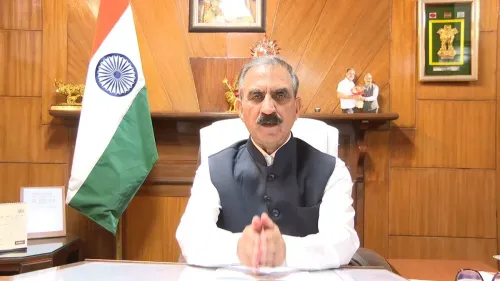
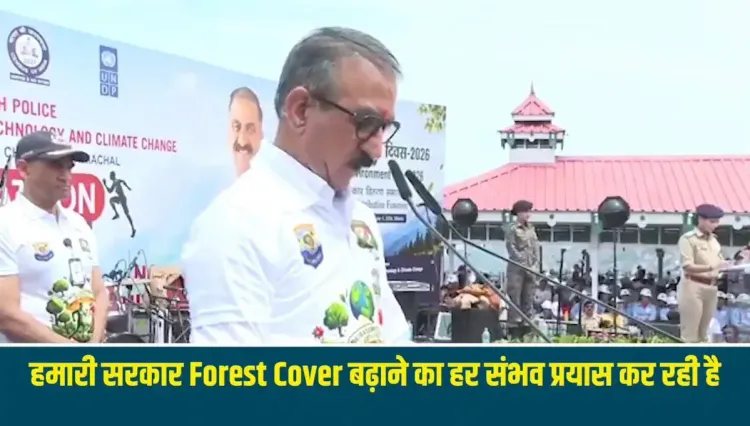
The Chief Minister's Office of Himachal Pradesh announced on Friday, June 5, 2026 — World Environment Day — the launch of the Rajiv Gandhi Van Sanvardhan Yojana, a state scheme aimed at expanding and protecting forest cover across Himachal Pradesh. The announcement, made via the official CMO account on X, described the state's forests as a 'lifeline' and framed their conservation as a shared public responsibility.
The post stated in Hindi: 'प्रदेश के जंगल हमारी जीवनरेखा हैं' ('The forests of our state are our lifeline'), adding that the government is making 'every possible effort' to increase forest cover. The launch of the Rajiv Gandhi Van Sanvardhan Yojana was presented as the central instrument of this commitment.
Context
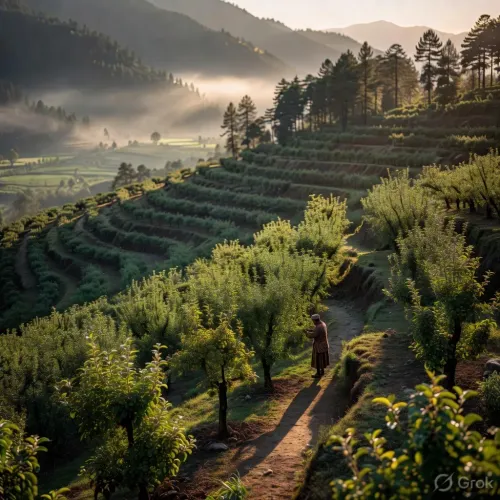
Himachal Pradesh is a Himalayan state where forests cover a substantial share of total land area and underpin ecology, tourism, and the livelihoods of hill communities. The state's mountain ecosystems are considered ecologically fragile, making forest loss a concern with cascading effects on water sources, biodiversity, and climate resilience. The CMO's announcement on World Environment Day signals a deliberate alignment of the scheme's public rollout with the global conversation on environmental protection. The scheme is named after former Prime Minister Rajiv Gandhi, who served from 1984 to 1989. Multiple central and state-level development programmes across India carry his name, a tradition that continues with this forest-focused initiative in Himachal Pradesh.Policy Backdrop
The Rajiv Gandhi Van Sanvardhan Yojana sits within a layered national policy framework. India's National Forest Policy of 1988 set a long-standing target of achieving 33 percent forest and tree cover nationally, and has guided state-level afforestation efforts for decades. Separately, the Compensatory Afforestation Fund Management and Planning Authority (CAMPA) framework, operational since 2009, has provided dedicated funding streams for forest regeneration in states including Himachal Pradesh. The new state scheme appears designed to complement these existing mechanisms with a Himachal-specific programme. Himalayan states have increasingly pursued targeted afforestation drives to reverse forest loss and meet national green cover goals, recognising that mountain forests face distinct pressures compared to plains ecosystems.Stakeholders and Impact
The communities most directly affected by the scheme's success are Himachal Pradesh's hill communities and forest-dependent households, whose water security, agricultural cycles, and daily livelihoods are tied to healthy forest cover. Forests in the Himalayan region also serve as carbon sinks and regulate river flows that feed into the broader Indo-Gangetic plain, giving the state's conservation efforts a significance beyond its borders. By framing forest protection as a 'shared responsibility' (साझा जिम्मेदारी), the CMO's messaging also signals an intent to involve local communities — not just the forest department — in implementation. Whether this translates into formal community participation mechanisms under the scheme remains to be seen.What's Next
Detailed operational guidelines, annual plantation targets, and budget allocations for the Rajiv Gandhi Van Sanvardhan Yojana are expected to emerge through upcoming state forest department reports or announcements in the Himachal Pradesh Legislative Assembly. The scheme's measurable impact will ultimately depend on the scale of funding committed, the species selected for afforestation, and the robustness of monitoring mechanisms put in place. Observers will watch whether the government follows the announcement with specific, time-bound green cover targets in the months ahead.Point of View
Naming a flagship scheme after Rajiv Gandhi reinforces ideological alignment with the party's central leadership while addressing a genuine ecological concern in a state where forests are central to identity and economy. The broader pattern here is one of Himalayan states using branded afforestation schemes to signal climate seriousness ahead of increased scrutiny on mountain ecosystem health. The real test, however, will be whether this announcement is backed by ring-fenced funding and verifiable targets — without which it risks remaining an aspirational declaration rather than a policy intervention.
NationPress
22 Oct 2026
Frequently Asked Questions
What is the Rajiv Gandhi Van Sanvardhan Yojana in Himachal Pradesh?
The Rajiv Gandhi Van Sanvardhan Yojana is a state government scheme launched by the Himachal Pradesh government to expand and protect forest cover across the state. It was announced by the Chief Minister's Office on June 5, 2026.
Why was the scheme launched on June 5?
June 5 is observed globally as World Environment Day, and the Himachal Pradesh government chose this date to publicly announce the scheme, aligning the launch with the international focus on environmental protection.
Who is the Rajiv Gandhi Van Sanvardhan Yojana named after?
The scheme is named after former Prime Minister Rajiv Gandhi, who served from 1984 to 1989. Naming state and central schemes after him is a long-standing tradition across several Indian states.
What is the current forest policy framework in Himachal Pradesh?
Himachal Pradesh's forest conservation efforts are guided by India's National Forest Policy of 1988, which targets 33 percent forest and tree cover nationally, and the CAMPA framework operational since 2009, which provides dedicated funds for forest regeneration.
Who benefits from forest conservation schemes in Himachal Pradesh?
Hill communities and forest-dependent households in Himachal Pradesh are the primary beneficiaries, as healthy forests support their water security, agriculture, and livelihoods. The state's forests also regulate river flows that affect a much wider region.