HP CM Office Cuts Fishing Royalty from 7.5% to 1%
Synopsis
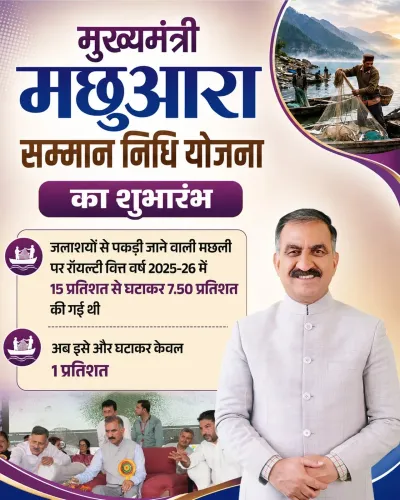
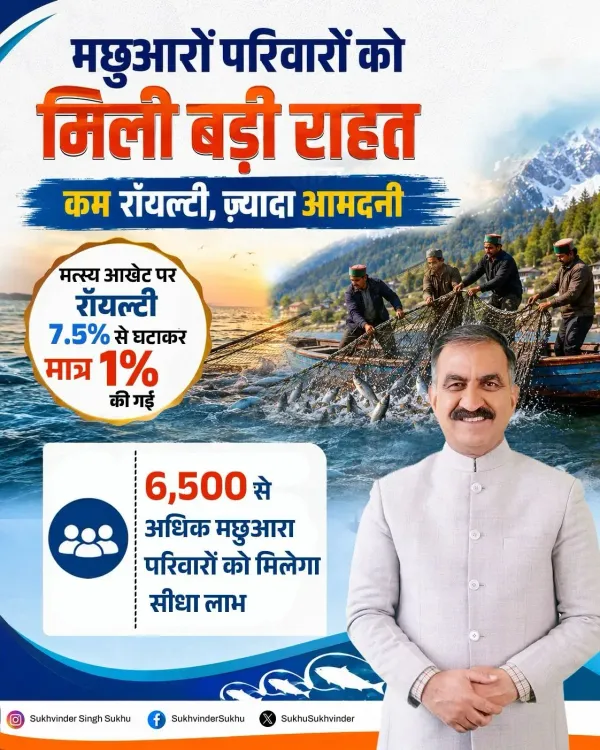
The Chief Minister's Office of Himachal Pradesh announced on 9 June 2026 that the state has cut the royalty rate on fish harvesting from 7.5 per cent to 1 per cent, calling fishing communities the backbone of the rural economy and citing livelihood protection as the top priority.
Key Takeaways
The Chief Minister's Office of Himachal Pradesh announced the royalty cut on 9 June 2026 .
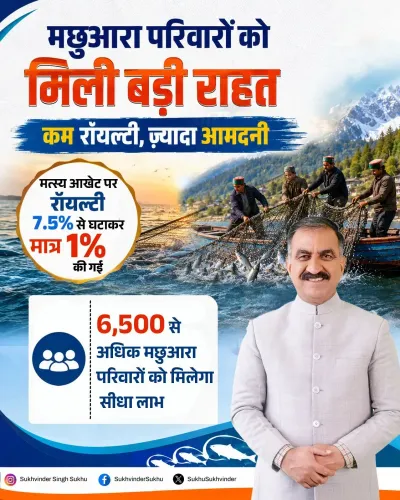
The royalty rate on fish harvesting ( matsya aakhet ) has been reduced from 7.5 per cent to 1 per cent — a reduction of 6.5 percentage points.
The government described fishing communities as 'the backbone of the rural economy' and cited livelihood protection as its 'topmost priority.' Key beneficiaries include fishermen operating in Himachal Pradesh's major reservoirs and river stretches, particularly in districts such as Bilaspur, Kangra, and Chamba .
An official notification detailing implementation and collection mechanisms is awaited.
The move aligns with a broader pattern of Indian hill states revising extraction levies to support marginal occupational communities.
The Chief Minister's Office of Himachal Pradesh announced on Tuesday, 9 June 2026 that the state government has slashed the royalty rate on fish harvesting from 7.5 per cent to 1 per cent, describing the fisher community as the backbone of the rural economy. The decision is framed as a direct measure to protect the livelihoods of fishing families across the hill state.
Context
The official post, shared by the Chief Minister's Office of Himachal Pradesh, stated in Hindi: 'हमारे मछुआरा भाई ग्रामीण अर्थव्यवस्था की रीढ़ हैं' ('Our fisher brothers are the backbone of the rural economy'). It added that the protection of their hard work and livelihoods is the government's 'topmost priority,' and that the royalty on fish harvesting (matsya aakhet) has been reduced from 7.5 per cent to just 1 per cent. The announcement signals a significant reduction in the cost burden borne by fishermen who operate in the state's rivers and reservoirs.
Policy Backdrop
Himachal Pradesh, a landlocked hill state with limited agricultural flatlands, has a substantial inland fisheries sector concentrated around major reservoirs such as Gobind Sagar, Pong Dam Lake, and Chamera, as well as river stretches across districts. Royalty on fish catch is a form of extraction levy that fishing communities pay to the state for the right to harvest from government-owned water bodies. At 7.5 per cent, this rate represented a considerable share of earnings for marginal fishermen operating on subsistence or small commercial scales.
Indian states periodically revise royalty structures on inland fisheries and minor forest produce as part of rural welfare interventions. Such adjustments are typically aimed at reducing the financial burden on traditional occupational groups, discouraging illegal or unreported catches driven by high levy costs, and integrating the sector into formal livelihood support frameworks. The reduction to 1 per cent brings the effective royalty burden close to nominal levels.
Stakeholders and Impact
The primary beneficiaries of this decision are fishing communities — locally referred to as macchuara families — spread across hill districts and reservoir belts of Himachal Pradesh. These households often lack access to alternative income sources and depend on seasonal fish harvesting as their principal livelihood. A reduction of this scale — from 7.5 per cent to 1 per cent — effectively means fishermen retain a substantially larger share of their gross catch value.
Rural economies in reservoir-adjacent districts such as Bilaspur, Kangra, and Chamba could see secondary benefits as higher net incomes among fishing families translate into greater local spending. The move may also reduce incentives for under-reporting of catches, which has historically been a challenge where royalty rates are perceived as prohibitive. State fisheries cooperatives and self-help groups linked to the sector are also likely to benefit from improved viability of formal operations.
What's Next
The government is expected to issue an official notification detailing the implementation mechanism for the revised 1 per cent royalty rate, including collection procedures and the effective date of application. Observers will watch whether this rate revision is accompanied by linked investments in fisheries infrastructure — such as hatcheries, cold storage, or market linkages — as part of a broader sectoral development push in the state's budget cycle. The announcement sets a precedent that could prompt other hill states with significant inland fisheries to review their own royalty structures.
Point of View
' the ruling dispensation is signalling a political priority ahead of what is likely a period of heightened rural outreach. The near-elimination of the royalty burden also has a practical anti-poaching logic: high extraction costs have historically pushed fishermen toward under-reporting, and a nominal levy reduces that incentive. Whether this announcement is followed by structural investments in cold chain, marketing, and hatchery infrastructure will determine if the gesture translates into lasting sectoral development.
NationPress
24 Sept 2026
Frequently Asked Questions
What is the new royalty rate on fish harvesting in Himachal Pradesh?
The Himachal Pradesh government has reduced the royalty rate on fish harvesting to 1 per cent , down from the earlier rate of 7.5 per cent , as announced by the Chief Minister's Office on 9 June 2026.
Who benefits from the Himachal Pradesh fishing royalty cut?
Fishing communities — particularly those harvesting fish from major reservoirs and rivers in districts such as Bilaspur, Kangra, and Chamba — are the primary beneficiaries, as they will now retain a significantly larger share of their catch value.
Why did Himachal Pradesh reduce the fish harvesting royalty?
The government stated that protecting the livelihoods of fishermen, described as the 'backbone of the rural economy,' is its topmost priority. Reducing the royalty lowers the financial burden on marginal fishing families dependent on inland water bodies.
What is matsya aakhet royalty in Himachal Pradesh?
Matsya aakhet royalty is a levy paid by fishermen to the state government for the right to harvest fish from government-owned water bodies such as reservoirs and river stretches in Himachal Pradesh .
When will the new 1% fishing royalty rate take effect in HP?
An official government notification detailing the implementation mechanism and effective date for the revised 1 per cent royalty rate is awaited following the announcement made on 9 June 2026 .