CMO Punjab: HPCL to Invest in Refinery, Biofuel, Biogas Sectors
Synopsis
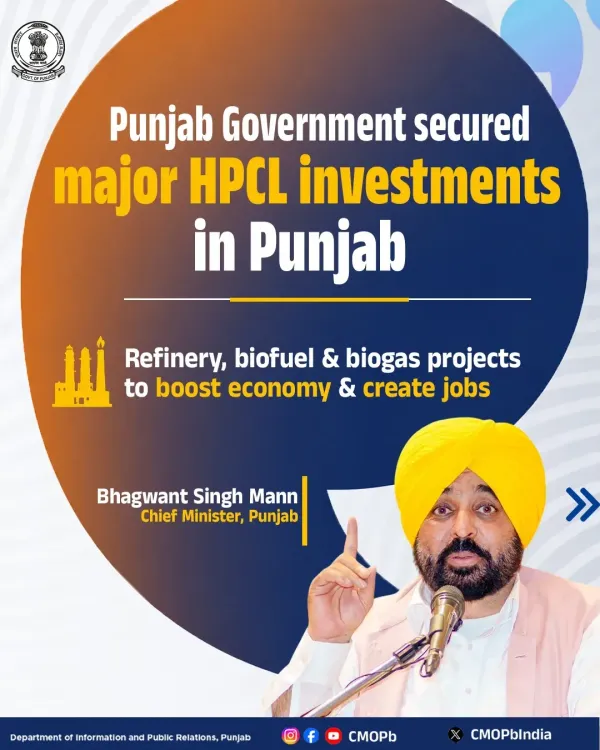
The Chief Minister's Office of Punjab has announced that Hindustan Petroleum Corporation Limited will expand its presence in the state with investments across refinery, biofuel and biogas sectors, marking a fresh endorsement of Chief Minister Bhagwant Mann's industrial outreach under the Invest Punjab initiative.
Key Takeaways
HPCL has committed to expand its Punjab footprint across refinery, biofuel and biogas sectors.
The announcement was made by the Chief Minister's Office of Punjab on 3 June 2026.
It builds on CM Bhagwant Mann's Invest Punjab investor outreach since 2022.
Biofuel and biogas projects align with India's 20 percent ethanol blending target.
Projects could open new offtake channels for paddy straw and farm residues.
Investment quantum, locations and timelines are yet to be disclosed.
The Chief Minister's Office of Punjab on Wednesday, 3 June 2026, announced that the state government, led by Chief Minister Bhagwant Mann, has secured fresh investment commitments from Hindustan Petroleum Corporation Limited (HPCL). The state-run energy major has signalled plans to expand its footprint across Punjab through outlays in the refinery, biofuel and biogas segments, the office said.
In its post, the CMO described the development as 'another major endorsement' of Punjab's emergence as a preferred investment destination, attributing the breakthrough to the Mann government's industrial outreach. The announcement was accompanied by hashtags including #InvestPunjab and #PunjabGovtInitiatives, underlining the administration's branding push for the state economy.
Context
Punjab, historically dependent on agriculture, has spent the last two years courting public-sector and private investors to diversify its industrial base. The Mann administration, in office since March 2022, has held a series of investor roadshows under the Invest Punjab banner, leveraging single-window clearances to attract capital in energy, food processing and manufacturing.
HPCL, one of India's largest downstream oil companies, has been steadily broadening its portfolio beyond conventional refining into compressed biogas (CBG), ethanol and second-generation biofuels. A deeper Punjab presence would slot the state into the company's expanding green-fuel value chain.
Policy backdrop
The commitments align with the National Policy on Biofuels, 2018, which set ambitious targets for ethanol and biodiesel blending to cut India's crude import bill. New Delhi has been pushing oil marketing companies to scale up 20 percent ethanol blending in petrol, a goal originally fixed for 2025.
At the state level, the Punjab Industrial and Business Development Policy, 2022 offers fiscal incentives, capital subsidies and stamp-duty exemptions for green-energy and petrochemical projects. Biofuel and biogas units also dovetail with Punjab's long-running effort to manage paddy crop residue, a key driver of seasonal air pollution across north India.
Stakeholders and impact
The commitments, if executed, could draw in multiple stakeholder groups. Punjab's farmers stand to gain new offtake channels for paddy straw and other agricultural residues that can serve as feedstock for CBG and ethanol plants, supplementing farm income.
For the local workforce, refinery and bio-energy expansions typically generate construction-phase jobs and longer-term technical employment. Energy PSUs, meanwhile, gain a foothold in a state strategically located along northern fuel-distribution corridors.
The CMO did not disclose the investment quantum, project sites or signing timelines in the post, and these details are awaited through formal project announcements.
What's next
Attention will turn to the next state budget session for indications on land allocation, environmental clearances and timelines for HPCL's Punjab projects. Progress on tying up feedstock supply through farmer cooperatives will be a critical determinant of how quickly biofuel and biogas units can come online.
The announcement also positions Punjab in a wider inter-state contest to host public-sector energy investments as India sharpens its energy-security playbook. For the Mann government, converting commitments into commissioned plants will be the real test of its investment pitch.
Point of View
The Mann government is signalling that industrial growth and crop-residue management can be addressed in the same policy frame. The harder task lies ahead: turning headline commitments into commissioned capacity, especially in a state where land and feedstock politics are sensitive. How quickly cooperatives, regulators and the PSU align will determine whether this becomes a template or a talking point.
NationPress
21 Oct 2026
Frequently Asked Questions
What has HPCL committed to invest in Punjab?
HPCL has announced plans to expand its footprint in Punjab through investments in the refinery, biofuel and biogas sectors, as stated by the Chief Minister's Office. The exact investment quantum has not been disclosed.
Who is leading Punjab's investment push?
Chief Minister Bhagwant Mann is leading the investment outreach through the Invest Punjab platform. His government has held multiple roadshows since taking office in March 2022.
How does HPCL's biofuel plan link to national policy?
It aligns with India's National Policy on Biofuels, 2018 and the target of 20 percent ethanol blending in petrol. It also supports compressed biogas expansion under central energy-transition goals.
How will Punjab farmers benefit from HPCL's biofuel investments?
Farmers may gain new buyers for paddy straw and other crop residues used as feedstock in biofuel and biogas units. This could supplement farm income and help manage seasonal stubble burning.
When will HPCL's Punjab projects begin?
Project sites, land allocation and timelines have not been officially announced. Clarity is expected through formal HPCL filings and the next Punjab state budget session.