IAF AN-32 crash at Jorhat: ATC must issue early statement, says defence expert
Synopsis
An IAF AN-32 burst into flames after landing at Jorhat airbase in Assam, killing at least five personnel. Defence expert Praful Bakshi's demand that ATC issue an immediate statement — rather than staying silent while investigators work — cuts to a systemic transparency gap that surfaces every time a military aircraft goes down.
Key Takeaways
An IAF AN-32 transport aircraft reportedly caught fire after touchdown at Jorhat airbase , Assam , on 13 June .
At least five IAF personnel were killed in the incident, according to initial reports.
Defence expert Praful Bakshi called for the ATC to issue an immediate statement on its last communication with the aircraft.
Possible causes cited include heavy landing due to power loss, tyre burst, bird strike, or an explosion of fuel or cargo.
The flight data recorder and cockpit voice recorder are expected to be central to the formal IAF Court of Inquiry.
An AN-32 transport aircraft of the Indian Air Force (IAF) reportedly burst into flames shortly after touchdown at Jorhat airbase in Assam on Saturday, 13 June, killing at least five IAF personnel. The incident has prompted defence expert Praful Bakshi to call for immediate accountability from the Air Traffic Control (ATC), arguing that the ATC's silence in the early hours of crash investigations is a systemic problem that must change.
What Happened at Jorhat Airbase
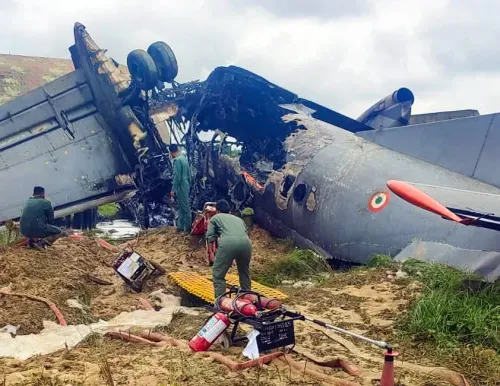
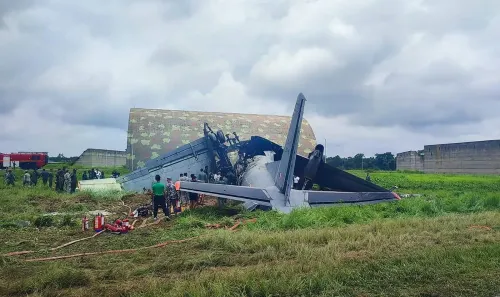
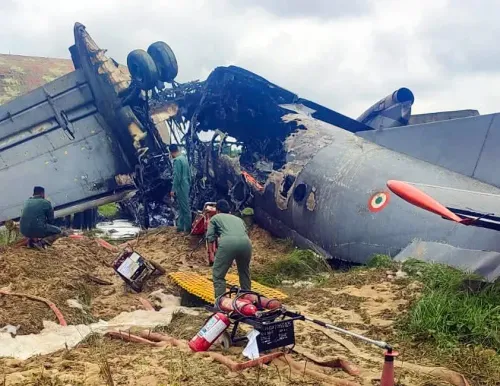
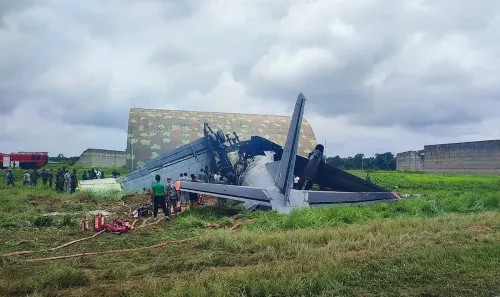
The AN-32, a workhorse transport aircraft widely used by the IAF, reportedly caught fire after making contact with the runway at Jorhat airbase. At least five IAF personnel lost their lives in the incident, according to initial reports. The exact sequence of events on the runway remains under investigation.
Possible Causes Outlined by the Expert
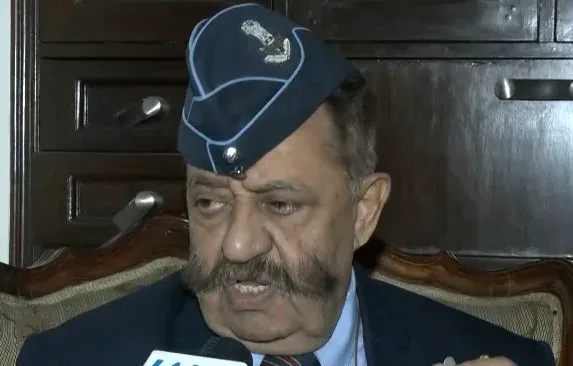
Speaking to reporters, Praful Bakshi drew on the recent Ahmedabad plane crash to contextualise the Jorhat incident, noting that a landing aircraft faces a distinct set of risk factors once it makes runway contact. He outlined three broad possibilities: a heavy landing caused by sudden loss of engine power that the pilot could not arrest; a tyre burst that sent the aircraft veering off the runway; or a bird strike that shattered the windscreen and disoriented the pilot.
'When an aircraft crashes during landing, there can be many causes,' Bakshi said. He added that it was also not yet known whether the aircraft had veered into a ditch, whether there was a sudden fuel explosion, or whether it was carrying inflammable cargo or ammunition — factors that could explain the severity of the breakup and the fire.
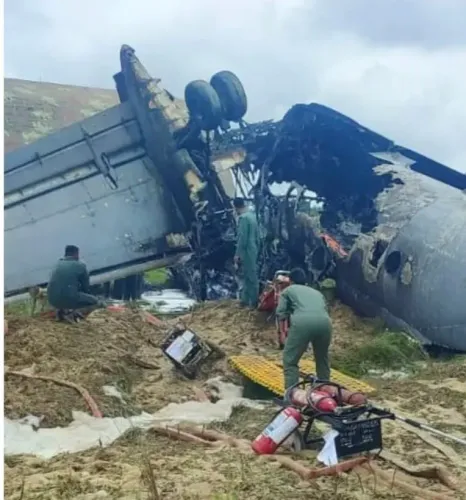
'Though it has broken up very seriously,' he noted, underlining that the degree of structural damage pointed to a high-energy impact or a secondary explosion.
The Role of Flight Recorders
Bakshi stressed that the flight data recorder (FDR) and cockpit voice recorder (CVR) would be critical in establishing the exact cause. The FDR, he explained, would reveal the aircraft's approach speed and whether it touched down with excessive force — the gravitational impact at the moment of contact would be logged. The CVR, meanwhile, would indicate whether the pilot had communicated any emergency to the ATC before the crash.
ATC Accountability: The Core Demand
The sharpest part of Bakshi's statement was directed at the ATC. He argued that the first question investigators should put to air traffic controllers is what the last conversation with the aircraft was. 'I think that should be the first question put to them,' he said.
Bakshi acknowledged that withholding early statements is a global practice among ATC authorities. 'There is a tendency all over the world for ATC not to speak immediately because it does not know the direction the investigation will take. They may not want to disclose everything at that stage,' he said, describing it as 'a current practice' — but one that, in his view, undermines transparency in the critical early hours after a crash.
According to Bakshi, the ATC's account invariably surfaces later in the investigation rather than at the outset, leaving a vacuum of information at the moment when public and institutional scrutiny is highest.
What Comes Next
A formal Court of Inquiry is expected to be convened by the IAF, as is standard procedure following fatal aircraft accidents. Investigators will aim to recover and analyse both black boxes. The findings will determine whether the cause lay with the aircraft, the crew, ground conditions, or ATC communication — and could have implications for IAF operational protocols at forward airbases.
Point of View
Black boxes are cited as the definitive arbiter, and the public waits months for answers. The Jorhat crash is the latest reminder that the IAF's ageing AN-32 fleet — a Soviet-era design still flying critical missions — raises persistent questions about airworthiness and operational risk management. Whether the cause turns out to be mechanical, human, or procedural, the pattern of institutional silence in the first 48 hours consistently erodes public trust. Mandating an early ATC disclosure, even a limited one, would be a meaningful reform — not just for optics, but for the integrity of the investigation itself.
NationPress
27 Oct 2026
Frequently Asked Questions
What happened at Jorhat airbase on 13 June?
An IAF AN-32 transport aircraft reportedly burst into flames shortly after touching down at Jorhat airbase in Assam on 13 June, killing at least five IAF personnel. The exact cause is under investigation.
What are the possible causes of the AN-32 crash at Jorhat?
Defence expert Praful Bakshi outlined several possibilities: a heavy landing caused by sudden loss of engine power, a tyre burst that sent the aircraft off the runway, a bird strike that disabled the pilot's visibility, or a secondary explosion from fuel or cargo. No cause has been officially confirmed.
Why is Praful Bakshi demanding accountability from the ATC?
Bakshi argues that the ATC's last communication with the aircraft is the single most important piece of early evidence, yet ATC authorities globally tend to withhold statements until investigators set the direction of inquiry. He says this practice delays transparency at the most critical stage of a crash investigation.
How will investigators determine the cause of the crash?
The IAF is expected to convene a Court of Inquiry. Investigators will rely on the flight data recorder, which logs approach speed and impact force, and the cockpit voice recorder, which captures any emergency communication between the pilot and ATC before the crash.
What is the AN-32 aircraft?
The AN-32 is a Soviet-designed twin-turboprop transport aircraft that has been a mainstay of the IAF's tactical airlift fleet for decades. It is used for cargo, troop transport, and supply missions, including to remote and high-altitude airfields.