Delimitation row: Giriraj warns women will teach Congress lesson
Synopsis
The delimitation fight is splitting the Opposition. The DMK is backing the Bills and the NCP (SP) is leaning in, while the BJP is casting Congress resistance as a betrayal of women's reservation. Giriraj Singh warns that half the country will punish the party at the ballot box, and Rahul Gandhi looks increasingly alone.
Key Takeaways
Union Minister Giriraj Singh said on 29 November 2026 that women would teach the Congress a lesson if it opposed the delimitation Bill.
Singh dared Rahul Gandhi to resign and cited the Congress's defeat in Tripura .
BJP leader Shahnawaz Hussain said the Bill will pass because Gandhi lacks the numbers in Parliament.
The DMK , led by M.K.
Stalin , has announced support for the Bills, and Congress ally NCP (SP) has signalled willingness to back them.
Gandhi alleged the exercise gives Modi , Amit Shah and CEC Gyanesh Kumar a “blank canvas” to redraw the electoral map.
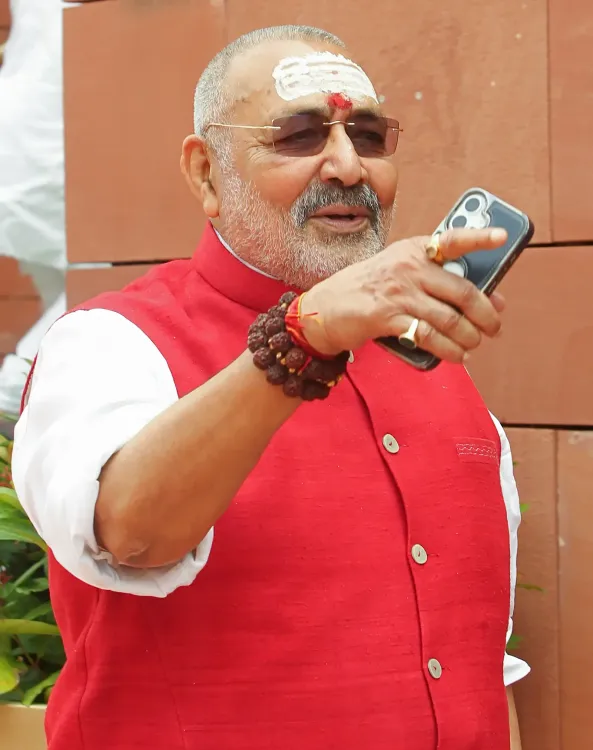
Union Minister Giriraj Singh on Sunday, 29 November 2026, attacked the Indian National Congress over its opposition to the Centre's proposed delimitation Bills. Speaking in New Delhi, he warned that women, whom he called half of the country's population, would teach the party a lesson at the ballot box if it opposed the legislation. Singh accused the Congress of contradicting its earlier support for the Women's Reservation Bill. His remarks are the latest salvo in a widening political battle over how India's parliamentary constituencies will be redrawn.
Giriraj Singh's Attack on the Congress
Singh said the Congress was undermining itself by reversing its earlier position. “All I want to say is that the Congress, by shamelessly retracting its own position and contradicting itself, is only exposing itself,” he said.
He went on: “The Congress had supported the Women's Reservation Bill. If it now opposes it, then half of the country's population will teach it a lesson, not only in the Uttar Pradesh elections but also in elections across the country.”
Singh's remarks tie the delimitation exercise to the women's reservation question. BJP leaders are using this link to frame the Congress's opposition as a stand against women's representation.
Challenge to Rahul Gandhi
Responding to remarks by Leader of Opposition Rahul Gandhi, Singh asked why the Congress leader was afraid to face the people. He also dared Gandhi to resign if his objections were so strong.
“Why is Rahul Gandhi afraid of the people? You were defeated even through the ballot in Tripura. And if you are so committed to morality, then first resign yourself. The Home Minister of Kerala says that if the SIR had not happened, we would have lost the election. They should first ensure the resignation of their own government,” Singh said.
Bharatiya Janata Party (BJP) leader Shahnawaz Hussain also targeted Gandhi. “Rahul Gandhi appears rattled as his allies continue to drift away, leaving him increasingly isolated. The growing support for this Bill has clearly unsettled him,” Hussain said.
He added: “Whether he likes it or not, the Bill will be passed because Parliament functions on the strength of numbers, and he simply does not have the majority to stop it.”
JD(U) Pitches Bihar Model, Appeals to JMM
Janata Dal (United) national spokesperson Rajiv Ranjan urged the Jharkhand Mukti Morcha (JMM) to support the delimitation initiative. He also said every political party has the right to express its views.
Ranjan pointed to Bihar's record on women's empowerment. “When Nitish Kumar was Chief Minister of Bihar, he showed the nation a path forward,” he said. “This movement is not going to stop, and the JMM should also come forward and support this initiative.”
Shifting Alliances in the Opposition Camp
The exchanges follow Rahul Gandhi's appeal to the Dravida Munnetra Kazhagam (DMK) to reconsider its decision to back the Bills. Gandhi described the fight over parliamentary constituencies as a battle for the future of Indian democracy. His appeal came after the DMK, led by former Tamil Nadu Chief Minister M.K. Stalin, announced its support for the legislation.
Gandhi also urged the BJP's southern allies to withdraw their support for the exercise. These include the Chandrababu Naidu-led Telugu Desam Party (TDP) and the Pawan Kalyan-led Jana Sena Party (JSP).
Notably, a close Congress ally, the Nationalist Congress Party (Sharadchandra Pawar), has signalled that it is willing to support delimitation. That move further complicates the Opposition's position.
Gandhi has alleged that the exercise is a calculated move to hand Prime Minister Narendra Modi, Union Home Minister Amit Shah and Chief Election Commissioner Gyanesh Kumar a “blank canvas” to redraw India's electoral map.
What Comes Next
Southern parties such as the DMK are backing the Bills, and the NCP (SP) is open to supporting them. The Congress therefore faces a test of whether it can hold the Opposition together. The next few weeks are likely to decide whether the Bills reach Parliament with broad consensus or as a sharply divided vote.
Point of View
Which makes any opposition look anti-women rather than anti-redistricting. The Congress has failed to separate those two questions in public debate. The bigger story, though, is the DMK's support for the Bills, since the party had been seen as a likely voice of southern concern over seat redistribution. When even the NCP (SP) breaks ranks, Rahul Gandhi's ‘blank canvas’ warning sounds less like an Opposition consensus and more like a lone dissent. That should worry the Congress far more than any minister's rhetoric.
NationPress
29 Nov 2026
Frequently Asked Questions
What did Giriraj Singh say about the Congress and the delimitation Bill?
Giriraj Singh said that if the Congress opposed the delimitation Bill, half of the country's population would teach it a lesson in elections in Uttar Pradesh and across the country. He accused the party of contradicting its earlier support for the Women's Reservation Bill.
Why is Rahul Gandhi opposing the delimitation Bills?
Rahul Gandhi has alleged that the delimitation exercise is a calculated move to give PM Narendra Modi, Amit Shah and CEC Gyanesh Kumar a ‘blank canvas’ to redraw India's electoral map. He has called the fight over constituencies a battle for the future of Indian democracy.
Which parties support the delimitation Bills?
The DMK, led by M.K. Stalin, has announced support for the proposed Bills. The NCP (Sharadchandra Pawar), a Congress ally, has signalled willingness to back delimitation, and the JD(U) has urged the JMM to support it.
Whom has Rahul Gandhi appealed to over the delimitation Bills?
Gandhi has appealed to the DMK to reconsider its support. He has also urged the BJP's southern allies, including Chandrababu Naidu's TDP and Pawan Kalyan's Jana Sena Party, to withdraw their backing.
What did Shahnawaz Hussain say about the Bill's chances in Parliament?
BJP leader Shahnawaz Hussain said the Bill will be passed because Parliament functions on numbers and Rahul Gandhi does not have the majority to stop it. He also said Gandhi appears isolated as his allies drift away.