Rijiju urges Congress to back Women's Reservation Bill after Rahul Gandhi's remarks
Synopsis
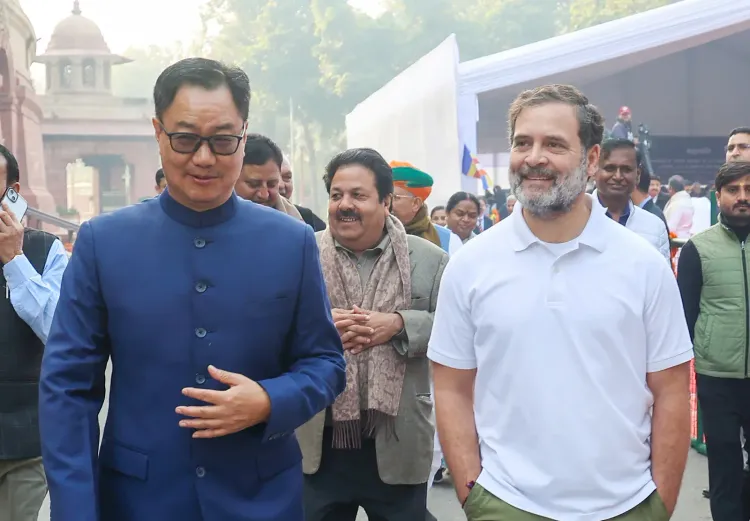
Union Minister Kiren Rijiju seized on Rahul Gandhi's public remarks about women's freedom to publicly call on Congress to back the Women's Reservation Bill — a move that doubles as political pressure during the Monsoon Session, where the government is struggling to revive the delimitation Bill that would actually trigger the quota's implementation.
Key Takeaways
Kiren Rijiju on 8 August called on Congress to unconditionally support the Women's Reservation Bill after Rahul Gandhi's remarks on women's empowerment.
Gandhi said India is 'stunted and incomplete' without the free expression of women, in an Instagram post on Friday .
The Nari Shakti Vandan Adhiniyam reserves 33 per cent of seats for women in the Lok Sabha , state assemblies, and Delhi Legislative Assembly .
Implementation depends on the Constitution (131st Amendment) Bill, 2026 (delimitation), which failed in the Budget Session in April .
Rijiju has made three attempts during the Monsoon Session to seek Gandhi's support for the delimitation Bill.
Union Parliamentary Affairs Minister Kiren Rijiju on 8 August called on the Indian National Congress (INC) to unconditionally support the Women's Reservation Bill in Parliament, citing recent remarks by Lok Sabha Leader of Opposition Rahul Gandhi on women's freedom and empowerment as a signal of a potential shift in the party's stance.
What Rijiju Said
Responding directly to Gandhi's public comments, Rijiju described them as an encouraging sign. 'This seems to be a positive message from the Congress Party. There's a visible change of heart in Shri Rahul Gandhi Ji about the women. Now, I hope Congress Party will support the Women's Reservation Bill unconditionally,' Rijiju said.
The minister framed Gandhi's remarks as an opening for bipartisan consensus on one of India's most debated pieces of legislation on gender representation.
What Rahul Gandhi Said
Gandhi had made the remarks in an Instagram post on Friday, building on responses he gave during an 'Ask Me Anything' session on Thursday. He argued that India's development is constrained by the suppression of women's voices and agency.
'I was thinking to myself that the energy of India's women is trapped, is not allowed to express itself, is not allowed to imagine. For me, no country can be successful if its women are not expressing themselves,' Gandhi said.
He further stated: 'A lot of my politics, and a lot of what politics should be in this country, is about making people understand that our country is stunted and incomplete without the expression of women.'
Gandhi stressed that empowerment must go beyond political or corporate participation and extend to everyday spaces — homes, streets, and family structures. 'It is not just about women doing well in business or in the political system, but about them being able to express themselves in their homes and walk the streets comfortably,' he added.
About the Women's Reservation Bill
The Women's Reservation Bill — officially enacted as the Constitution (One Hundred and Sixth Amendment) Act, 2023, also known as the Nari Shakti Vandan Adhiniyam — reserves 33 per cent of seats for women in the Lok Sabha, state legislative assemblies, and the Delhi Legislative Assembly. Its implementation, however, remains contingent on a delimitation exercise.
The Delimitation Link and Rijiju's Outreach
The exchange comes against the backdrop of the government's push to revive the Constitution (131st Amendment) Bill, 2026 — the delimitation Bill — which had failed to pass through the Lok Sabha during the Budget Session in April. Rijiju had telephoned Gandhi on Thursday to seek Opposition support for the Bill's reintroduction, marking his third such attempt during the ongoing Monsoon Session.
According to sources, Rijiju argued that Opposition backing for the delimitation Bill would accelerate the implementation of women's reservation, and warned that failure to implement the quota could generate resentment among women voters.
What Comes Next
The political debate over women's representation in India's legislative institutions is now entering a fresh phase, with the government actively lobbying the Opposition during the Monsoon Session. Whether Gandhi's remarks translate into Congress formally backing the delimitation Bill — the prerequisite for women's reservation to take effect — remains to be seen.
Point of View
And that is a far more contested political question involving seat redistribution between states. By framing Gandhi's empowerment rhetoric as an implicit endorsement of the delimitation Bill, the government is attempting to box Congress into a corner. Whether Congress reads this as an opportunity or a trap will define the Monsoon Session's most consequential floor dynamic.
NationPress
22 Sept 2026
Frequently Asked Questions
What is the Women's Reservation Bill and has it been passed?
The Women's Reservation Bill was enacted as the Constitution (One Hundred and Sixth Amendment) Act, 2023, also known as the Nari Shakti Vandan Adhiniyam. It reserves 33 per cent of seats for women in the Lok Sabha, state legislative assemblies, and the Delhi Legislative Assembly, but its implementation is tied to a delimitation exercise that has not yet been completed.
Why did Kiren Rijiju call on Congress to support the Bill on 8 August?
Rijiju cited Rahul Gandhi's public remarks about women's freedom and empowerment as evidence of a 'visible change of heart' in Congress, and used them to publicly urge the party to back the Women's Reservation Bill unconditionally. The appeal came during the Monsoon Session, where the government is seeking Opposition support for the delimitation Bill that would trigger the quota.
What did Rahul Gandhi actually say about women?
Gandhi, in an Instagram post and an 'Ask Me Anything' session, argued that India's development is held back by the suppression of women's voices. He said the country is 'stunted and incomplete' without women's free expression, and called for freedom from patriarchal control in homes, families, and public spaces.
What is the Constitution (131st Amendment) Bill, 2026 and why does it matter?
The Constitution (131st Amendment) Bill, 2026 is the delimitation Bill whose passage is a prerequisite for implementing women's reservation under the Nari Shakti Vandan Adhiniyam. It failed to pass through the Lok Sabha during the Budget Session in April, and the government is now seeking Opposition support for its reintroduction during the Monsoon Session.
How many times has Rijiju reached out to Rahul Gandhi on this issue?
According to sources, Rijiju has made three attempts during the ongoing Monsoon Session to discuss the delimitation Bill with Gandhi, including a phone call on Thursday in which he argued that Opposition support would speed up the implementation of women's reservation.