Rahul Gandhi demands Women's Reservation Act 2023 implementation without conditions
Synopsis
More than three years after the Women's Reservation Act was unanimously passed, it remains unimplemented — and a fresh political clash between Rahul Gandhi and Kiren Rijiju has put that delay squarely in the spotlight. Gandhi's demand to 'implement the 2023 law without any conditions' exposes the central contradiction: a law passed with cross-party consensus that the ruling government has yet to activate.
Key Takeaways
Rahul Gandhi on 8 August demanded unconditional implementation of the Women's Reservation Act 2023 , pushing back against Kiren Rijiju on X .
Gandhi accused the government of 'unnecessarily' linking the law's activation to delimitation , more than three years after its passage.
The Nari Shakti Vandan Adhiniyam reserves 33% of seats for women in the Lok Sabha , state assemblies, and the Delhi Legislative Assembly .
The Constitution (131st Amendment) Bill, 2026 , which sought to use the 2011 Census for early delimitation, failed to pass the Lok Sabha in April 2026 for want of a two-thirds majority.
Rijiju had described Gandhi's earlier remarks on women's empowerment as a 'positive message' and urged Congress to back the bill 'unconditionally'.
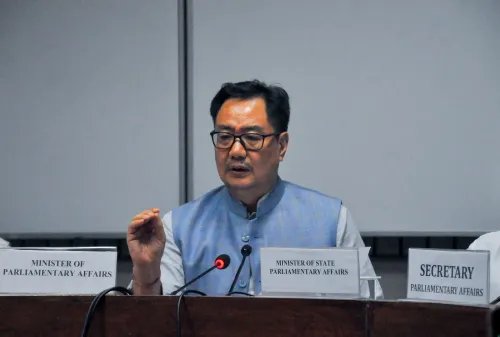
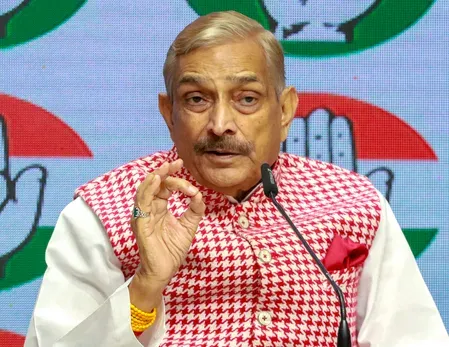
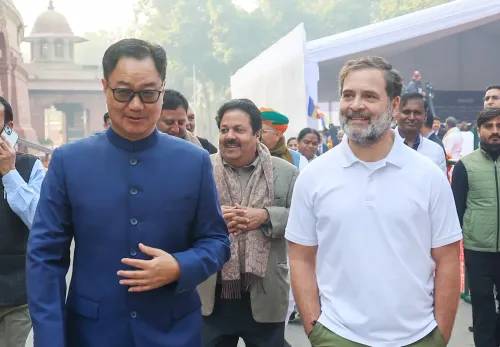
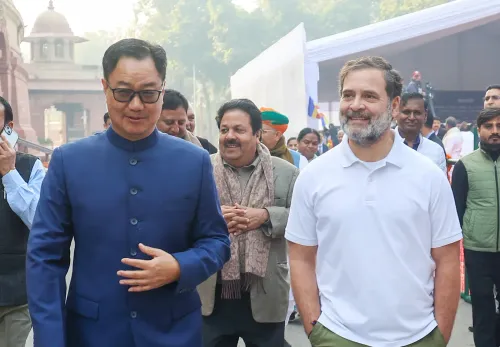
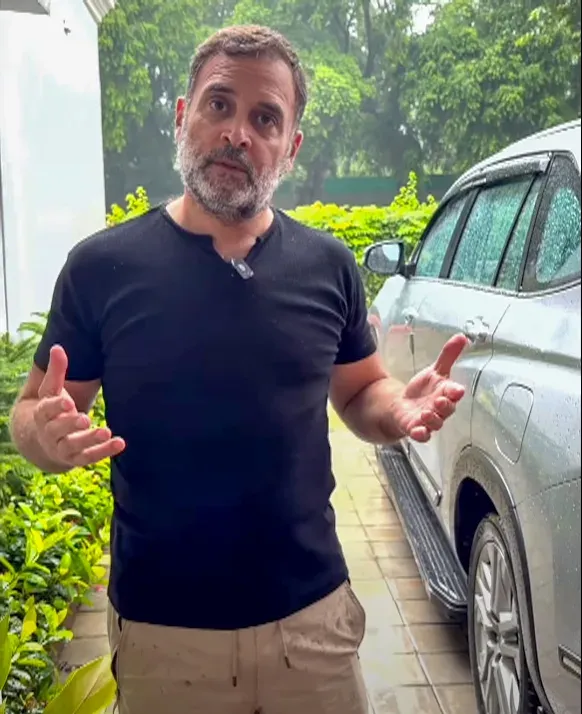
Congress leader and Lok Sabha Leader of Opposition Rahul Gandhi on Saturday, 8 August sharply pushed back against Union Parliamentary Affairs Minister Kiren Rijiju, demanding immediate implementation of the Women's Reservation Act 2023 and accusing the government of stalling the landmark law by tying it to delimitation.
What Rahul Gandhi Said
Taking to X, Gandhi reminded Rijiju that the Women's Reservation Bill 2023 had already been passed unanimously in Parliament — with the Congress party's full backing. 'Mr Rijiju, who would know better than you, as the Minister of Parliamentary Affairs — that the Women's Reservation Bill 2023 has already been passed unanimously, with the full support of the Congress,' Gandhi posted.
He pressed further: 'The question is, why has it still not been implemented even after three years, and why do you now want to unnecessarily link it to delimitation? Implement the 2023 law. Without any conditions.'
What Triggered the Exchange
The back-and-forth was sparked by Gandhi's remarks on women's empowerment, first made during an 'Ask Me Anything' session on Thursday and expanded upon in an Instagram post on Friday. In those remarks, Gandhi argued that no country can achieve true progress if women are unable to express themselves freely, and called for greater space for women in public life — extending beyond politics and business to homes, families, and everyday spaces.
Responding to those comments, Rijiju characterised them as a potentially positive shift in the Congress party's approach to women's political representation. 'This seems to be a positive message from the Congress Party. There's a visible change of heart in Shri Rahul Gandhi Ji about the women. Now, I hope Congress Party will support the Women's Reservation Bill unconditionally,' Rijiju said.
The Law at the Centre of the Dispute
The Constitution (One Hundred and Sixth Amendment) Act, 2023 — officially titled the Nari Shakti Vandan Adhiniyam — reserves 33 per cent of seats for women in the Lok Sabha, state legislative assemblies, and the Delhi Legislative Assembly. Despite being enacted in 2023, the law has not yet come into force, as its activation is contingent on a fresh delimitation exercise.
A subsequent attempt to accelerate implementation — the Constitution (131st Amendment) Bill, 2026, introduced in April 2026 — sought to use the 2011 Census for early delimitation to fast-track the 33% reservation. However, the bill failed to pass in the Lok Sabha after falling short of the required two-thirds majority.
The Broader Political Context
The exchange underscores the deepening political divide over when and how the women's quota will actually take effect. While both the ruling Bharatiya Janata Party (BJP) and the Congress claim ownership of the legislation's passage, the question of implementation — and the conditions attached to it — has become a flashpoint. Notably, this is not the first time the delimitation link has drawn opposition criticism; the failure of the 2026 amendment bill has only sharpened those concerns.
With women's representation remaining a live electoral issue ahead of several state elections, the debate over the Nari Shakti Vandan Adhiniyam is unlikely to recede anytime soon.
Point of View
Yet its implementation hinges on delimitation — a process the Centre controls entirely. The failure of the 2026 amendment bill, which tried to short-circuit that wait using 2011 Census data, reveals that the political will to actually seat more women in Parliament remains contested. Gandhi's demand for implementation 'without any conditions' is constitutionally awkward — the law itself ties activation to delimitation — but it is politically effective, forcing the government to own the delay rather than share it.
NationPress
22 Sept 2026
Frequently Asked Questions
What is the Women's Reservation Act 2023?
The Women's Reservation Act 2023, formally the Constitution (One Hundred and Sixth Amendment) Act, 2023 and also known as the Nari Shakti Vandan Adhiniyam, reserves 33 per cent of seats for women in the Lok Sabha, state legislative assemblies, and the Delhi Legislative Assembly. It was passed unanimously in Parliament in 2023 but has not yet been implemented.
Why has the Women's Reservation Act not been implemented yet?
The Act's activation is contingent on a fresh delimitation exercise — the redrawing of constituency boundaries — which has not yet taken place. Critics, including Rahul Gandhi, argue the government is using this condition to delay implementation indefinitely.
What was the Constitution (131st Amendment) Bill, 2026?
Introduced in April 2026, the Constitution (131st Amendment) Bill sought to fast-track women's reservation by using the 2011 Census for early delimitation, bypassing the wait for a fresh census. The bill failed to pass in the Lok Sabha after falling short of the required two-thirds majority.
What did Rahul Gandhi say about the Women's Reservation Bill?
On 8 August, Gandhi posted on X reminding Kiren Rijiju that the bill had already been passed unanimously with Congress's full support, and demanded the government implement the 2023 law immediately and without linking it to delimitation. He called the delimitation condition 'unnecessary'.
How did Kiren Rijiju respond to Rahul Gandhi's remarks on women?
Rijiju described Gandhi's remarks on women's empowerment as a 'positive message' and a 'visible change of heart,' expressing hope that Congress would now support the Women's Reservation Bill unconditionally in Parliament.