Rijiju's special Parliament session hint sparks NDA-Opposition clash
Synopsis
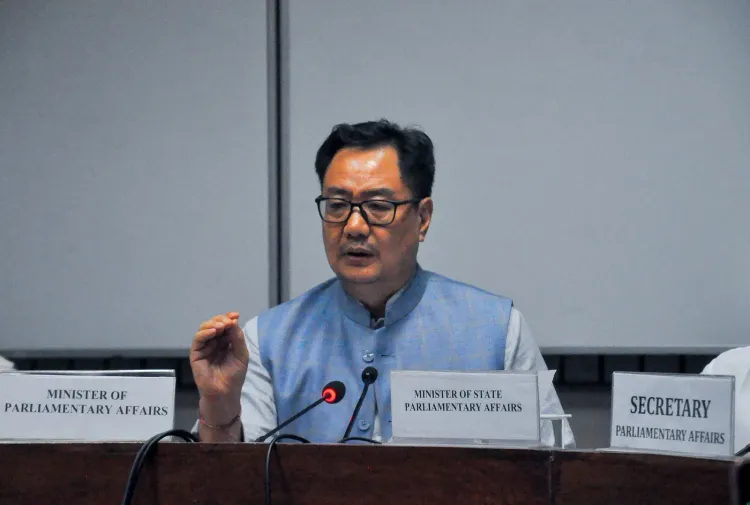
Parliamentary Affairs Minister Kiren Rijiju's hint at a special Parliament session has cracked open one of India's most combustible fault lines — the attempt to link women's reservation with delimitation. The Opposition, led by Congress and DMK, argues this is a calculated tactic: make any opponent of delimitation look anti-women. With the Constitution (131st Amendment) Bill already defeated once in the Lok Sabha, the NDA's path is narrow and politically treacherous.
Key Takeaways
Parliamentary Affairs Minister Kiren Rijiju reportedly indicated a special Parliament session could be convened, triggering a political row on 29 August .
Congress President Mallikarjun Kharge wrote to PM Modi seeking clarity on whether the session would be used to pass a delimitation Bill.
The Constitution (131st Amendment) Bill, 2026 — which includes delimitation — was already defeated in the Lok Sabha .
BJP spokesperson Pratul Shahdeo said PM Modi and Home Minister Amit Shah are resolved to re-introduce the women's reservation and delimitation bill.
DMK and Congress leaders accused the government of bundling delimitation with women's reservation to politically corner the Opposition.
Opposition parties say they support implementing the Women's Reservation Act, 2023 on the existing 543 Lok Sabha seats without waiting for delimitation.
Parliamentary Affairs Minister Kiren Rijiju's reported indication that a special session of Parliament could be convened has ignited a sharp political exchange, with the National Democratic Alliance (NDA) rallying behind the move on Saturday, 29 August, while the Opposition accused the Centre of using women's reservation as cover to push through delimitation. The row deepens an already fraught debate over the Constitution (131st Amendment) Bill, 2026, which was defeated in the Lok Sabha.
The Trigger: Kharge's Letter to Modi
Congress President Mallikarjun Kharge wrote to Prime Minister Narendra Modi seeking clarity on whether the government intended to convene a special session to pass a proposed delimitation Bill. Kharge said he was reiterating the demand after Rijiju reportedly signalled in a television interview that such a session remained on the table. The letter framed the government's approach as an attempt to bundle delimitation with women's reservation — a charge the ruling alliance firmly denies.
NDA Defends the Move
Shiv Sena spokesperson Shaina NC backed Rijiju, saying: 'As the Parliamentary Affairs Minister, he has always reached out to the Opposition...if a special session is announced, it is the prerogative for all stakeholders to partake and understand their parliamentary responsibilities.'
Bharatiya Janata Party (BJP) spokesperson Pratul Shahdeo said the government had 'resolved to re-introduce the women's reservation and delimitation bill' following the defeat of the Constitution (131st Amendment) Bill, 2026 in the Lok Sabha. He attributed the resolve directly to Prime Minister Narendra Modi and Home Minister Amit Shah, and argued that Opposition claims about seat reductions were misleading. 'People are being misled (by the Opposition) that the number of seats will go down...they (Opposition) are indulging in negative politics and will be exposed if a special session (of the Parliament) is convened,' Shahdeo said.
Opposition Pushes Back Hard
The Opposition was unsparing in its response. Purnia MP Pappu Yadav said Rijiju and 'the entire government is frustrated,' adding that the Women's Reservation Bill had already been passed three years ago and that the government did not appear serious about its implementation — 'specially the poor and middleclass women.'
Congress leader Rakesh Sinha questioned the very premise of a new bill. 'The Women's Reservation Bill has already been passed by Parliament (in 2023). So, what Women's Reservation Bill are they going to bring now?' he said, asserting that Congress and allied parties were ready to support implementation of the Women's Reservation Act, 2023 on the existing 543 Lok Sabha seats immediately, without waiting for delimitation.
Sinha further warned that delimitation would 'especially impact the southern states,' and demanded that the government make its delimitation blueprint public through an all-party meeting before any special session is called.
Southern States and the Delimitation Concern
Dravida Munnetra Kazhagam (DMK) spokesperson T.K.S. Elangovan articulated the concern most sharply, accusing the BJP of using women's reservation as political camouflage. 'They want to club delimitation with women's reservation because if anyone opposes delimitation, they will portray them as being against women's reservation. This is a tactic being used by the BJP,' he said. Elangovan clarified that the DMK was not opposed to women's reservation — it had supported the original bill — but firmly opposed the proposed delimitation and the seat numbers being suggested.
Jharkhand Mukti Morcha (JMM) spokesperson Manoj Pandey questioned whether the NDA even had the parliamentary numbers to pass the Constitution (131st Amendment) Bill, 2026, asking pointedly: 'How many more parties will they break for this?'
What Happens Next
No official announcement of a special Parliament session has been made as of 29 August. The political battle lines, however, are already drawn — with the NDA framing the push as a pro-women reform and the Opposition characterising it as a delimitation manoeuvre that threatens southern states' representation. Whether the Centre calls a special session will test both its legislative arithmetic and its ability to separate the two contentious issues in public perception.
Point of View
The government forces the Opposition into an uncomfortable corner — oppose delimitation and risk being branded anti-women. But the Opposition has found its counter-frame: the Women's Reservation Act, 2023 exists and can be implemented today on 543 seats. That argument is hard to dismiss. The deeper problem is arithmetic — the Constitution (131st Amendment) Bill, 2026 was already defeated in the Lok Sabha, and JMM's pointed question about 'how many more parties will they break' signals that the numbers remain elusive. A special session called without the votes would be a significant political miscalculation.
NationPress
13 Oct 2026
Frequently Asked Questions
Why is a special Parliament session being discussed?
Parliamentary Affairs Minister Kiren Rijiju reportedly indicated in a television interview that a special session of Parliament could be convened, possibly to pass a delimitation Bill. Congress President Mallikarjun Kharge subsequently wrote to PM Modi seeking clarity on the government's intentions.
What is the Constitution (131st Amendment) Bill, 2026?
It is a proposed constitutional amendment that reportedly links women's reservation in Parliament with a fresh delimitation of Lok Sabha seats. The Bill was defeated in the Lok Sabha, and the NDA has stated its resolve to re-introduce it.
Why is the Opposition opposing the special session?
The Opposition argues that the government is using women's reservation as political cover to push through delimitation, which they say will reduce representation for southern states. They contend the Women's Reservation Act, 2023 — already passed by Parliament — can be implemented immediately on the existing 543 Lok Sabha seats without any new delimitation.
What is the Women's Reservation Act, 2023?
The Women's Reservation Act, 2023 was passed by Parliament in 2023 and reserves one-third of seats in the Lok Sabha and state assemblies for women. However, its implementation is linked to a delimitation exercise, which the Opposition says the government should decouple.
Which parties are opposing the government's position?
Congress, DMK, JMM, and Purnia MP Pappu Yadav's faction are among those opposing the Centre's approach. The DMK has been particularly vocal, warning that the proposed delimitation would adversely affect southern states' seat count in Parliament.