Rijiju vs Rahul Gandhi: Women's quota row over 2023 law and delimitation delay

Synopsis
The Nari Shakti Vandan Adhiniyam was passed unanimously in 2023 — yet women’s reservation may not arrive until 2034. Rijiju’s public rebuttal to Rahul Gandhi lays bare an uncomfortable truth: a landmark law sits constitutionally locked behind a census and delimitation process that the government itself says could take years, and the bill that could have unlocked it early was just defeated in the Lok Sabha.
Key Takeaways
Kiren Rijiju publicly rebutted Rahul Gandhi on 8 August over the implementation of the Nari Shakti Vandan Adhiniyam (Constitution 106th Amendment Act, 2023) .
The law mandates 33% reservation for women in the Lok Sabha and state assemblies, but is constitutionally linked to a post- 2026 census and subsequent delimitation.
Rijiju warned that the delay could push implementation to at least the 2034 general elections if an early delimitation is not undertaken.
The Constitution (131st Amendment) Bill, 2026 , introduced in April 2026 to fast-track the process using 2011 Census data, was defeated in the Lok Sabha for failing to secure a two-thirds majority .
Rahul Gandhi accused the government of unnecessarily tying women’s reservation to delimitation, arguing the 2023 law already had broad parliamentary support.
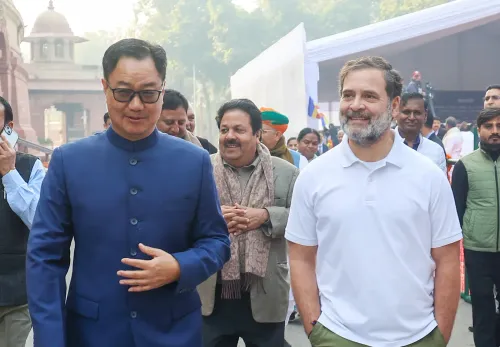
Union Parliamentary Affairs Minister Kiren Rijiju on 8 August fired back at Congress leader and Lok Sabha Leader of Opposition Rahul Gandhi over the implementation of women's reservation, citing the provisions of the Constitution (106th Amendment) Act, 2023 — also known as the Nari Shakti Vandan Adhiniyam — and the structural hurdles tied to delimitation and the ongoing census exercise.
What Rijiju Said on X
Posting on X, Rijiju stated: “Rahul Ji, you know it very well that: The reservation of seats for women in the House of the People and Legislative Assembly of the State is provided in the Constitution (106th Amendment) Act, 2023 (Nari Shakti Vandan Adhiniyam).” He pointed out that the constitutional provision can only come into effect “after an exercise of delimitation is undertaken” and “based on the census figures published after the year 2023, which means the census figures published after the year 2026.”
The minister cautioned that the census process “may take substantial time (due to caste-based census) to be finally published,” adding: “In view of this, it may result in considerable delay in the implementation of women reservation, at least not before 2034 General Elections.”
The 2029 Window and the Legislative Route
Rijiju argued that implementing women’s reservation in time for the 2029 general elections would require the delimitation exercise to begin “at the earliest, based on the latest available Census figures, as published.” To that end, the government had introduced the Delimitation Bill, 2026 in the Lok Sabha alongside proposed constitutional amendments to fast-track the process using 2011 Census data.
However, the Constitution (131st Amendment) Bill, 2026 — introduced in April 2026 specifically to enable early delimitation and bring 33 per cent reservation into effect before 2029 — was defeated in the Lok Sabha after falling short of the required two-thirds majority.
Rahul Gandhi’s Counter
Earlier in the day, Gandhi had reacted to Rijiju’s initial remarks by asserting that the women’s quota Bill had been unanimously passed by Parliament in 2023 with the “full support of Congress.” The Congress leader accused the government of “unnecessarily linking” the implementation of women’s reservation with the delimitation exercise, maintaining that the legislation already had broad cross-party backing and that the government was stalling its operationalisation.
The exchange was triggered after Rijiju had earlier suggested that Congress should have “no difficulty” in supporting the Women’s Reservation Bill in Parliament — a framing Gandhi pushed back against sharply.
Why the Delay Matters
The Nari Shakti Vandan Adhiniyam, passed unanimously in September 2023, was widely hailed as a landmark step. Yet its activation is constitutionally contingent on two sequential events: completion of a fresh census and a subsequent delimitation of constituencies. With the current census incorporating caste enumeration for the first time in decades, the timeline has grown uncertain. Rijiju’s remarks suggest the government now formally acknowledges that 2034 is the more realistic implementation window unless an accelerated legislative path is found.
This is the latest in a running public exchange between the two leaders on X over the women’s quota timeline, and it underscores a deepening political fault line: the government contends the delay is constitutional and structural, while the Opposition argues it reflects a lack of political will. With the 2029 elections less than four years away, the question of whether women’s reservation can be operationalised in time is set to remain a central battleground.
Point of View
2026, which would have broken the deadlock using 2011 Census data, was the government’s own vehicle, and it failed to clear the Lok Sabha. Rijiju’s warning that 2034 is the realistic window is less a statement of legal inevitability and more an admission of legislative failure. Meanwhile, Gandhi’s charge that the government is ‘unnecessarily linking’ reservation to delimitation sidesteps the constitutional text, which makes that linkage explicit. The real accountability question — who is responsible for the 131st Amendment’s defeat — is the one neither side is answering directly.
NationPress
22 Sept 2026
Frequently Asked Questions
What is the Nari Shakti Vandan Adhiniyam?
The Nari Shakti Vandan Adhiniyam is the Constitution (106th Amendment) Act, 2023, passed unanimously by Parliament in September 2023. It provides for 33% reservation for women in the Lok Sabha and state legislative assemblies, but its implementation is constitutionally linked to a fresh census and a subsequent delimitation exercise.
Why has women’s reservation not been implemented yet?
The 2023 law can only take effect after delimitation of constituencies based on census figures published after 2026. The ongoing census — which now includes caste enumeration — may take considerable time, potentially pushing implementation beyond the 2029 general elections and possibly to 2034, according to Minister Rijiju.
What was the Constitution (131st Amendment) Bill, 2026, and why did it fail?
The Constitution (131st Amendment) Bill, 2026, introduced in April 2026, sought to fast-track women’s reservation by using 2011 Census data for an early delimitation, enabling the 33% quota in time for the 2029 elections. The bill was defeated in the Lok Sabha after it fell short of the required two-thirds majority.
What is Rahul Gandhi’s position on the women’s reservation dispute?
Gandhi asserted that the 2023 women’s quota Bill was passed with the full support of Congress and accused the government of unnecessarily linking its implementation to delimitation. He argued that the legislation had broad cross-party backing and that the government lacked the political will to operationalise it.
Can women’s reservation still be implemented before the 2029 elections?
Rijiju stated that implementation by 2029 is possible only if the delimitation exercise begins immediately using the latest available census figures. However, with the Constitution (131st Amendment) Bill, 2026, defeated and the census process ongoing, the path to a 2029 implementation remains constitutionally and legislatively uncertain.