R&D gap: FM Sitharaman urges India Inc to shift from 'Made in India' to 'Imagined in India'

Synopsis
India spends just 0.83% of GDP on R&D — less than a third of the OECD average — and its private sector contributes only 36% of that, versus 70%+ in advanced economies. Finance Minister Sitharaman used a national management forum to demand a structural shift: from assembling products to imagining them, with more IP, more academia-industry collaboration, and more inclusive product design.
Key Takeaways
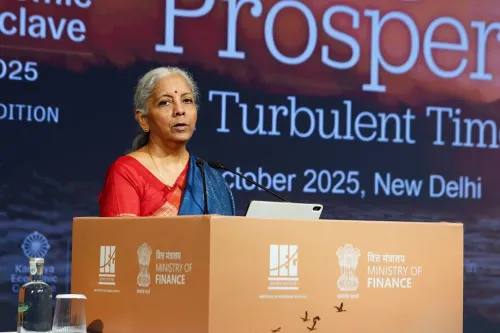
Finance Minister Nirmala Sitharaman addressed the All India Management Association (AIMA) in New Delhi on 22 September 2026 .
India's Gross Expenditure on R&D is just 0.83% of GDP , against an OECD average of 2.7% , China's 2.6% , and the US's 3.5% .
India's private sector accounts for only 36% of R&D spending, compared with over 70% in leading advanced economies.
Sitharaman called for the national ambition to shift from 'Made in India' to 'Imagined in India' — products conceived, designed, and developed domestically.
She urged corporates to widen their consumer focus beyond the urban elite and to engage constructively with regulators rather than default to litigation.
All efforts were framed within the Viksit Bharat by 2047 development roadmap.
Finance Minister Nirmala Sitharaman on Tuesday, 22 September called on Indian industry to move beyond mere business expansion and build enterprises that are innovative, resilient, well-governed, and globally competitive. Addressing an event organised by the All India Management Association (AIMA) in New Delhi, she argued that India's next growth chapter must be grounded in quality — and that means significantly scaling up corporate spending on research and development.
The 'Imagined in India' Vision
Sitharaman articulated a clear ambition for Indian industry: stop being a manufacturing destination and become an innovation origin. 'Our ambition must move from Made in India to Imagined in India — products not only manufactured here, but conceived, designed, and technologically developed here, and then taken to markets across the world,' she said. She urged corporates to raise R&D investment either through in-house units or through structured collaboration with academia, with the explicit goal of generating more intellectual property created in and from India.
India's R&D Spending: A Stark Gap
The Finance Minister cited sobering numbers to make her case. India's Gross Expenditure on R&D stands at just 0.83% of GDP — far below the OECD average of 2.7%, China's 2.6%, and the United States' 3.5%. Equally telling is the structure of that spending: India's private sector accounts for only 36% of total R&D outlay, compared with over 70% in leading advanced economies. This gap, Sitharaman observed, reflects a persistent shortfall in private-sector R&D depth that needs urgent correction if India is to compete at the technology frontier.
Management Education and Inclusive Growth
Beyond R&D, the Finance Minister stressed the need to redesign management education. She called for short, practical courses covering hiring, delegation, financial discipline, customer management, compliance, and systems-building — targeted at founders and early employees of growing firms. She also flagged the specific needs of family-owned businesses, urging practical programmes on succession planning, governance, professionalisation, conflict management, and delegation.
Sitharaman also pushed back against a narrowly urban, premium-focused growth model. 'India's consumption base rests on working families across agriculture, rural construction, transport, and informal enterprise. If corporate India pursues premiumisation for the urban tier alone, growth will lose its structural durability,' she warned, urging companies to design products and services for a far wider consumer base.
Corporate Governance and Industry-Government Relations
The Finance Minister used the platform to address corporate governance and the tone of business-government relations. She urged companies to strengthen internal governance mechanisms and to resist the reflex of seeking legal recourse at the first sign of disagreement with regulators. 'Every disagreement need not begin as litigation. There is considerable value in engaging early, placing evidence on the table, participating seriously in consultations and working towards solutions before differences become disputes,' she said. In turn, she acknowledged that a mature economy required businesses to offer predictability and transparency — and that the relationship should be capable of 'disagreement without immediately becoming adversarial.'
The Viksit Bharat Context
Sitharaman framed the entire address within the government's Viksit Bharat by 2047 roadmap, arguing that the quality of enterprises and institutions being built today would ultimately determine the country's trajectory. With India aiming to become a developed economy by its centenary of independence, the Finance Minister's message was direct: incremental growth is no longer enough — structural transformation in innovation capacity, governance, and inclusivity is the actual bar.
Point of View
Not merely an ambition deficit. More pointed is her warning on premiumisation: with consumption growth increasingly concentrated in the top income decile, the risk of a structurally narrow recovery is real, and corporate India's product pipelines have not visibly shifted. The call to reduce adversarial litigation with regulators is well-timed given high-profile disputes, but it cuts both ways — predictability must come from the regulatory side too, a point she acknowledged only in passing.
NationPress
22 Sept 2026
Frequently Asked Questions
What did Finance Minister Sitharaman say about India's R&D spending?
Sitharaman said India's Gross Expenditure on R&D stands at just 0.83% of GDP, far below the OECD average of 2.7%, China's 2.6%, and the US's 3.5%. She called on corporate India to substantially raise R&D investment, either in-house or through academia collaboration, to generate more intellectual property from India.
What does 'Imagined in India' mean?
'Imagined in India' is the ambition Sitharaman articulated for Indian industry — a step beyond 'Made in India' — where products are not just manufactured in India but conceived, designed, and technologically developed here before reaching global markets. It reflects a push to move India up the innovation value chain.
Why is India's private-sector R&D share a concern?
India's private sector contributes only 36% of total R&D spending, compared with over 70% in leading advanced economies. This means the bulk of India's already-low R&D outlay comes from public institutions, limiting the commercial application and speed of innovation needed to compete globally.
What did Sitharaman say about corporate governance and litigation?
Sitharaman urged corporate leaders to strengthen internal governance and avoid defaulting to legal action whenever they disagree with regulators. She said businesses should engage early, present evidence, and participate in consultations before disputes escalate — while also acknowledging that companies must offer predictability and transparency in return.
How does this speech connect to the Viksit Bharat goal?
Sitharaman framed the entire address within the government's Viksit Bharat by 2047 roadmap, arguing that the quality of enterprises built today will determine whether India achieves developed-economy status by its centenary of independence. She said the contribution of Indian management will be judged by institutional quality, not just business size.