IIT Kharagpur law school signs MoU with Law Commission to boost policy research
Synopsis
IIT Kharagpur's specialist IP law school has formally partnered with the Law Commission of India — one of the first times a technology-focused law school has linked directly with the country's apex law reform body. The tie-up opens a pipeline from academic research to national legislation, with emerging areas like digital evidence squarely in its remit.
Key Takeaways
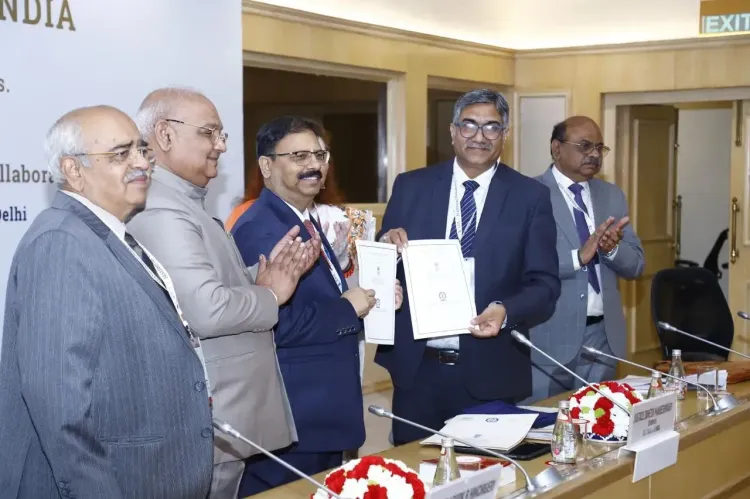
RGSoIPL at IIT Kharagpur signed an MoU with the Law Commission of India on 11 November 2026 .
The partnership covers joint research, academic exchanges, capacity-building, publications, and expert input on law reform , including digital evidence and administrative studies.
The MoU was signed by Additional Secretary Praveen Srivastava (ILS) in the presence of Law Commission Chairperson Justice Dinesh Maheshwari and RGSoIPL Dean Prof.
RGSoIPL was founded in 2006 with support from alumnus Vinod Gupta to train scientists and engineers as intellectual property law specialists.
The school is recognised by the Bar Council of India and offers LL.B., LL.M., and doctoral programmes in Intellectual Property Law.
The Rajiv Gandhi School of Intellectual Property Law (RGSoIPL) at the Indian Institute of Technology (IIT) Kharagpur has signed a Memorandum of Understanding (MoU) with the Law Commission of India on 11 November 2026, in a move aimed at bridging academic legal research with national policymaking and law reform efforts.
Key Signatories and Officials Present
The MoU was formally signed on behalf of the Law Commission by Additional Secretary Praveen Srivastava (ILS). The ceremony was attended by Law Commission Chairperson Justice Dinesh Maheshwari, Member Prof. D.P. Verma, Member Secretary Anju Rathi Rana, and RGSoIPL Dean Prof. Uday Shankar.
Scope of the Collaboration
According to IIT Kharagpur, the partnership will facilitate joint legal and policy research, academic exchanges, capacity-building programmes, publications, impact assessments, and expert contributions to law reform initiatives. The collaboration will also extend to emerging areas such as digital evidence and administrative studies.
The institute stated that the alliance reflects its commitment to interdisciplinary excellence and evidence-based policymaking, giving faculty and students direct avenues to shape India's regulatory framework. 'Together, we aim to transform academic knowledge into meaningful legal and policy impact for a stronger, future-ready India,' the institution's statement noted.
About RGSoIPL: Background and Programmes
Established in 2006 with the support of distinguished IIT Kharagpur alumnus Vinod Gupta, RGSoIPL was founded to train scientists and engineers as specialists in intellectual property law — a response to the growing convergence of rapid technological advancement and complex legal frameworks.
Recognised by the Bar Council of India, the school offers a specialised three-year LL.B. programme in Intellectual Property Law, alongside LL.M. and doctoral programmes. Its interdisciplinary curriculum is delivered by a faculty that combines technical and legal expertise, and the school enrolls graduates from diverse science and technology disciplines.
Significance and What Comes Next
The MoU positions RGSoIPL as a direct contributor to India's law reform pipeline at a time when emerging technology — from artificial intelligence to digital evidence — is outpacing existing legislation. The school's existing network of domestic and international academic tie-ups, student exchange programmes, and industry expert lectures provides an infrastructure the Law Commission can leverage for expert input.
Notably, this is among the few instances of a technology-focused law school formally partnering with the country's apex law reform body, signalling a broader shift toward evidence-driven, technically informed legal reform. How the collaboration's research outputs are translated into actionable recommendations will be closely watched by legal academia and policymakers alike.
Point of View
AI liability frameworks, and data protection implementation all remain works in progress. By formally linking a technology-oriented law school to the Law Commission, this MoU attempts to close that gap institutionally rather than on a case-by-case basis. The real test will be whether joint research outputs actually feed into draft legislation with traceable academic input, or remain conference papers. Given how slowly Commission recommendations have translated into statute in the past, the collaboration's value will depend entirely on the pipeline it builds — not the signing ceremony.
NationPress
11 Nov 2026
Frequently Asked Questions
What is the MoU between IIT Kharagpur and the Law Commission of India about?
The MoU formalises a collaboration between RGSoIPL at IIT Kharagpur and the Law Commission of India for joint legal and policy research, academic exchanges, capacity-building, and expert contributions to law reform initiatives, including emerging areas such as digital evidence. It was signed on 11 November 2026.
Who signed the MoU on behalf of the Law Commission of India?
Additional Secretary Praveen Srivastava (ILS) signed the MoU on behalf of the Law Commission. Law Commission Chairperson Justice Dinesh Maheshwari, Member Prof. D.P. Verma, and Member Secretary Anju Rathi Rana were present at the signing.
What is the Rajiv Gandhi School of Intellectual Property Law (RGSoIPL)?
RGSoIPL is a specialised law school at IIT Kharagpur established in 2006 with support from alumnus Vinod Gupta to train scientists and engineers as intellectual property law specialists. It is recognised by the Bar Council of India and offers LL.B., LL.M., and doctoral programmes in Intellectual Property Law.
Why does this MoU matter for India's legal and policy landscape?
The partnership gives India's apex law reform body direct access to technically qualified legal researchers at a time when emerging technology — including AI, digital evidence, and data governance — is outpacing existing legislation. It represents one of the few formal links between a technology-focused law school and the Law Commission.
What areas will the IIT Kharagpur–Law Commission collaboration focus on?
The collaboration will cover joint research and publications, academic and student exchanges, capacity-building programmes, impact assessments, and expert input on law reform. Specific emerging areas highlighted include digital evidence and administrative studies.