IIT Kharagpur, MbPA, ASI launch ₹1 crore Elephanta Island maritime study
Synopsis
Elephanta Island — long known for its rock-cut Shiva caves — is now at the centre of a landmark scientific investigation. A ₹1 crore joint project by IIT Kharagpur, the Mumbai Port Authority, and ASI will drill sediment cores and analyse isotopes to reconstruct 1,500 years of sea-level shifts and maritime trade, with findings that could directly inform Mumbai's climate-resilience planning.
Key Takeaways
IIT Kharagpur , Mumbai Port Authority (MbPA) , and ASI have launched a joint research project on Elephanta Island's maritime and climate history.
The MbPA has committed ₹1 crore to fund the interdisciplinary initiative.
Recent ASI excavations uncovered a 165-square-metre , eight-metre-deep reservoir and artefacts including Indo-Mediterranean amphora fragments and Mesopotamian torpedo jars .
The IPCC projects sea levels along India's western coast could rise by up to 1 metre by 2100 , threatening Mumbai and the island's heritage structures.
Researchers will drill sediment cores and analyse strontium and neodymium isotopes to trace ancient trade routes and reconstruct past climate conditions.
The study covers the Early Historic to Medieval period , approximately 1,000–1,500 years before the present .
IIT Kharagpur, the Mumbai Port Authority (MbPA), and the Archaeological Survey of India (ASI) have jointly launched an interdisciplinary research project to examine how historical climate fluctuations and sea-level changes shaped maritime trade and human settlements around Elephanta Island and India's western coast. The MbPA has committed ₹1 crore to fund the initiative, which was announced on Wednesday, 2 September.
Scope of the Research Project
The project will combine advanced earth-science techniques — including radiocarbon dating, sediment analysis, and isotopic profiling — with archaeological evidence to reconstruct past sea levels, climatic conditions, and maritime activity spanning the Early Historic to Medieval period, roughly 1,000 to 1,500 years before the present. According to a statement issued by IIT Kharagpur, the initiative is expected to generate new scientific insights into the relationship between environmental change, coastal geography, ancient settlements, and maritime trade networks.
Prof Melinda Bera of the Department of Geology and Geophysics, IIT Kharagpur, and Principal Investigator of the project, explained the methodology: 'We would like to reconstruct the past climate and sea level by using state-of-the-art scientific tools available at IIT Kharagpur. The modern terrain, with two hills divided by a tidal valley surrounded by low-gradient, mangrove-fringed foreshores, makes the island highly sensitive to even minor sea-level shifts. We would like to drill several cores around Elephanta and other parts of the west coast and study the sediments for radiocarbon dating, sediment sources, and oxygen, carbon, and nitrogen isotopes for reconstructing both climate and sea level in the past.'
What Excavations Have Already Revealed
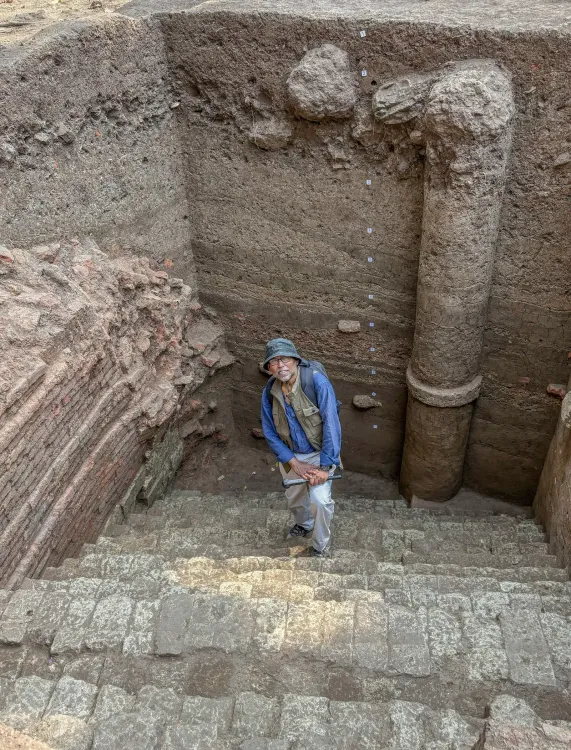
Recent excavations led by Abhijit Ambekar of the ASI have uncovered compelling evidence that Elephanta Island was a significant centre of human activity approximately 1,500 years ago. Archaeologists unearthed a massive 165-square-metre, eight-metre-deep rectangular reservoir connected to a stepped junction — indicating sophisticated freshwater storage systems on the island.
The dig also yielded giant storage jars, Indo-Mediterranean amphora fragments, turquoise glazed ware, and Mesopotamian torpedo jars, pointing to extensive maritime links with distant civilisations. Submerged wharf structures, intertidal habitation remains, and multiple watermarks on port installations further suggest that Elephanta was integrated into wider maritime trade networks, rather than functioning solely as a religious site — home to the iconic 1,500-year-old rock-cut caves of Lord Shiva, a UNESCO World Heritage Site.
The Climate Change Dimension
The research carries urgent contemporary relevance. The Intergovernmental Panel on Climate Change (IPCC) projects global sea levels to rise between 0.4 and 0.8 metres by the end of 2100. For India's western coast, that rise could reach up to 1 metre, according to the statement — a scenario that would submerge low-lying areas of Mumbai and threaten the terrain surrounding Elephanta Island itself. By studying how past sea-level shifts affected human settlement and trade, the team hopes to generate data with direct bearing on future coastal planning.
Prof V. Ravikant, a co-investigator and expert in radiogenic isotope studies, said the team would also analyse archaeological potsherds and jars for strontium and neodymium isotopes: 'They can pinpoint and trace the exact locations of the soils used for manufacturing these pots and jars.' Ajay Yadav, a research scientist and expert in ancient trade currently working abroad and associated with the IIT group, added: 'Indeed, Elephanta opens up a new avenue for scientifically studying the ancient maritime trade of India.'
Why This Study Matters Beyond Academia
This is among the first projects to formally integrate geological core-drilling with archaeological isotope analysis on India's western coastline. Notably, the institutional partnership — combining a premier technical university, a port authority, and the country's apex archaeological body — signals a broader push to apply hard science to India's cultural heritage sites. The findings could reshape understanding of pre-medieval Indian Ocean trade routes and inform climate-resilience strategies for coastal cities like Mumbai.
Results from the core-drilling and isotopic analysis are expected to be published in peer-reviewed research over the coming years, with the project's scope extending across multiple sites along India's western coast.
Point of View
500-year-old UNESCO caves are directly in the frame. If the sediment cores and isotopic data yield credible sea-level reconstructions, they could provide the evidentiary baseline that urban planners and heritage bodies have been missing when making decisions about coastal infrastructure.
NationPress
17 Oct 2026
Frequently Asked Questions
What is the IIT Kharagpur and ASI Elephanta Island research project?
It is a joint interdisciplinary project by IIT Kharagpur, the Mumbai Port Authority, and the Archaeological Survey of India to study how historical climate shifts and sea-level changes shaped maritime trade and human settlements around Elephanta Island and India's western coast. The Mumbai Port Authority has committed ₹1 crore to fund the initiative.
What did recent excavations at Elephanta Island uncover?
Excavations led by ASI's Abhijit Ambekar revealed a 165-square-metre, eight-metre-deep rectangular reservoir, giant storage jars, Indo-Mediterranean amphora fragments, turquoise glazed ware, and Mesopotamian torpedo jars. Submerged wharf structures and intertidal habitation remains suggest Elephanta was a major maritime trade hub roughly 1,500 years ago.
How is climate change connected to the Elephanta Island study?
The IPCC projects sea levels along India's western coast could rise by up to 1 metre by 2100, threatening Mumbai's low-lying areas and the terrain around Elephanta Island. The project aims to use past sea-level data to better understand and anticipate the future impact of climate-driven coastal changes on the region.
What scientific methods will the research team use?
Researchers will drill sediment cores around Elephanta and other western coast sites to conduct radiocarbon dating and analyse oxygen, carbon, and nitrogen isotopes for climate and sea-level reconstruction. They will also study strontium and neodymium isotopes in archaeological pottery to trace the geographic origins of ancient trade goods.
Why is Elephanta Island historically significant?
Elephanta Island is home to 1,500-year-old rock-cut caves dedicated to Lord Shiva and is designated a UNESCO World Heritage Site. New archaeological evidence now suggests it also served as an important maritime trade centre with connections to the Mediterranean and Mesopotamia, making it a site of both religious and commercial historical importance.