Would INDIA bloc Have Engaged with the US as Equals?
Synopsis
In a passionate speech, Rahul Gandhi asserts that an INDIA bloc government would have negotiated with the US on equal terms, safeguarding India's interests. He highlights the importance of energy security and the strategic value of Indian data amid global instability. Explore his insights into the current geopolitical landscape and India's strengths.
Key Takeaways
India's negotiating stance should be based on equality.
Energy security is a top priority for India.
Data sovereignty is crucial in the current geopolitical landscape.
Global instability calls for a reevaluation of diplomatic strategies.
India's strength lies in its people and resources .
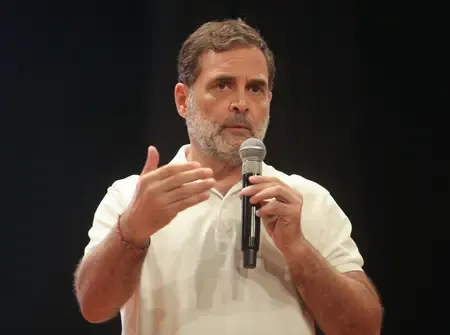
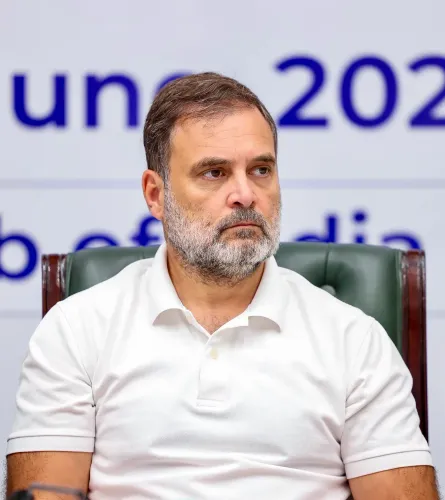
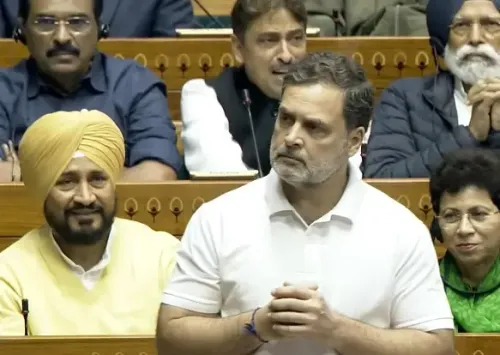
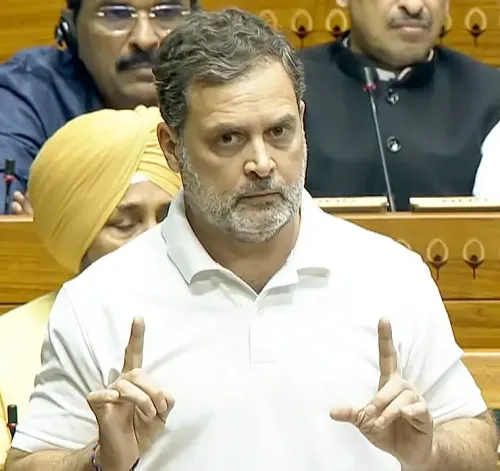
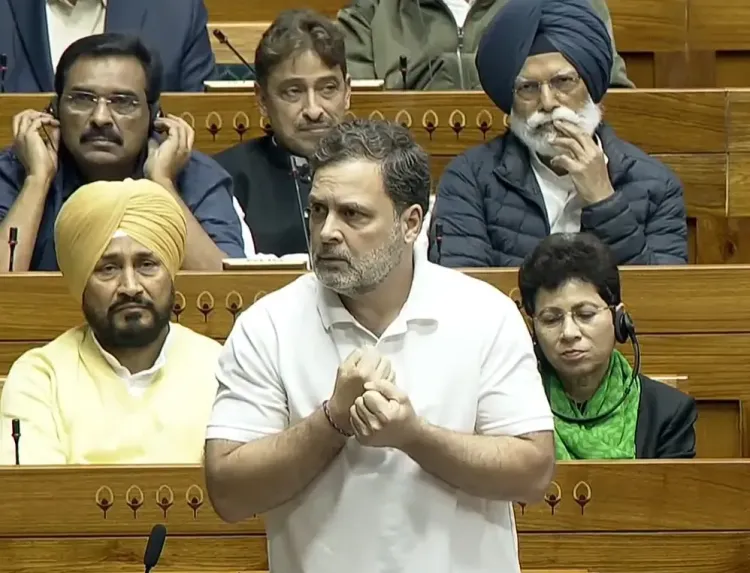
New Delhi, Feb 11 (NationPress) Rahul Gandhi, the Leader of Opposition in the Lok Sabha, stated on Wednesday that had an INDIA bloc government engaged in negotiations with the US, it would have secured an agreement on equal terms, preventing India from being compared to Pakistan. He emphasized that such a government would take all necessary measures to protect India’s energy security and farmers' interests.
During a discussion on the Union Budget, Gandhi called for what he termed “creative freedom” in his address, using martial arts analogies to illustrate political strategies and negotiations.
“The essence of martial arts begins with the grip. Without grip, nothing occurs. First comes the grip, followed by another grip, leading to the choke. The choke targets the neck and establishes control... Eventually, you can see defeat in the opponent's eyes, and they acknowledge their loss, tapping out... While grip, choke, and tap are evident in martial arts, they are absent in politics,” he remarked.
Gandhi referenced the Economic Survey, stating it underscored two significant global trends influencing the current geopolitical climate. “Upon reviewing the economic survey, I noted two key points. Firstly, we exist in a world of escalating geopolitical conflict, as US dominance faces challenges from China, Russia, and other powers.”
“Secondly, we live in a realm of energy and financial weaponization. The main takeaway is that we are transitioning from a state of stability to one of instability. The Prime Minister and, surprisingly, the NSA claim that the era of war is over. In truth, we are entering a warlike era,” he stated.
Addressing ongoing global conflicts, Gandhi remarked, “Wars are evident in Ukraine, Gaza, and the Middle East, and threats loom over Iran. We previously had Operation Sindoor. Thus, we are entering a world of instability.”
The Congress leader concurred with the Economic Survey’s assertion that the dominance of the US dollar is being contested. “I agree with the Economic Survey's claim that the US dollar faces challenges, as does US supremacy. We are transitioning from a singular superpower to a potentially unpredictable landscape of multiple powers,” he added.
Gandhi highlighted concerns surrounding the implications of artificial intelligence and the significance of data in the contemporary technological landscape. “Discussions about AI are akin to discussing the internal combustion engine without mentioning petrol. Data is the fuel for AI. Without data, AI is ineffective,” he explained.
“Which are the two largest data reservoirs globally? The Indian and Chinese pools. They share a population of 1.4 billion; however, we possess a larger populace, grant more freedoms, and enable our citizens to engage in more dynamic endeavors, thus yielding more valuable data,” he continued.
He urged India to recognize its strengths in a swiftly evolving global landscape. “To navigate a perilous world, we must acknowledge our strengths. Our primary strength lies in our people,” he asserted.
“The second strength is our food supply and farmers. Food availability is abundant today. Thirdly, energy resources must be safeguarded during tumultuous times,” Gandhi stated.
He mentioned that while the Union Budget seems to acknowledge these crucial areas, it fails to address them comprehensively.
Discussing the interim trade agreement with the US, Gandhi said, “In conjunction with the Budget, we've secured a deal with the United States. It’s crucial to clarify a misunderstanding—In the context of US-China relations, India's data is our most valuable asset.”
“To maintain superpower status and safeguard their dollar, the Americans must prioritize Indian data. Why? Because the Chinese possess a data pool of 1.4 billion individuals,” he noted, adding that the data pool from the US, Africa, and Europe cannot compete with China's.
Gandhi outlined India's negotiating stance, stating, “When India approaches the negotiation table, we bring our people— their wisdom, preferences, creativity, and fears. In the 21st century, this holds significant value. In the 20th century, it was undervalued.”
He contrasted how the INDIA Alliance would have approached discussions with US President Donald Trump, saying, “We would assert that the pivotal factor in this equation is Indian data. You aim to protect your dollar. As your allies, we can help safeguard it, but you must recognize that the greatest asset to protect your dollar lies with the Indian populace. Additionally, we would have conveyed to President Trump that he must treat us as equals, not as subordinates.”
He further stated, “Our energy security is paramount, and we will prioritize it. We acknowledge that you need to support your farmers, but we will equally defend our farmers.”
“We would engage on equal footing, refusing to be equated with Pakistan,” Gandhi asserted.
He also mentioned that an INDIA bloc government would have reacted to Pakistan Field Marshal Asim Munir's meeting with the US President.
Gandhi expressed concerns that the trade arrangement might compromise India’s strategic autonomy regarding energy procurement.
“The US will dictate where we purchase our oil, not our Prime Minister. If India opts to buy oil from a country disapproved by the US, we will face punitive tariffs,” he warned.
Continuing his critique, Gandhi stated, “You’ve weaponized energy, yet you lack solutions to address this.”
Point of View
It's crucial to recognize the importance of strong diplomatic relationships while advocating for national interests. Rahul Gandhi's perspective sheds light on the necessity of viewing India as an equal partner in international negotiations, particularly in the context of energy security and data sovereignty.
NationPress
1 Oct 2026
Frequently Asked Questions
What are the key points made by Rahul Gandhi in his speech?
Rahul Gandhi emphasized that an INDIA bloc government would negotiate with the US on equal terms, protect India's energy security and farmers, and recognize the strategic value of Indian data.
How does Gandhi compare India's negotiating power?
He argues that India's population and data resources position it as a valuable ally for the US, contrasting this with being equated to Pakistan.
What concerns does Gandhi raise regarding US energy policies?
He warns that the new trade arrangement could limit India's autonomy in energy procurement, with the US potentially dictating oil sources.