Is the Finance Minister’s Smile Hiding a Betrayal of Our Data? - Rahul Gandhi
Synopsis
In a sharp critique of the India-US trade agreement, Rahul Gandhi questions the Finance Minister's policies on data and taxation, asserting they compromise India's economic integrity. His remarks highlight significant tariff changes and their potential impact on industries, particularly textiles, raising alarms about national interests.
Key Takeaways
Rahul Gandhi criticizes the India-US trade agreement.
Allegations of tax concessions for foreign firms.
Concerns over tariff disparities impacting Indian industries.
Claims of weakening energy independence .
Call for protecting national interests across party lines.
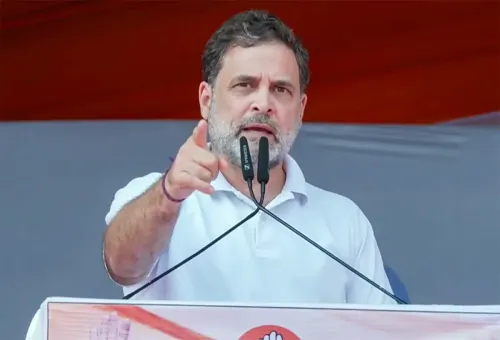
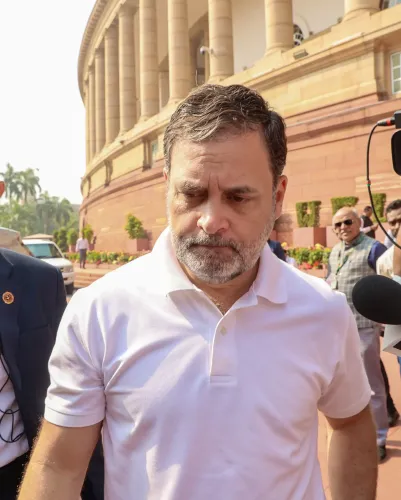
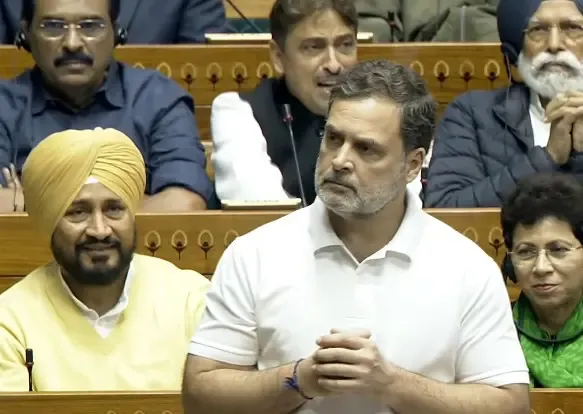
New Delhi, Feb 11 (NationPress) The Leader of the Opposition in the Lok Sabha, Rahul Gandhi, directed his criticism towards the Centre and Finance Minister Nirmala Sitharaman regarding the India-US trade agreement and the alleged tax breaks given to foreign cloud service providers, asserting that this deal undermines India's economic and strategic interests.
During the discussion on the Union Budget, Gandhi condemned the government's stance on data and tax policies, particularly taking a jab at the Finance Minister.
"The Finance Minister has a penchant for smiling; she enjoys smiling a lot. A twenty-year tax exemption for major corporations; what have you done with our data?" Gandhi posed.
He expressed concerns about tariff modifications stemming from the trade agreement, claiming that the deal favors the United States excessively.
"What have you done regarding tariffs? Initially, the average was 3 percent, and it has now escalated to 18 percent—a sixfold increase. The US imports are projected to rise from $46 billion to $146 billion. This is ludicrous, and they (the US) hold no loyalty towards us; we have a commitment to them... we appear foolish... Our tariffs have surged from 3 percent to 18 percent, while theirs have plummeted from 16 percent to 0," he stated.
Gandhi mentioned that despite political disagreements, legislators from all parties are likely keen on protecting national interests.
"I trust that members from both sides intend to safeguard our nation. I have faith that the Prime Minister recognizes that India's greatest asset is its people and thus its data. I refuse to believe that the Prime Minister is unaware of this," he remarked.
The Congress leader also highlighted the comparative tariff advantages allegedly granted by the US to Bangladesh, contending that such actions would harm India's textile industry.
"The US has reduced the tariff on Bangladesh to 0, while India's stands at 18 percent. What do you expect our textile workers to do? They are devastated! The entire textile sector is collapsing. If Bangladesh imports US cotton, they enjoy a 0 percent duty. The textile industry in India is finished," he asserted.
Gandhi further claimed that the agreement jeopardizes India’s energy autonomy and grants the United States considerable influence over India's oil purchasing decisions.
"The US will dictate where we source our oil, not our Prime Minister. They will keep tabs on us. If India opts to buy oil from a nation the US disapproves of, we will be penalized with tariffs," he emphasized.
He accused the government of neglecting farmers' welfare and characterized the situation as dire.
Gandhi alleged that the Centre has "opened a gateway to destroy our impoverished farmers" and labeled the situation as "shameful."
"No Prime Minister has ever committed such acts, and no future Prime Minister will ever do so," he declared.
Continuing his critique, Gandhi stated, "You've weaponized energy... You lack solutions to tackle this issue."
In a heightened escalation of his accusations, the Leader of the Opposition charged the government with compromising national interests and described the interim trade agreement as significantly biased.
"I assert that you have betrayed India. Are you not embarrassed to betray India? Do you have no shame in selling out India? You have sold our mother, Bharat Mata," he expressed.
He went on to allege that the Prime Minister was succumbing to external pressures in consenting to the agreement.
Point of View
Our editorial perspective remains grounded in safeguarding national interests. While political discourse is often polarizing, the priority should be the welfare of India's citizens, ensuring that economic policies are beneficial and equitable for all.
NationPress
19 Sept 2026
Frequently Asked Questions
What are the main concerns raised by Rahul Gandhi regarding the India-US trade agreement?
Rahul Gandhi's main concerns include potential negative impacts on India's economy, strategic interests, and specific industries like textiles due to tariff changes favoring the US.
How does the trade agreement affect tariffs?
Gandhi highlighted a significant increase in India's tariffs from 3% to 18%, while US tariffs dropped from 16% to 0%, suggesting a disadvantageous position for India.
What implications does Gandhi suggest the agreement has for India's energy independence?
He claims the agreement compromises India's energy autonomy, allowing the US to influence India's oil purchasing decisions, raising concerns about national sovereignty.
What is Gandhi's stance on the impact of this agreement on farmers?
Gandhi accused the government of neglecting farmers' interests, stating that the agreement opens doors to harm India's agricultural sector.
How does Gandhi view the government's approach to foreign trade?
He views the government's approach as skewed, suggesting it prioritizes foreign interests over the welfare of Indian citizens and industries.