India coal output tops 1 billion tonnes for 2nd year as commercial mining scales up

Synopsis
India has now produced over a billion tonnes of coal in back-to-back fiscal years — a number that was unthinkable a decade ago when output stood at 609 MT. The real story is structural: commercial and captive blocks have grown from under 11% to over 20% of national output in four years, with 44 first-time miners now in the mix. The next test is whether auctioned mines actually reach full capacity — and whether the employment and revenue projections hold.
Key Takeaways
India's coal output hit 1,040.08 MT in FY 2025-26 and 1,047.52 MT in FY 2024-25 , crossing 1 billion tonnes for two consecutive years.
Captive and commercial blocks produced 210.46 MT in FY 2025-26 , up from 28.83 MT a decade ago — a 22% compound annual growth rate .
141 coal mines auctioned across 14 rounds ; average revenue share of 24.17% — six times the 4% floor.
At full capacity, auctioned blocks are projected to yield ₹47,000 crore annual revenue and 4,75,000 jobs.
Mine operationalisation timelines cut from 51 to 40 months (fully explored) and 66 to 52 months (partially explored), effective from the 15th round .
Premium revenue to the exchequer grew from ₹461 crore in FY 2014-15 to ₹5,553 crore in FY 2025-26 , a 26% CAGR .
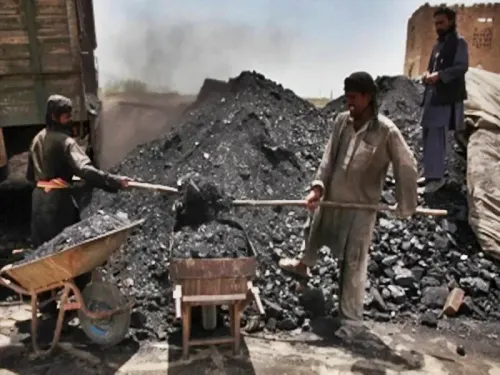
India's domestic coal production has exceeded one billion tonnes for two consecutive fiscal years — reaching 1,047.52 million tonnes (MT) in FY 2024-25 and 1,040.08 MT in FY 2025-26 — up sharply from 609.18 MT in FY 2014-15, according to a factsheet issued by the government on Sunday, 2 August. A growing share of this output is being driven by captive and commercial mining blocks, whose contribution to national production has climbed from 10.9% in FY 2021-22 to 20.2% in FY 2025-26.
Background: From Court Cancellations to Auction-Based Reform
The current framework traces its origins to a landmark Supreme Court ruling in 2014, which cancelled 204 of the 218 coal blocks allocated between 1993 and 2012, citing arbitrary allocation and the absence of consistent, objective criteria. The court's verdict made a transparent, auction-based regime a legal and policy imperative.
Parliament responded with the Coal Mines (Special Provisions) Act, 2015, which placed re-allocation on a firm statutory footing. The first auction tranche was launched in December 2014. Between 2015 and 2020, ten tranches of auction and nine of allotment brought 76 coal mines back into productive use.
Commercial Mining Launch and Participation
Commercial coal mining was formally opened in June 2020 under Prime Minister Narendra Modi's Aatmanirbhar Bharat vision. The new model allows successful bidders to sell coal to any consumer in any sector at market-determined prices, with no captive-use restriction and no bar on end-use — a significant departure from the earlier regime that confined coal to designated consumers.
Across 14 rounds of commercial auctions, 141 coal mines have been auctioned, with a combined peak rated capacity of 366.35 MT per annum. The average revenue share discovered through bidding stands at 24.17% — six times the 4% floor price. Of the winning bidders, 123 are private entities, and notably, 44 had no prior coal mining experience, signalling meaningful new entry into the sector.
Output Milestones and Revenue Impact
Captive and commercial blocks together produced 210.46 MT in FY 2025-26, crossing the 200 MT mark for the first time. A decade earlier, the combined figure was just 28.83 MT — implying a compound annual growth rate of approximately 22% over the period. Within this, commercial mines specifically contributed 26.12 MT in FY 2025-26, with 23 mines having received Mine Opening Permission and now operational.
At full production, the blocks auctioned so far are projected to generate annual revenue of approximately ₹47,000 crore, attract capital expenditure of around ₹48,756 crore, and create employment for roughly 4,75,000 people. Revenue from premium generation has grown from ₹461 crore in FY 2014-15 to ₹5,553 crore in FY 2025-26, a compound annual growth of about 26%, with proceeds accruing to both the central exchequer and coal-producing states.
Ease of Doing Business and What Comes Next
The government has identified mine operationalisation timelines as a key bottleneck and has moved to shorten them. For fully explored blocks, the scheduled timeline has been reduced from 51 months to 40 months; for partially explored blocks, from 66 months to 52 months. These revised timelines apply from the 15th auction round, which is currently underway.
The stated priority now is ensuring every auctioned mine is brought into production — a shift from awarding blocks to activating them. Whether the streamlined clearance process translates into on-ground acceleration will be closely watched by investors and state governments that depend on coal royalties for fiscal headroom.
Point of View
But the more consequential number is the 20.2% share now held by captive and commercial blocks — up from 10.9% in just four years. That structural shift matters more than the headline volume, because it signals that coal supply is no longer a near-monopoly story. The harder question is capacity utilisation: 141 mines have been auctioned, but only 23 commercial mines are operational. The gap between blocks awarded and blocks producing is where policy ambition most often stalls. Shorter operationalisation timelines help, but land acquisition, environmental clearances, and state-level coordination remain the unglamorous bottlenecks that no factsheet fully resolves.
NationPress
16 Sept 2026
Frequently Asked Questions
Has India really produced over 1 billion tonnes of coal two years in a row?
Yes. India produced 1,047.52 MT in FY 2024-25 and 1,040.08 MT in FY 2025-26, according to a government factsheet released on 2 August. This compares with 609.18 MT in FY 2014-15, reflecting a near-doubling of output over a decade.
What is commercial coal mining in India and when did it start?
Commercial coal mining allows private and public entities to mine coal and sell it to any buyer at market prices, with no restriction on end-use. It was formally launched in June 2020 under the Aatmanirbhar Bharat initiative, following the Coal Mines (Special Provisions) Act, 2015, which established an auction-based allocation framework after the Supreme Court cancelled 204 arbitrarily allotted blocks in 2014.
How many commercial coal mines have been auctioned and how many are producing?
141 mines have been auctioned across 14 rounds, with a combined peak rated capacity of 366.35 MT per annum. Of these, 23 commercial mines have received Mine Opening Permission and are currently operational, producing about 26.12 MT in FY 2025-26.
What revenue and employment are expected from commercial coal mining?
At full production, the auctioned blocks are projected to generate annual revenue of approximately ₹47,000 crore, attract capital expenditure of around ₹48,756 crore, and create employment for roughly 4,75,000 people, according to government projections.
How has the government reduced timelines for bringing coal mines into operation?
From the 15th auction round onward, operationalisation timelines have been shortened from 51 months to 40 months for fully explored blocks, and from 66 months to 52 months for partially explored ones. The government has also simplified and reduced the number of clearances required.