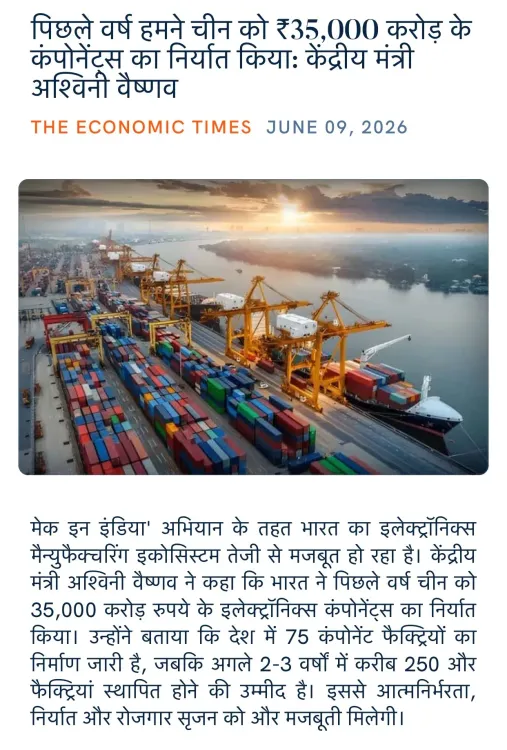
Giriraj Singh shares Vaishnaw's claim: India exported ₹35,000 cr components to China
Synopsis
Union Textiles Minister Giriraj Singh amplified a statement by Electronics Minister Ashwini Vaishnaw claiming India exported components worth ₹35,000 crore to China last year, spotlighting the PLI scheme's role in reshaping the India-China trade dynamic.
Key Takeaways
Union Textiles Minister Giriraj Singh shared the statement on June 9, 2026 via the NaMo App.
Electronics and IT Minister Ashwini Vaishnaw claimed India exported ₹35,000 crore worth of components to China in the previous year.
The claim comes against the backdrop of India's long-standing structural trade deficit with China.
The PLI scheme , launched in 2020 , is the primary policy instrument credited with boosting India's electronics component manufacturing capacity.
Formal verification of the export figure is expected through Commerce Ministry trade data releases.
The development, if sustained, signals India's emerging role as a component supplier — not just a consumer — in global electronics supply chains.
Union Textiles Minister Giriraj Singh on Tuesday, June 9, 2026, shared a statement attributed to Union Minister for Electronics and IT Ashwini Vaishnaw, highlighting that India exported components worth ₹35,000 crore to China in the previous year. Singh shared the post via the NaMo App, amplifying the claim as part of the ruling party's broader messaging on India's manufacturing resurgence.
Context
The statement, as shared by Singh, quotes Vaishnaw as saying: 'Pichle varsh humne China ko ₹35,000 crore ke components ka niryaat kiya' ('Last year we exported components worth ₹35,000 crore to China'). The remark positions India not merely as a consumer of Chinese goods but as a supplier of components into Chinese supply chains — a notable rhetorical reversal in the context of persistent concerns about India's trade deficit with China.
India and China have long maintained a structurally imbalanced trade relationship, with India running a significant deficit driven by imports of electronics, machinery, and intermediate goods. Against that backdrop, a component export figure of this scale, if sustained, would represent a meaningful shift in the bilateral trade narrative.
Policy Backdrop
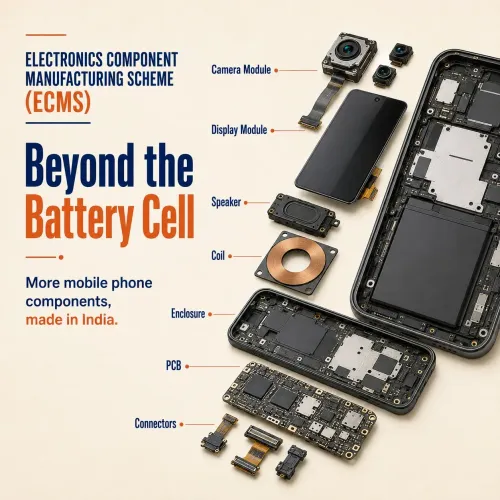
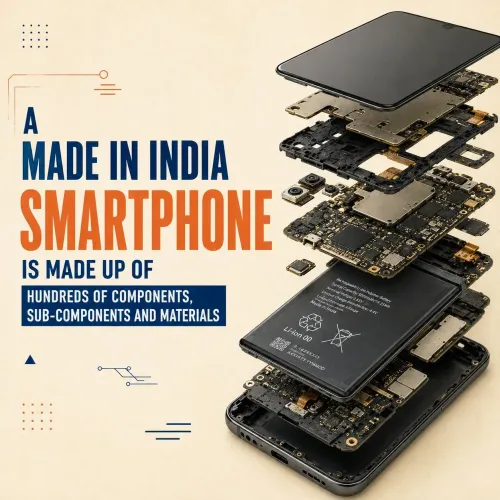
The claim directly reflects the intended outcomes of the Production Linked Incentive (PLI) scheme, first launched in 2020 for mobile and electronics manufacturing and subsequently expanded to components and related sectors. The PLI framework offers manufacturers financial incentives tied to incremental sales, with the explicit goal of raising domestic value addition and building India's position in global electronics supply chains.
Successive administrations have pursued manufacturing incentives to reduce import dependence, particularly from China. The PLI scheme for electronics has attracted investment from both domestic firms and global original equipment manufacturers, gradually deepening India's component ecosystem. Vaishnaw, as the minister overseeing Electronics and IT, has consistently cited export milestones to underscore the scheme's progress.
Stakeholders and Impact
The primary beneficiaries of this trend, if the figures hold, are Indian electronics component manufacturers and exporters who have scaled up under the PLI incentive structure. A growing export relationship with China — even within an overall deficit — signals that Indian-made components are competitive enough to enter one of the world's most demanding manufacturing ecosystems.
For the broader industry, the development carries symbolic weight: it suggests that India is beginning to occupy a position as a component supplier in the Indo-Pacific electronics value chain rather than remaining solely a downstream assembler or end-market. Workers and small suppliers in electronics manufacturing clusters across states such as Tamil Nadu, Uttar Pradesh, and Telangana stand to benefit if this export momentum continues.
What's Next
Formal validation of the ₹35,000 crore figure will come from monthly and quarterly merchandise trade data released by the Commerce Ministry. Parliamentary discussions on PLI scheme performance are also expected to provide a more granular breakdown of which component categories are driving the export surge.
As India seeks to deepen its role in global electronics supply chains and simultaneously reduce its own import bill from China, the trajectory of component exports will be a closely watched indicator. The government's ability to sustain and grow this number will be central to its 'Make in India' credibility in the electronics sector.
Point of View
000 crore figure, if verified, would mark a qualitative shift in the India-China trade narrative, moving India from a purely deficit-absorbing economy to one that supplies into Chinese industrial chains. This fits the broader BJP arc of using PLI scheme milestones to validate its 'Make in India' and 'Atmanirbhar Bharat' branding. However, the figure will face scrutiny: analysts and opposition voices are likely to benchmark it against India's far larger import bill from China to question whether the deficit has structurally narrowed.
NationPress
23 Oct 2026
Frequently Asked Questions
What did Ashwini Vaishnaw say about India's exports to China?
Ashwini Vaishnaw claimed that India exported components worth ₹35,000 crore to China in the previous year, highlighting the growth of India's electronics manufacturing sector.
What is the PLI scheme and how does it relate to electronics exports?
The Production Linked Incentive (PLI) scheme, launched in 2020, offers financial incentives to manufacturers based on incremental sales. It has been credited with expanding India's domestic electronics and component manufacturing capacity, contributing to the export growth cited by Vaishnaw.
Does India have a trade deficit with China?
Yes, India has a significant structural trade deficit with China, driven largely by imports of electronics, machinery, and intermediate goods. Component exports to China form part of still-interdependent supply chains even as India pursues greater self-reliance.
Why did Giriraj Singh, the Textiles Minister, share a statement about electronics exports?
Giriraj Singh shared the statement via the NaMo App as part of the ruling BJP's broader messaging effort to highlight India's manufacturing achievements, even across ministerial portfolios.
Where can I find official data on India's component exports to China?
Official data on India's merchandise trade, including component exports to China, is released periodically by the Commerce Ministry and can be tracked through its trade statistics portal.