India fish production hits 197.75 lakh tonnes under PMMSY: Parliament
Synopsis
India's fish output has climbed nearly 40% in five years under the PMMSY — from 141.64 lakh tonnes to 197.75 lakh tonnes — while ₹2,797 crore flows into cold chain and market infrastructure. The scheme's gender-inclusion angle, with ₹4,178 crore benefiting over 1.47 lakh women, signals a deliberate shift from production-only targets to a full value-chain overhaul.
Key Takeaways
India's fish production rose from 141.64 lakh tonnes in 2019-20 to 197.75 lakh tonnes in 2024-25 under the PMMSY .
Fisheries development proposals worth ₹4,178.30 crore sanctioned over six financial years , benefiting 1,47,654 women .
Women beneficiaries receive financial assistance of up to 60% of unit cost under the scheme. ₹2,797 crore approved for cold chain and marketing infrastructure, including 775 cold storages and 28,489 fish transportation units .
Government has sanctioned 6,018 fish kiosks , 117 retail fish markets , and 24 wholesale fish markets across states and UTs.
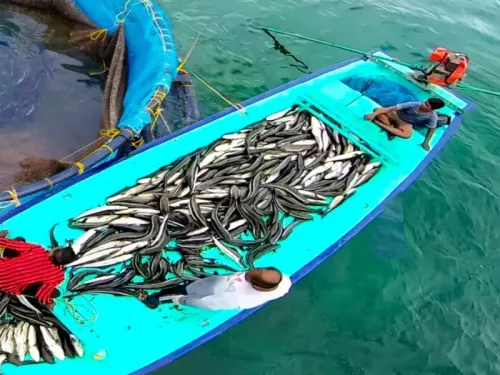
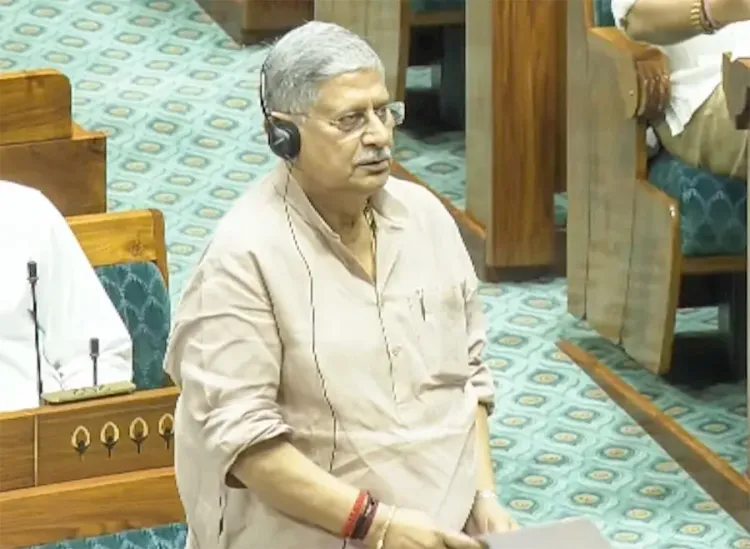
India's fish production has surged from 141.64 lakh tonnes in 2019-20 to 197.75 lakh tonnes in 2024-25 under the Pradhan Mantri Matsya Sampada Yojana (PMMSY), the government told Parliament on Tuesday, 21 July 2025. Union Fisheries, Animal Husbandry and Dairying Minister Rajiv Ranjan Singh shared the figures in a written reply in the Lok Sabha, crediting the scheme with driving holistic growth across the fisheries and aquaculture sector.
PMMSY's Role in the Production Surge
The PMMSY, operational since the 2020-21 financial year, has been the central driver behind the 39.6% rise in fish output over five years. Minister Singh stated the scheme has contributed significantly to enhancing fish production while also focusing on the sustainable development of the broader aquaculture ecosystem. The scheme's design links financial assistance to verifiable beneficiary outcomes, a structural feature that distinguishes it from earlier sector interventions.
Women's Inclusion and Financial Support
A notable feature of the PMMSY is its focus on women engaged in the fisheries sector. The scheme provides financial assistance of up to 60% of the unit cost for beneficiary-oriented activities. Over the last six financial years — from 2020-21 to 2025-26 — fisheries development proposals worth ₹4,178.30 crore have been sanctioned under the scheme, directly benefiting 1,47,654 women across states and Union Territories.
Cold Chain and Market Infrastructure Build-Out
The government has significantly stepped up investment in post-harvest infrastructure. Proposals worth ₹2,797 crore have been approved under the PMMSY and the Fisheries and Aquaculture Infrastructure Development Fund (FIDF) till April 2026 for cold chain and marketing facilities. The approved projects include 775 cold storages and ice plants, along with 28,489 fish transportation units — comprising 13,718 motorcycles fitted with ice boxes, 8,527 bicycles with ice boxes, 4,257 auto-rickshaws, 1,577 insulated trucks, and 410 refrigerated trucks.
Retail and Wholesale Market Expansion
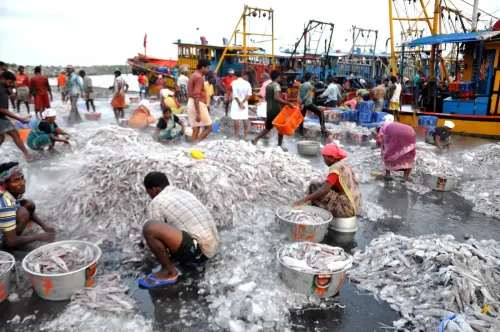
Beyond cold chain logistics, the government has sanctioned 1,394 live fish vending units, 6,018 fish kiosks, 117 retail fish markets, and 24 wholesale fish markets across states and Union Territories. These investments are aimed at reducing post-harvest losses, improving market access for fishers and fish farmers, and strengthening the end-to-end fisheries value chain.
What This Means for the Sector
India is already among the world's top fish-producing nations, and the PMMSY's infrastructure push is designed to consolidate that position by addressing a long-standing structural weakness — the gap between production volumes and market realisation. Reducing spoilage and improving cold chain connectivity directly translates into higher incomes for fishing communities. With the scheme's sanctioned projects still being rolled out, production and income metrics are expected to improve further in the coming financial years.
Point of View
But the more consequential story is the cold chain and market infrastructure push. India has historically lost a significant share of its fish output to post-harvest spoilage — a problem that raw production targets cannot solve. The scheme's gender-inclusion design, tying 60% subsidies to women beneficiaries, is also a structural departure from earlier fisheries programmes that were largely gender-neutral. The real test will be whether the 28,489 transportation units and 775 cold storages are operationally active or merely sanctioned on paper — a distinction that past rural infrastructure schemes have struggled to maintain.
NationPress
20 Oct 2026
Frequently Asked Questions
What is the Pradhan Mantri Matsya Sampada Yojana (PMMSY)?
The PMMSY is a flagship central government scheme for the holistic development of India's fisheries and aquaculture sector, operational since the 2020-21 financial year. It provides financial assistance for production, infrastructure, and beneficiary-oriented activities, with a special focus on women in the sector.
By how much has India's fish production increased under PMMSY?
India's fish production rose from 141.64 lakh tonnes in 2019-20 to 197.75 lakh tonnes in 2024-25 — an increase of approximately 56 lakh tonnes, or nearly 40%, over five years. The government attributed this growth to the PMMSY in a written reply to the Lok Sabha on 21 July 2025.
How many women have benefited from PMMSY so far?
A total of 1,47,654 women across states and Union Territories have benefited from fisheries development proposals worth ₹4,178.30 crore sanctioned under PMMSY between 2020-21 and 2025-26. The scheme offers financial assistance of up to 60% of the unit cost for beneficiary-oriented activities.
What cold chain infrastructure has been approved under PMMSY?
Proposals worth ₹2,797 crore have been approved under PMMSY and the FIDF till April 2026 for cold chain and marketing infrastructure. This includes 775 cold storages and ice plants, 28,489 fish transportation units, 6,018 fish kiosks, 117 retail fish markets, and 24 wholesale fish markets.
Why is cold chain infrastructure important for India's fisheries sector?
Cold chain infrastructure reduces post-harvest losses, improves market access, and increases income for fishers and fish farmers. India's fisheries sector has historically suffered from high spoilage rates due to inadequate storage and transportation, and the PMMSY's infrastructure push is aimed at addressing this structural gap.