India-Japan MAHASAGAR-FOIP axis: A democratic bloc reshaping Indo-Pacific
Synopsis
India and Japan are quietly assembling the Indo-Pacific's most consequential democratic partnership. With Modi's MAHASAGAR expanding India's maritime doctrine from the Indian Ocean to the Global South, and Takaichi's FOIP anchoring Japan's rule-of-law vision, the two frameworks are converging into a unified counter-narrative to China's BRI — one that offers smaller nations security, development, and autonomy on their own terms.
Key Takeaways
Prime Minister Modi unveiled MAHASAGAR in March 2025 in Mauritius , expanding India's maritime doctrine from the Indian Ocean to a Global South-wide framework.
SAGAR , the predecessor doctrine, was first articulated in March 2015 , positioning India as a 'net security provider' in the Indian Ocean Region .
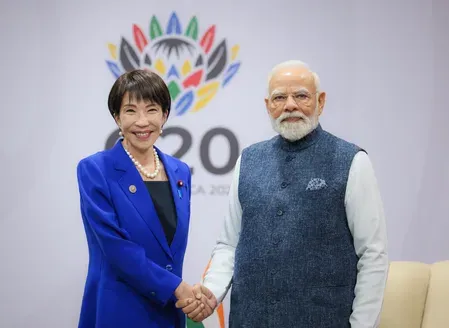
Japanese Prime Minister Sanae Takaichi praised India as an 'indispensable partner' and aligned her FOIP vision with India's MAHASAGAR in a recent article.
Together, MAHASAGAR and FOIP are described as a democratic counter-narrative to China's Belt and Road Initiative (BRI) and its 'String of Pearls' strategy.
Institutional ties include the Quad (with the US and Australia) and the Asia-Africa Growth Corridor (AAGC) , with joint projects in Bangladesh , Myanmar , Sri Lanka , and Africa.
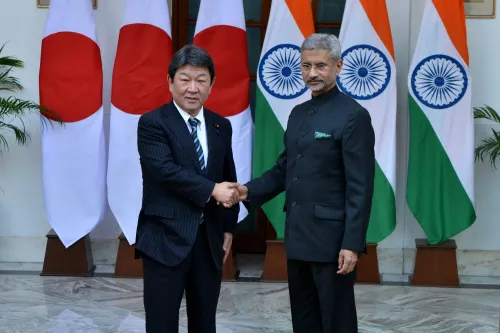
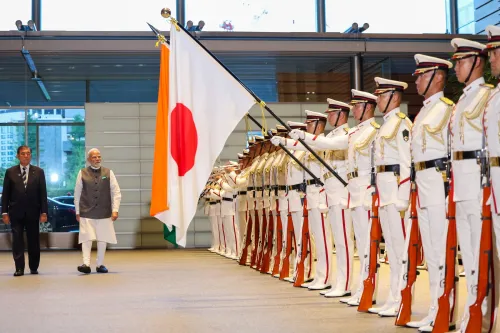
India and Japan are forging what analysts describe as a democratic axis in the Indo-Pacific, as Prime Minister Narendra Modi's MAHASAGAR framework and Japanese Prime Minister Sanae Takaichi's Free and Open Indo-Pacific (FOIP) vision converge into a combined strategy that blends security with development and deterrence with inclusivity. The alignment, underscored by Takaichi in a recent article praising India as an 'indispensable partner', signals a deepening strategic partnership between the two democracies at a moment of heightened geopolitical uncertainty.
From SAGAR to MAHASAGAR: India's Expanding Maritime Vision
India's maritime doctrine has evolved significantly over the past decade. Prime Minister Modi first articulated SAGAR — Security And Growth for All in the Region — in March 2015, while commissioning the offshore patrol vessel Barracuda, built at Kolkata's Garden Reach shipyard, in Mauritius. The doctrine positioned India as a 'net security provider' in the Indian Ocean Region (IOR), committed to trust, transparency, and peaceful resolution of maritime disputes.
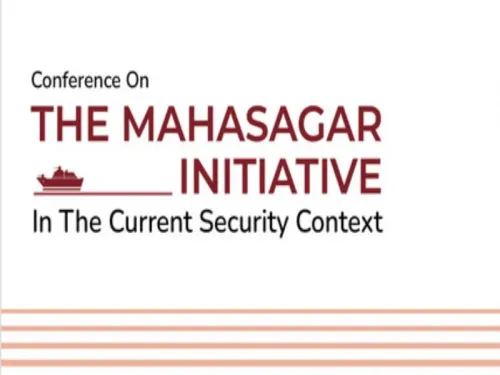
A decade on, when Modi returned to Mauritius in March 2025, he unveiled MAHASAGAR — Mutual and Holistic Advancement for Security and Growth Across Regions. The upgraded framework moves India's ambitions well beyond the Indian Ocean, positioning New Delhi as a leader of the Global South and offering a blueprint that integrates security, trade, development, and sustainability. Notably, in several Indian languages, 'sagar' means sea and 'mahasagar' means ocean — a deliberate linguistic signal of strategic expansion.
According to Suchitra Durai, former Ambassador of India to Thailand, the shift marks a strategic evolution from a regional focus on the Indian Ocean to a global maritime vision with particular emphasis on the Global South. She noted that Modi's engagements with Mauritius, Maldives, Trinidad and Tobago, Ghana, and the Philippines are all aligned with the MAHASAGAR vision.
Japan's FOIP and the Takaichi Alignment
Prime Minister Takaichi's article explicitly aligns Japan's FOIP framework with India's MAHASAGAR initiative. In her words, a genuinely free and open region is 'not one where only the great powers enjoy freedom but one where every nation is able to chart its own course of its own free will, unswayed by external coercion.' She praised India as a maritime nation that has taken concrete action to provide regional stability and support the resilience of countries in the area.
The convergence is substantive: Japan's FOIP emphasises rule of law and freedom of navigation, while India's MAHASAGAR adds a developmental dimension. Together, critics argue, they present a democratic counter-narrative to China's Belt and Road Initiative (BRI) and its so-called 'String of Pearls' encircling strategy in the Indian Ocean.
Why This Matters for the Indo-Pacific Order
The Indo-Pacific has emerged as the defining geopolitical theatre of the 21st century. China's assertiveness — through military expansion in the South China Sea and infrastructure diplomacy across South Asia — has unsettled smaller regional nations. Even the United States, despite its considerable influence, is recalibrating its strategic commitments, creating space for middle powers such as India and Japan to step up.
For India, MAHASAGAR aims to establish New Delhi's credentials as a responsible power that balances hard security with soft power. For Japan, FOIP ensures that democratic values and freedom of navigation remain central to regional order. For the Global South broadly, both frameworks offer alternatives to dependency on China, emphasising partnership and autonomy over debt-laden infrastructure deals.
Institutional Pillars: Quad, AAGC, and Bilateral Ties
The India-Japan relationship carries deep historical, cultural, and civilisational roots, but the modern partnership has acquired considerable strategic substance. Institutional frameworks reinforcing this include the Asia-Africa Growth Corridor (AAGC), a joint initiative under which India and Japan are already collaborating on projects in Bangladesh, Myanmar, Sri Lanka, and several African nations. Both countries are also members of the Quadrilateral Security Dialogue (Quad), alongside the United States and Australia.
As FOIP and MAHASAGAR deepen their alignment, the Indo-Pacific may be witnessing the emergence of a new cooperative axis — one that smaller nations across the Global South could increasingly look to as a credible alternative to great-power dependency.
Point of View
But the real test is delivery — the Asia-Africa Growth Corridor, launched with similar ambitions in 2017, has moved slowly against China's infrastructure pace. India and Japan are right to identify the Global South as the decisive arena, but smaller nations will judge this axis by projects on the ground, not frameworks on paper. The absence of a dedicated financing vehicle comparable to BRI's scale remains the partnership's most visible gap — and the one Beijing will keep pointing to.
NationPress
30 Sept 2026
Frequently Asked Questions
What is India's MAHASAGAR framework?
MAHASAGAR — Mutual and Holistic Advancement for Security and Growth Across Regions — is India's expanded maritime doctrine unveiled by Prime Minister Modi in March 2025 in Mauritius. It builds on the earlier SAGAR doctrine to position India as a leader of the Global South, integrating security, trade, development, and sustainability across regions beyond the Indian Ocean.
How does Japan's FOIP align with India's MAHASAGAR?
Japanese Prime Minister Sanae Takaichi, in a recent article, explicitly aligned her Free and Open Indo-Pacific (FOIP) vision with India's MAHASAGAR, calling India an 'indispensable partner.' While FOIP emphasises rule of law and freedom of navigation, MAHASAGAR adds a developmental dimension, making the two frameworks complementary.
How do MAHASAGAR and FOIP counter China's Belt and Road Initiative?
Analysts argue that together, MAHASAGAR and FOIP present a democratic counter-narrative to China's BRI and its 'String of Pearls' strategy in the Indian Ocean, offering Global South nations an alternative that emphasises partnership, autonomy, and development without debt dependency.
What is the difference between SAGAR and MAHASAGAR?
SAGAR, articulated in March 2015, focused on stability and security in the Indian Ocean Region. MAHASAGAR, launched in March 2025, expands that vision globally — beyond the Indian Ocean — with a stronger emphasis on the Global South, trade, and sustainability alongside security.
What institutional frameworks support the India-Japan Indo-Pacific partnership?
Key institutional pillars include the Quadrilateral Security Dialogue (Quad), which also includes the United States and Australia, and the Asia-Africa Growth Corridor (AAGC), under which India and Japan are collaborating on projects in Bangladesh, Myanmar, Sri Lanka, and several African nations.