India Leads Globally in Genetic Resource Compliance under Nagoya Protocol
Synopsis
India has established itself as a frontrunner in the issuance of Internationally Recognised Certificates of Compliance (IRCCs) under the Nagoya Protocol, accounting for over 56% of the global total. This significant achievement showcases India's dedication to sustainable biodiversity practices.
Key Takeaways
India issues over 56% of all IRCCs globally.
Issued 3,561 IRCCs out of 6,311 worldwide.
Only 34 countries have issued IRCCs.
Reflects India's commitment to fair use of biological resources.
Supports international biodiversity governance and agreements.
New Delhi, March 31 (NationPress) India has taken the lead on the global stage by issuing the highest number of Internationally Recognised Certificates of Compliance (IRCCs) under the Nagoya Protocol on Access and Benefit-sharing (ABS), representing over 56 percent of all certificates distributed worldwide, as announced by the Ministry of Environment, Forest and Climate Change.
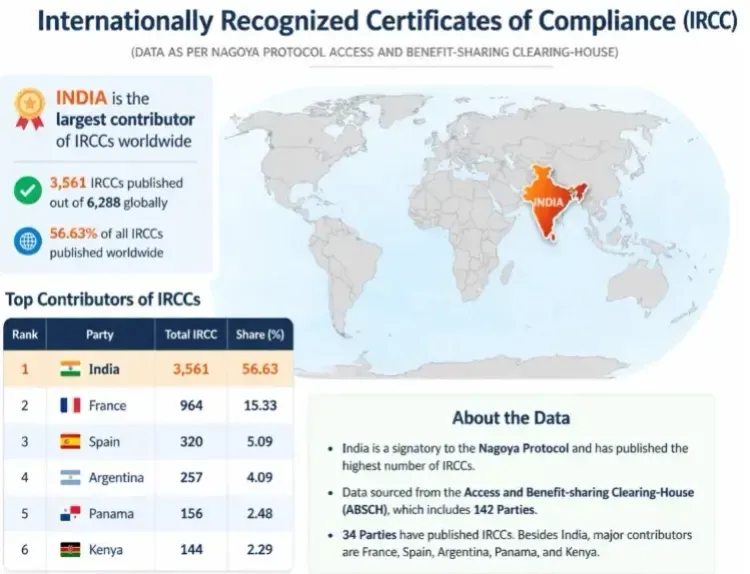
As per the latest statistics from the ABS Clearing-House, India has issued 3,561 IRCCs out of a total of 6,311 globally, positioning it well ahead of other nations in the execution of the protocol.
Among the 142 countries registered on the ABS Clearing-House, which acts as a global platform to enhance transparency and accountability, only 34 countries have successfully issued IRCCs thus far.
France follows India with 964 certificates, while Spain, Argentina, Panama, and Kenya have issued 320, 257, 156, and 144 certificates respectively.
The Ministry highlighted that this achievement underscores India’s dedication to ensuring fair and transparent utilization of biological resources and traditional knowledge.
“Under the Nagoya Protocol, nations that provide access to genetic resources and associated traditional knowledge are mandated to issue IRCCs. These certificates act as formal proof that Prior Informed Consent has been acquired and that Mutually Agreed Terms have been established between the resource users and providers. The relevant information is subsequently uploaded to the ABS Clearing-House,” stated the Ministry.
IRCCs are vital for monitoring the use of genetic resources, which spans from research and innovation to commercial applications, ensuring that benefits derived from their use are shared equitably with the provider nation.
The Ministry indicated that India's leading role signifies the effective execution of its ABS framework under the Biological Diversity Act of 2002.
This framework is enforced by the National Biodiversity Authority at the national level, in conjunction with State Biodiversity Boards, Union Territory Biodiversity Councils, and local Biodiversity Management Committees.
“Streamlined processes and robust institutional frameworks have facilitated the prompt processing of applications while ensuring adherence to international obligations,” the statement continued.
The Ministry emphasized that this accomplishment illustrates India’s proactive stance in global biodiversity governance and its ongoing efforts to encourage fair and equitable sharing of benefits arising from the use of biological resources.
“This also aligns with international objectives concerning biodiversity conservation and sustainable utilization, further solidifying India’s role as a significant participant in executing global environmental agreements,” the Ministry concluded.
Point of View
India's leadership in issuing IRCCs underscores the country's dedication to sustainable practices in biodiversity management. This achievement reflects a robust legal framework and proactive governance, positioning India as a key player in global environmental efforts.
NationPress
10 Oct 2026
Frequently Asked Questions
What are Internationally Recognised Certificates of Compliance?
IRCCs are certificates that provide formal evidence that Prior Informed Consent has been obtained for the use of genetic resources, ensuring compliance with the Nagoya Protocol.
Why is India leading in IRCC issuance?
India's leadership in IRCC issuance can be attributed to its effective implementation of the ABS framework under the Biological Diversity Act of 2002.
How many countries have issued IRCCs?
Out of 142 countries registered on the ABS Clearing-House, only 34 have issued IRCCs so far.
What is the significance of IRCCs?
IRCCs are crucial for tracking the use of genetic resources and ensuring that benefits from their use are shared equitably with the provider country.
What is the Nagoya Protocol?
The Nagoya Protocol is an international agreement that aims to ensure the fair and equitable sharing of benefits arising from the utilization of genetic resources.