India overtakes US as world's 2nd-fastest solar market, hits 162 GW
Synopsis
India added 37 GW of solar in 2025 — more than the US — to become the world's second-largest solar growth market, with total installed capacity at 162.15 GW. With tariffs crashing from ₹18 to ₹2.44 per unit and a new ₹5,070 crore floating solar scheme approved, India's energy transition is accelerating faster than most forecasters projected.
Key Takeaways
India's installed solar capacity reached 162.15 GW as of 30 June 2026 , up 50-fold from 3 GW in 2014.
India added 37 GW of solar in 2025 , surpassing the United States to become the world's second-largest solar growth market .
Solar tariffs have fallen from ₹18 per unit in 2010 to a record low of ₹2.44 per unit via competitive e-Reverse Auction bidding.
India's utility-scale solar LCOE stood at $35 per MWh in 2025, below the global average of $44 per MWh .
The Pradhan Mantri Surya Sarovar Yojana was approved on 31 July 2026 , targeting 5,000 MW of floating solar with ₹5,070 crore outlay through FY 2030–31.
Renewables met 51.5% of India's electricity demand on 29 July 2025 — the highest monthly share on record.
India has overtaken the United States to become the world's second-largest solar growth market, after adding 37 GW of solar capacity in 2025 alone — a milestone confirmed in a government factsheet released on Sunday, 2 August 2026. The country's total installed solar capacity now stands at 162.15 GW as of 30 June 2026, a staggering 50-fold surge from just 3 GW in 2014.
A Decade of Rapid Scale-Up
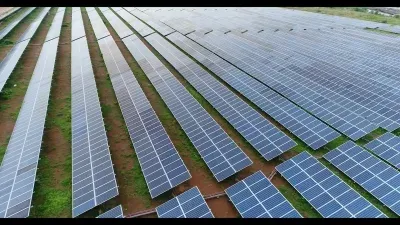
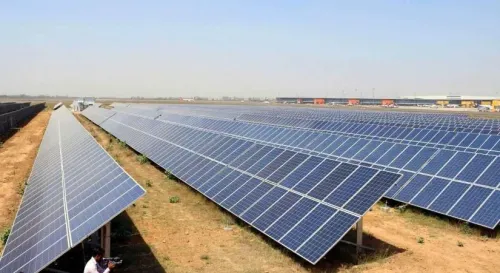
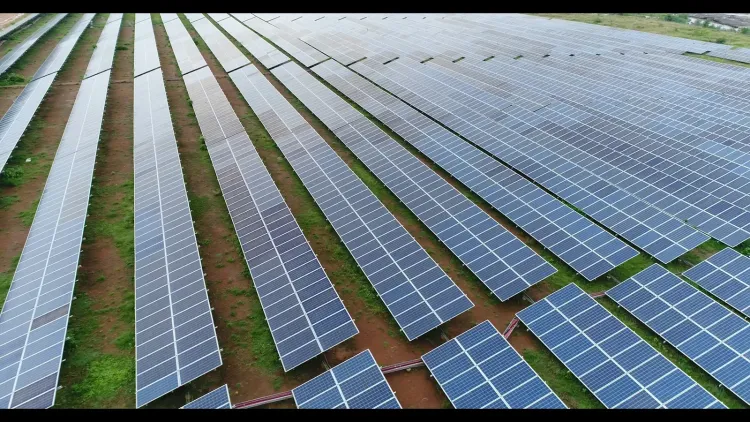
The transformation of India's solar sector over the past twelve years represents one of the fastest energy transitions recorded for a large economy. From a negligible base, the country has systematically scaled capacity through competitive bidding, policy support, and a sharp reduction in the cost of solar technology. Large utility-scale projects account for the bulk of this growth, contributing 118.79 GW of installed capacity, while grid-connected rooftop solar systems add another 27.88 GW. The remainder comes from hybrid solar projects — which pair solar with battery storage or other power sources — and off-grid systems serving areas beyond the grid.
Notable large-scale installations include the Bhadla Solar Park in Rajasthan, the Pavagada Solar Park in Karnataka, and the Rewa Ultra Mega Solar Park in Madhya Pradesh. These parks have served as anchors for India's utility solar expansion.
Tariff Crash: From ₹18 to ₹2.44 Per Unit
One of the most consequential shifts in the sector has been the collapse in power tariffs. Driven by competitive bidding through the e-Reverse Auction mechanism — where developers compete to supply electricity at the lowest price — solar tariffs have fallen from approximately ₹18 per unit in 2010 to a record low of ₹2.44 per unit. This decline has made solar power increasingly accessible across industrial and household segments alike.
In 2025, the Levelised Cost of Electricity (LCOE) from utility-scale solar PV in India stood at $35 per MWh, well below the global average of $44 per MWh, according to the government factsheet. This positions India among the world's lowest-cost solar power markets — a competitive advantage with implications for industrial energy costs and export competitiveness.
PM Surya Sarovar Yojana: Floating Solar Gets a Boost
India's solar ambitions received a fresh push with the approval of the Pradhan Mantri Surya Sarovar Yojana (PM-SSY) on 31 July 2026. The scheme targets 5,000 MW of Floating Solar Photovoltaic (FSPV) projects co-located with Energy Storage Systems (ESS) carrying a minimum storage capacity of two hours (10,000 MWh). By deploying solar panels over existing reservoirs and industrial ponds, the scheme avoids land acquisition challenges that have historically slowed ground-mounted projects.
With an outlay of ₹5,070 crore, PM-SSY will run from FY 2026–27 to FY 2030–31. The integrated storage component is designed to help states manage peak demand — a persistent challenge as variable renewable capacity grows on the grid.
Renewable Energy Crosses 51% of Monthly Demand
India's total non-fossil fuel installed capacity has reached 283.46 GW, including 274.68 GW of renewable energy. On 29 July 2025, renewable energy sources met 51.5% of India's electricity demand — the highest monthly share recorded to date. This comes amid India's broader Panchamrit climate commitments, announced at COP26 in Glasgow, which include a target of 500 GW of non-fossil fuel capacity by 2030 and net-zero emissions by 2070. These goals are embedded in India's updated Nationally Determined Contributions under the Paris Agreement.
With the halfway mark to the 500 GW target already crossed and annual additions accelerating, India's trajectory suggests the 2030 goal is within reach — though grid integration, storage infrastructure, and transmission capacity remain critical variables to watch.
Point of View
Not just a headline number — but the harder challenge now shifts from capacity installation to grid absorption. Adding 37 GW in a single year is impressive; ensuring the grid can dispatch it reliably, without curtailment, is a different engineering and regulatory problem. The PM-SSY's co-located storage mandate signals the government understands this, but 10,000 MWh across 5,000 MW is a modest buffer for a grid of India's scale. The real test of the energy transition will be whether transmission infrastructure and state-level discom finances keep pace with the generation curve.
NationPress
16 Sept 2026
Frequently Asked Questions
How much solar capacity has India installed as of 2026?
India's total installed solar capacity stood at 162.15 GW as of 30 June 2026, according to a government factsheet. This represents a 50-fold increase from just 3 GW in 2014.
How did India overtake the US in solar energy?
India added 37 GW of solar capacity in 2025, surpassing the United States in annual solar additions to become the world's second-largest solar growth market. Only China adds more solar capacity annually.
What is the Pradhan Mantri Surya Sarovar Yojana?
The Pradhan Mantri Surya Sarovar Yojana (PM-SSY), approved on 31 July 2026, is a government scheme to develop 5,000 MW of floating solar projects on existing reservoirs and industrial ponds, paired with energy storage systems. It carries an outlay of ₹5,070 crore and runs from FY 2026–27 to FY 2030–31.
Why have solar power tariffs fallen so sharply in India?
Solar tariffs in India fell from around ₹18 per unit in 2010 to a record low of ₹2.44 per unit, driven primarily by the e-Reverse Auction bidding mechanism, in which developers compete to supply electricity at the lowest tariff. Increased developer participation and falling technology costs accelerated the decline.
What are India's renewable energy targets under the Paris Agreement?
Under its Panchamrit commitments announced at COP26 in Glasgow, India has pledged to achieve 500 GW of non-fossil fuel capacity by 2030 and reach net-zero emissions by 2070. These targets are embedded in India's updated Nationally Determined Contributions under the Paris Agreement.