Joshi Hails India's 5 Gold Medals at IPhO 2026
Synopsis
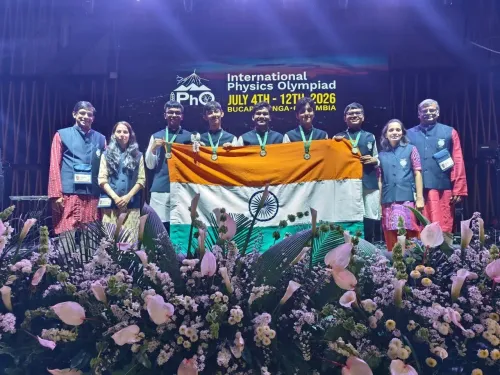
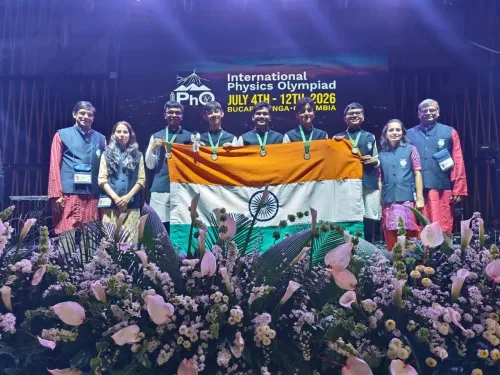
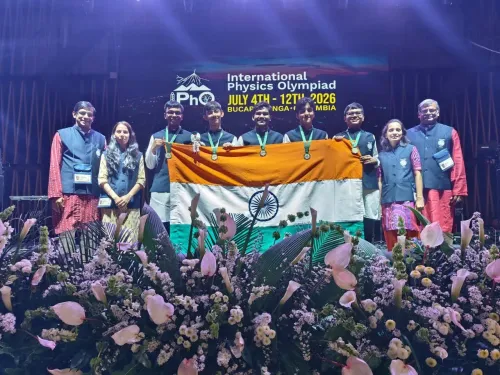
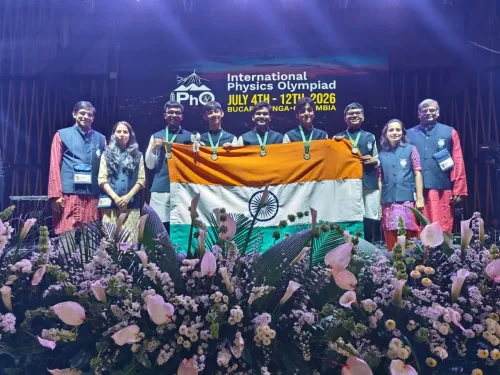
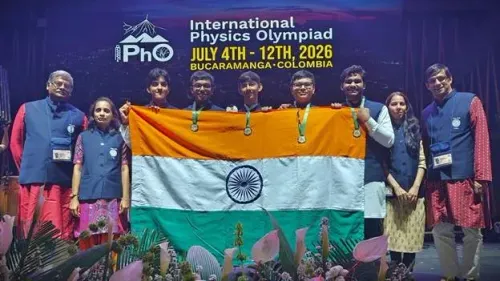
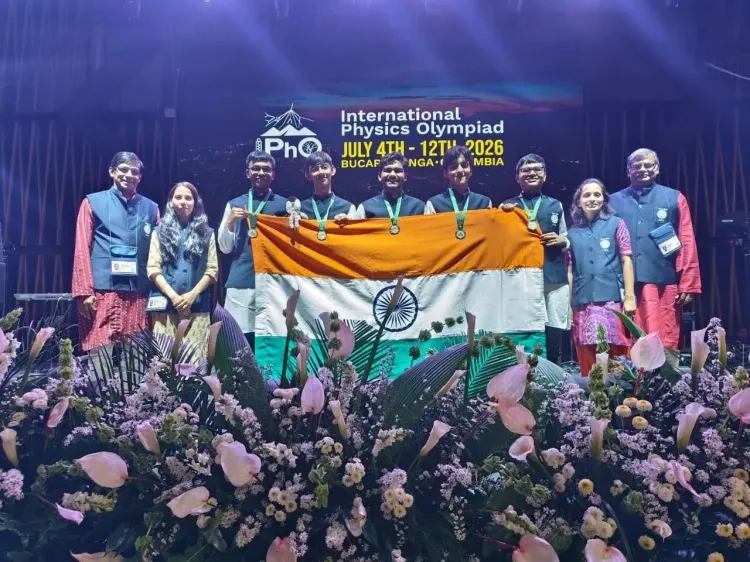
Five Indian students — Kanishk Jain, Riddhesh Anant Bendale, Rishit Garg, Shresth Suraiya, and Svarit Joshi — won all five gold medals at the 56th International Physics Olympiad 2026 in Bucaramanga, Colombia. Union Minister Pralhad Joshi hailed the sweep as proof of India's limitless youth potential under PM Modi's leadership.
Key Takeaways
India's team of five students won all 5 gold medals at the 56th International Physics Olympiad (IPhO) 2026 held in Bucaramanga, Colombia .
The medallists are Kanishk Jain , Riddhesh Anant Bendale , Rishit Garg , Shresth Suraiya , and Svarit Joshi .
Union Minister Pralhad Joshi publicly congratulated the students on 13 July 2026 , attributing the success to PM Modi's leadership.
India's IPhO teams are selected and trained by the Homi Bhabha Centre for Science Education (HBCSE) in Mumbai.
The achievement aligns with the National Education Policy 2020 and the INSPIRE scholarship scheme , both of which support olympiad-level science talent.
The result is seen as a milestone for India's broader Viksit Bharat 2047 STEM and R&D ambitions.
Union Consumer Affairs Minister Pralhad Joshi on Monday, 13 July 2026, congratulated five Indian students who swept all five gold medals at the 56th International Physics Olympiad (IPhO) 2026 held in Bucaramanga, Colombia, calling the feat a reflection of the 'limitless potential of India's Yuva Shakti.'
Context
The five students — Kanishk Jain, Riddhesh Anant Bendale, Rishit Garg, Shresth Suraiya, and Svarit Joshi — returned with a perfect gold-medal haul from the annual olympiad, which draws top secondary-school physics talent from across the world. Minister Joshi credited the achievement to the leadership of Prime Minister Narendra Modi, framing it as evidence that India's young minds continue to excel in science, innovation, and research on the global stage.
Policy Backdrop
India's participation in the IPhO is coordinated by the Homi Bhabha Centre for Science Education (HBCSE), a unit of the Tata Institute of Fundamental Research in Mumbai, which runs rigorous national selection and training camps. The country has fielded teams at the olympiad since the late 1990s, and medal tallies have grown steadily over the past decade through centralised preparation and state-level talent searches.
Two key policy frameworks underpin this pipeline. The INSPIRE scheme, launched by the Department of Science and Technology in 2008, provides scholarships and mentorship to identify and retain school-level science talent. More recently, the National Education Policy 2020 explicitly called for strengthening olympiad pathways and experiential science learning from middle school onward, signalling sustained institutional support for competitive science education.
Stakeholders and Impact
The immediate beneficiaries are the five medallists themselves, whose achievement opens doors to elite undergraduate programmes and research fellowships in India and abroad. More broadly, the result reinforces the standing of HBCSE's training model and is likely to encourage greater enrolment in national olympiad preparatory programmes at the school level.
The win also carries symbolic weight for the government's Viksit Bharat 2047 vision, which sets explicit targets for expanding quality STEM pipelines and raising gross expenditure on research and development. Successive administrations have pointed to international olympiad performances as early indicators of the country's long-term R&D workforce potential.
What's Next
Attention will now turn to India's performance in the remaining 2026 international science olympiads — covering chemistry, mathematics, biology, and astronomy — as the country looks to build on this physics result. Analysts will also watch whether the 2026-27 Union Budget or the Ministry of Education's action plan includes supplementary provisions specifically aimed at scaling olympiad training infrastructure. A perfect five-for-five gold tally at IPhO sets a high benchmark and is likely to intensify calls for increased public investment in nurturing school-level scientific talent across all states.
Point of View
Where STEM excellence is presented as foundational to India's superpower aspirations. Whether this momentum translates into concrete budget allocations for olympiad training infrastructure will be the real test of policy intent.
NationPress
12 Oct 2026
Frequently Asked Questions
Who won gold medals for India at IPhO 2026?
Kanishk Jain , Riddhesh Anant Bendale , Rishit Garg , Shresth Suraiya , and Svarit Joshi won all five gold medals for India at the 56th International Physics Olympiad 2026 in Bucaramanga, Colombia.
Where was the 56th International Physics Olympiad held?
The 56th International Physics Olympiad (IPhO) 2026 was held in Bucaramanga, Colombia .
How many gold medals did India win at IPhO 2026?
India won 5 gold medals — a perfect sweep — at the 56th International Physics Olympiad 2026.
Which organisation trains India's IPhO team?
The Homi Bhabha Centre for Science Education (HBCSE) , a unit of the Tata Institute of Fundamental Research in Mumbai, selects and trains India's International Physics Olympiad team through national olympiad programmes.
What government schemes support India's science olympiad students?
The INSPIRE scheme launched by the Department of Science and Technology in 2008 provides scholarships and mentorship to school-level science talent, while the National Education Policy 2020 explicitly supports strengthening olympiad pathways from middle school onward.