Sonowal: India Now World's No. 1 Ship Recycling Nation

Synopsis
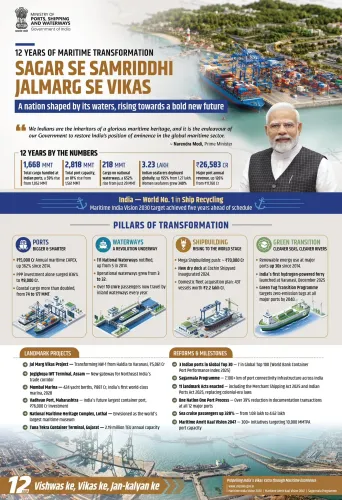
Union Minister Sarbananda Sonowal announced on 25 June 2026 that India has become the world's top ship recycling nation. He credited PM Modi's leadership and the Maritime India Vision 2030 and Maritime Amrit Kaal Vision 2047 frameworks for driving gains in shipbuilding, cargo handling and port efficiency.
Key Takeaways
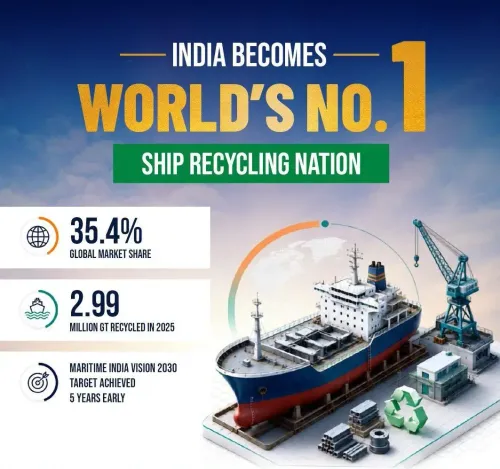
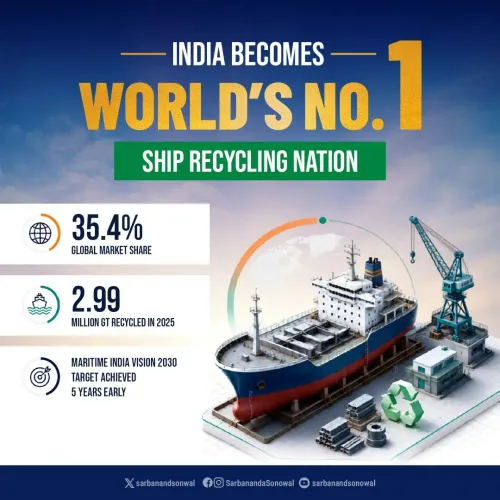
Union Minister Sarbananda Sonowal declared India the world's No.
1 ship recycling nation on 25 June 2026 .
The announcement credits Maritime India Vision 2030 (launched 2021 ) and Maritime Amrit Kaal Vision 2047 as the driving policy frameworks.
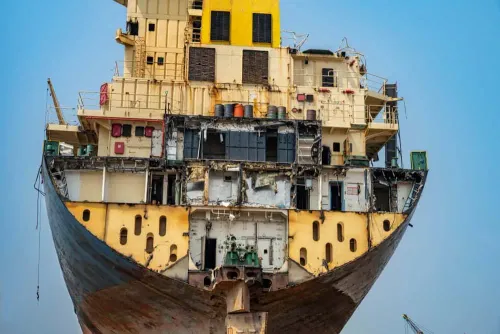
India's ship recycling industry is anchored at Alang, Gujarat , one of the world's largest ship-breaking yards.
The Sagarmala Project (launched 2015 ) laid the groundwork for port-led development that underpins current maritime growth.
Progress is also cited in shipbuilding , cargo handling and port efficiency , key metrics under the Atmanirbhar Bharat framework.
Independent verification of the ranking and fresh cargo-handling statistics is awaited in upcoming annual progress reports.
Union Minister of Ports, Shipping and Waterways Sarbananda Sonowal declared on Thursday, 25 June 2026 that India has become the world's number one ship recycling nation, citing accelerating momentum across shipbuilding, cargo handling and port efficiency as the country pursues global maritime leadership.
Context
In his post, Sonowal stated: 'Now India is the World's No. 1 ship recycling nation. Our maritime journey is gathering unprecedented momentum, as we scale new heights in shipbuilding, cargo handling and port efficiency.' He attributed the milestone to the leadership of Prime Minister Narendra Modi and to two flagship policy frameworks — Maritime India Vision 2030 and Maritime Amrit Kaal Vision 2047.
Ship recycling in India is centred primarily at Alang in Gujarat, which has long been one of the largest ship-breaking yards in the world. The sector employs hundreds of thousands of workers and contributes significantly to the domestic steel supply chain through the recovery of scrap metal from decommissioned vessels.
Policy Backdrop
Maritime India Vision 2030, launched in 2021, laid out a comprehensive short-to-medium-term roadmap for expanding port capacity, promoting domestic shipbuilding, improving logistics efficiency and formalising the ship recycling industry. It built on the earlier Sagarmala Project, initiated in 2015, which focused on port-led development and the creation of coastal economic zones.
Maritime Amrit Kaal Vision 2047 extends the country's ambitions further, targeting a position of global maritime leadership by India's centenary of independence. The vision encompasses large-scale capacity and technology upgrades across the entire maritime value chain — from shipbuilding and port infrastructure to crew training and green shipping transitions.
Both frameworks form part of the broader Atmanirbhar Bharat initiative, which seeks to reduce India's dependence on foreign shipping services and lower logistics costs that have historically weighed on the competitiveness of Indian exports.
Stakeholders and Impact
The ship recycling industry's growth directly benefits port authorities, steel producers, and the hundreds of thousands of workers employed at yards such as Alang. A top global ranking, if sustained, would also attract more vessel owners to route end-of-life ships to Indian yards, generating foreign exchange and boosting ancillary industries.
For the wider maritime sector, progress on cargo handling and port efficiency benchmarks is closely watched by exporters and logistics operators who depend on competitive turnaround times at major ports including JNPA (Nhava Sheva), Mundra, Chennai and Visakhapatnam. Faster port operations translate directly into lower costs for Indian goods in global markets.
What's Next
Annual progress reports on Maritime India Vision 2030 targets will be the primary yardstick for assessing whether the momentum Sonowal describes is reflected in independently verified throughput and capacity data. Upcoming quarters are also expected to bring new shipbuilding orders and potential port privatisation or concession bids that could test investor confidence in the sector's trajectory.
India's ability to consolidate its ship recycling leadership will depend on continued upgrades to environmental and safety standards at recycling yards — a factor that international shipping clients and regulators increasingly scrutinise before directing vessels to a particular destination.
Point of View
Linking day-to-day industry performance to the grand arc of two vision documents. The ship recycling claim is politically significant because it positions India not merely as a growing logistics hub but as a dominant force in the full maritime lifecycle — from cargo movement to vessel disposal. However, the credibility of the 'No. 1' ranking will hinge on independent corroboration, and the government will need to demonstrate that the Alang yards meet rising international environmental and safety standards if the ranking is to translate into sustained commercial advantage. Seen alongside Sagarmala and the Atmanirbhar Bharat agenda, this announcement reinforces a consistent BJP narrative of India graduating from a passive participant in global trade to an active shaper of maritime rules and rankings.
NationPress
24 Sept 2026
Frequently Asked Questions
Is India really the world's number one ship recycling nation?
Union Minister Sarbananda Sonowal claimed on 25 June 2026 that India has achieved the top global rank in ship recycling. India's yard at Alang in Gujarat has historically been among the largest in the world, though independent verification of the current ranking is pending.
What is Maritime India Vision 2030?
Maritime India Vision 2030 is a policy framework launched in 2021 to expand port capacity, promote domestic shipbuilding, improve logistics efficiency and formalise the ship recycling industry as part of India's broader maritime growth strategy.
What is Maritime Amrit Kaal Vision 2047?
Maritime Amrit Kaal Vision 2047 is India's long-term maritime roadmap targeting global leadership by the country's centenary of independence in 2047, focusing on capacity expansion, technology upgrades and green shipping transitions.
Where is India's main ship recycling hub?
Alang in Gujarat is India's primary ship recycling hub and one of the largest ship-breaking yards in the world, employing hundreds of thousands of workers and supplying significant volumes of scrap steel to domestic industry.
What is the Sagarmala Project and how does it relate to India's maritime growth?
The Sagarmala Project, launched in 2015, is a port-led development initiative focused on modernising port infrastructure, creating coastal economic zones and integrating ports with industrial corridors — forming the foundation on which Maritime India Vision 2030 and later frameworks were built.